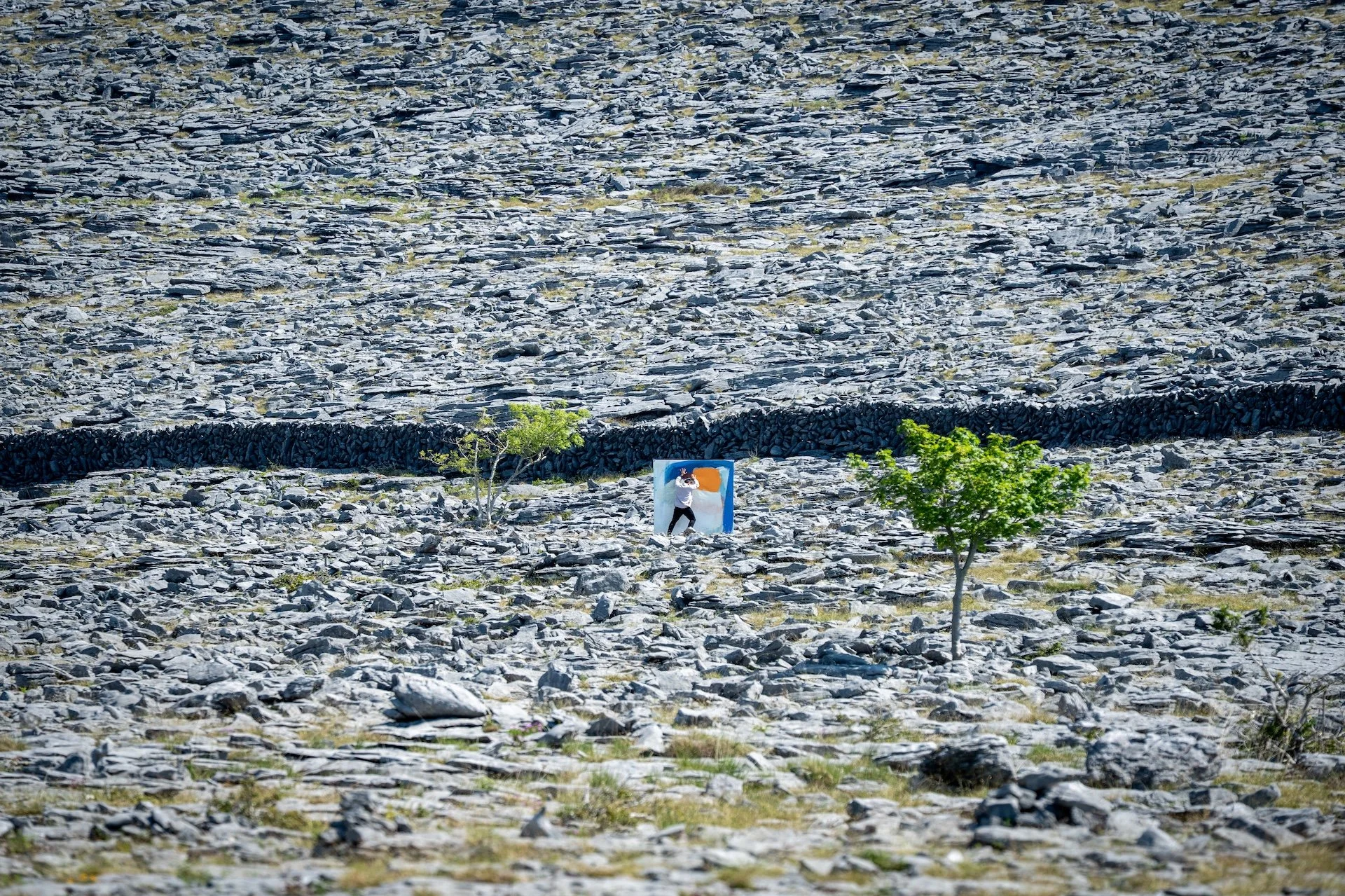
Richard Hearns:
Slipping Past Each Name
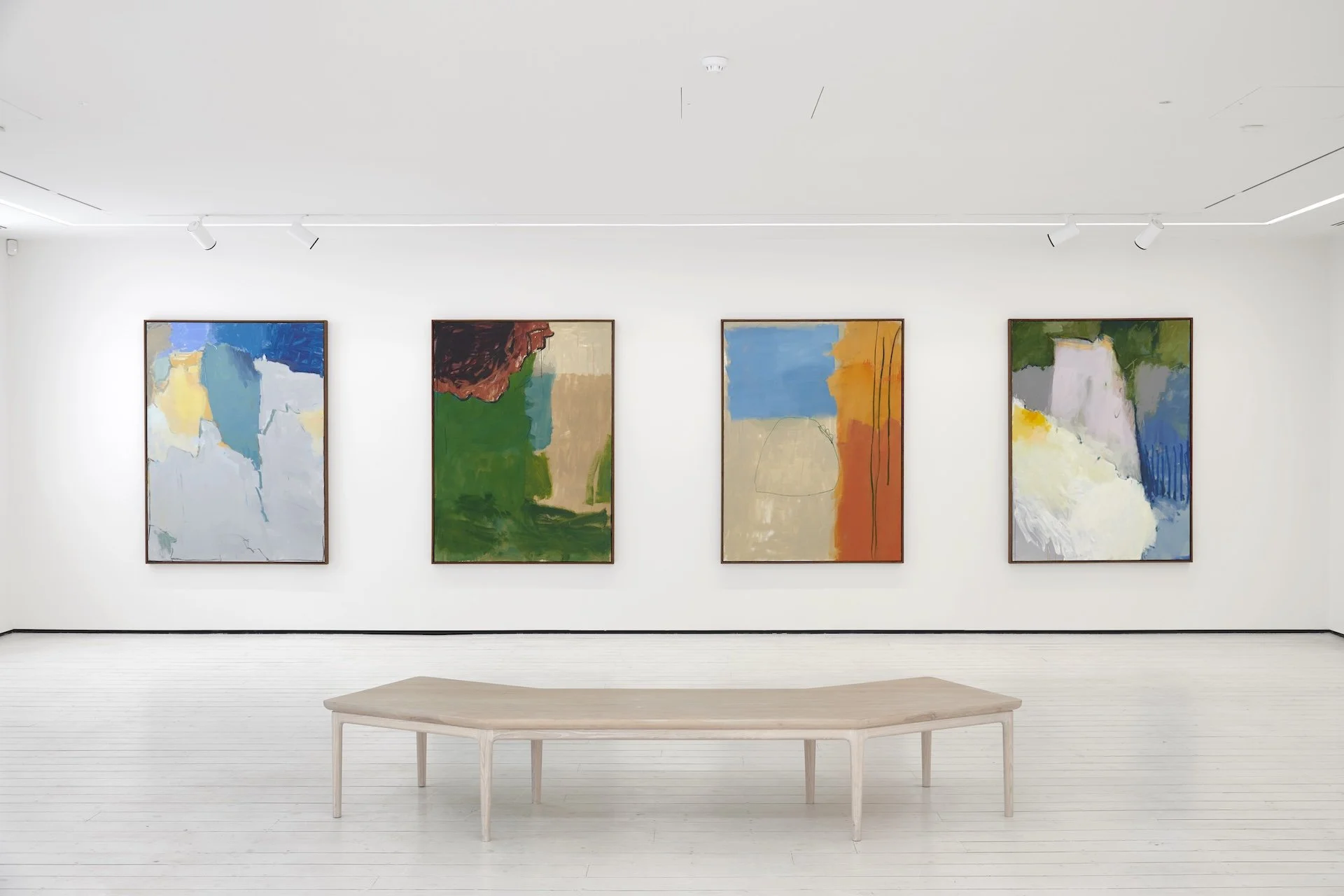
Richard Hearns: No Ruined Stones, left to right: The Measure of Distance, 2026; The Vessel, 2026; No Ruined Stones, 2026; The First Monument, 2026, at Cadogan Gallery, London. © Richard Hearns. Photo: Andy Keate. Courtesy of the artist and Cadogan Gallery.
Richard Hearns: No Ruined Stones
Cadogan Gallery, London
September 3 through October 3, 2026
Review by Raphy Sarkissian
Four expansive canvases by Richard Hearns commandingly line a single wall: The Measure of Distance, The Vessel, No Ruined Stones, and The First Monument. Their worked surfaces carry a sense of primordiality: something pre-linguistic and older than naming. Blue runs through all four, sometimes as a field occupying half the canvas, sometimes narrowed to a single seam between two other colors, never entirely absent. It offers a point of arrival even as the rest of each canvas remains unresolved, closer to oil than to geology.
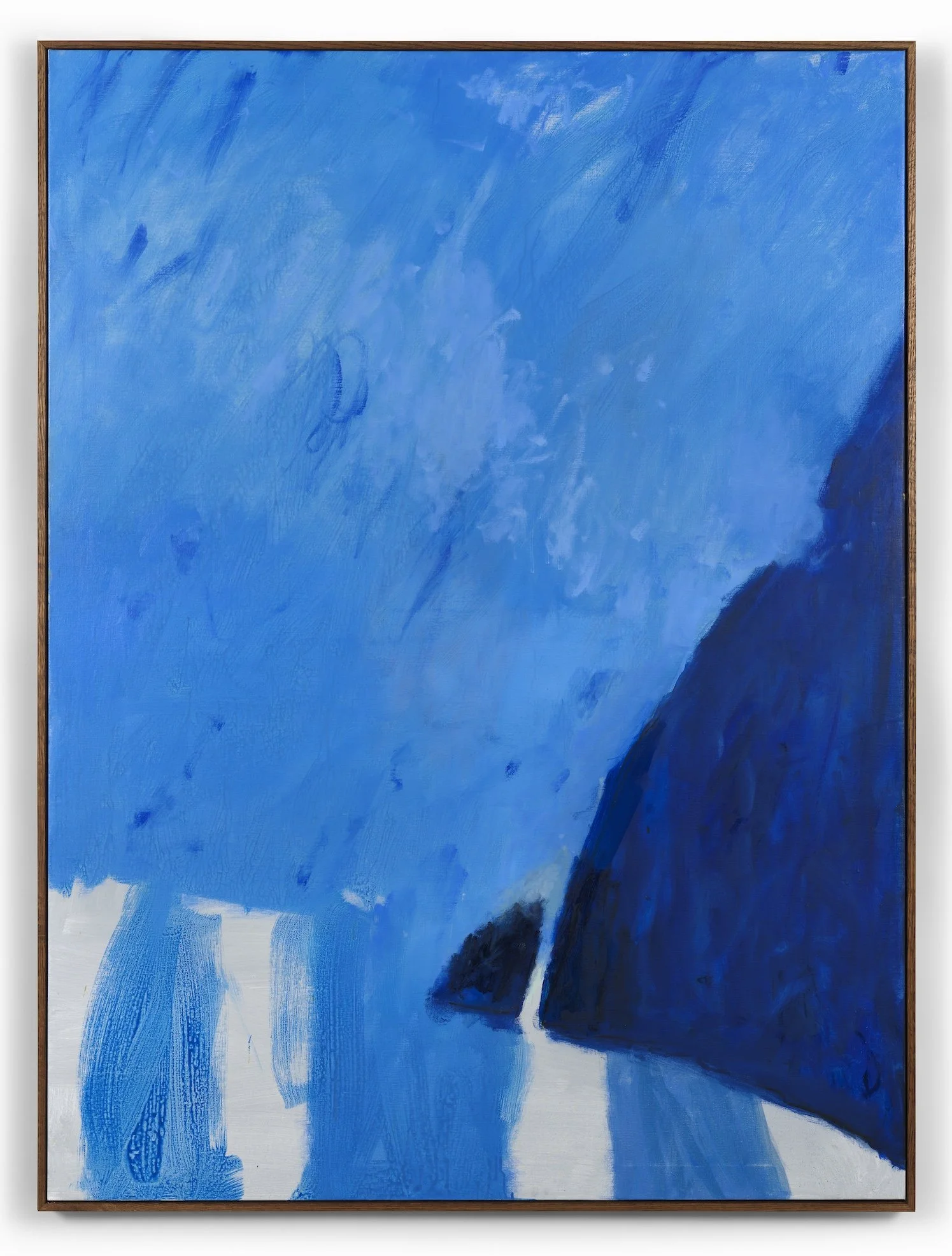
Richard Hearns, Firmament, 2026. Oil on linen, 70 by 52 inches. © Richard Hearns. Photo: Andrew Radford. Courtesy of the artist and Cadogan Gallery.
In Firmament, a mass in shades of ultramarine rises from the right edge of a field of bright cobalt, where sea and sky trade places, commingled in so many washes of blue. Lighter blues and white are worked through it with Abstract Expressionist looseness, an untamed liberty of the hand that still gives the mass signs of volume and a ripple of movement. Near its vertex stands a smaller form in the same ultramarine, parted from it by a sliver of white. The vast ultramarine can be translated as an abstraction of a headland, a mountain, an island, a sail, or the ship itself. Or is it Hearns's decision to let a raw form exist, adrift among the other shapes? Four white bands rise from the lower edge as extensions of the gallery floor, the first cropped by the left edge, the last passing under the ultramarine forms. The triangular bodies are pulled taut against the lighter ones beside them. The whole surface is worked wet-into-wet, the brush loading and thinning in the same stroke, sweeping rather than describing. Contour dissolves, color goes down unhedged, and the pigment holds a place and a feeling without ever consenting to picture it. Firmament borrows Impressionism's dissolution of contour and Post-Impressionism's color freed from description, carried into Hearns’s own idiom, with a touch of Howard Hodgkin’s facture.

Richard Hearns, Blue Holds the Sun, 2026. Oil on linen, 78 by 78 inches. © Richard Hearns. Photo: Andrew Radford. Courtesy of the artist and Cadogan Gallery.
In Blue Holds the Sun, a bright orange form in the upper right quadrant occupies an unstable position between quadrilateral and circle, adopting the syntax of both geometric and organic vocabularies without conceding to either. A single arch of deep blue frames the composition along the upper edge and the right side. The radiant orange shape asserts itself as an intense mass of pigment, echoing the Der Blaue Reiter movement and Franz Marc's late abstract canvases, where color is granted chromatic autonomy in lieu of representational proof. To its left sits a cloud of cream-yellow with feathery pale-green strokes. What the title anchors with a name, the painted surface immediately unmoors: the surrounding field refuses to settle into a single identity, dissolving into a low-register accumulation of pale, atmospheric gestures, peach washes, and thin drawn lines that evoke vapor, silt, and sky simultaneously. Hearns allows representation and nonrepresentation function as an ongoing painterly system, each continually unraveling the other the way a picture shifts as the eye traverses it.

Richard Hearns, Green Monolith, 2026. Oil on linen, 78 by 78 inches. © Richard Hearns. Photo: Andrew Radford. Courtesy of the artist and Cadogan Gallery.
A comparable pictorial tension animates Green Monolith. The painting anchors itself in a slate green ground, relying on a pictorial economy like Milton Avery's Green Sea of the Metropolitan Museum of Art, yet with a broader range of greens. Oil here is handled loose and unfussed, applied with a swift indifference to the boundary of a given form. Viewed from a distance, the composition holds together as if built to cohere from across the room; yet seen up close, that legibility yields to material reality, revealing fluid staining and pooling as the pale ground shows through. Out of this fluid ground rises a rectangular mass with a sheared upper edge. Color moves through it as a gradient, bright chartreuse and acid yellow-green near the top, deepening through olive into a muted mustard at the base, with a few dark green strokes cut into the lower left. This architectonic form stands upon a broad, nearly black green island. Thin dark lines trace its open edges. These two bodies anchor the composition, yet their unruly surfaces refuse to commit to solidity, staying closer to water than to architecture.
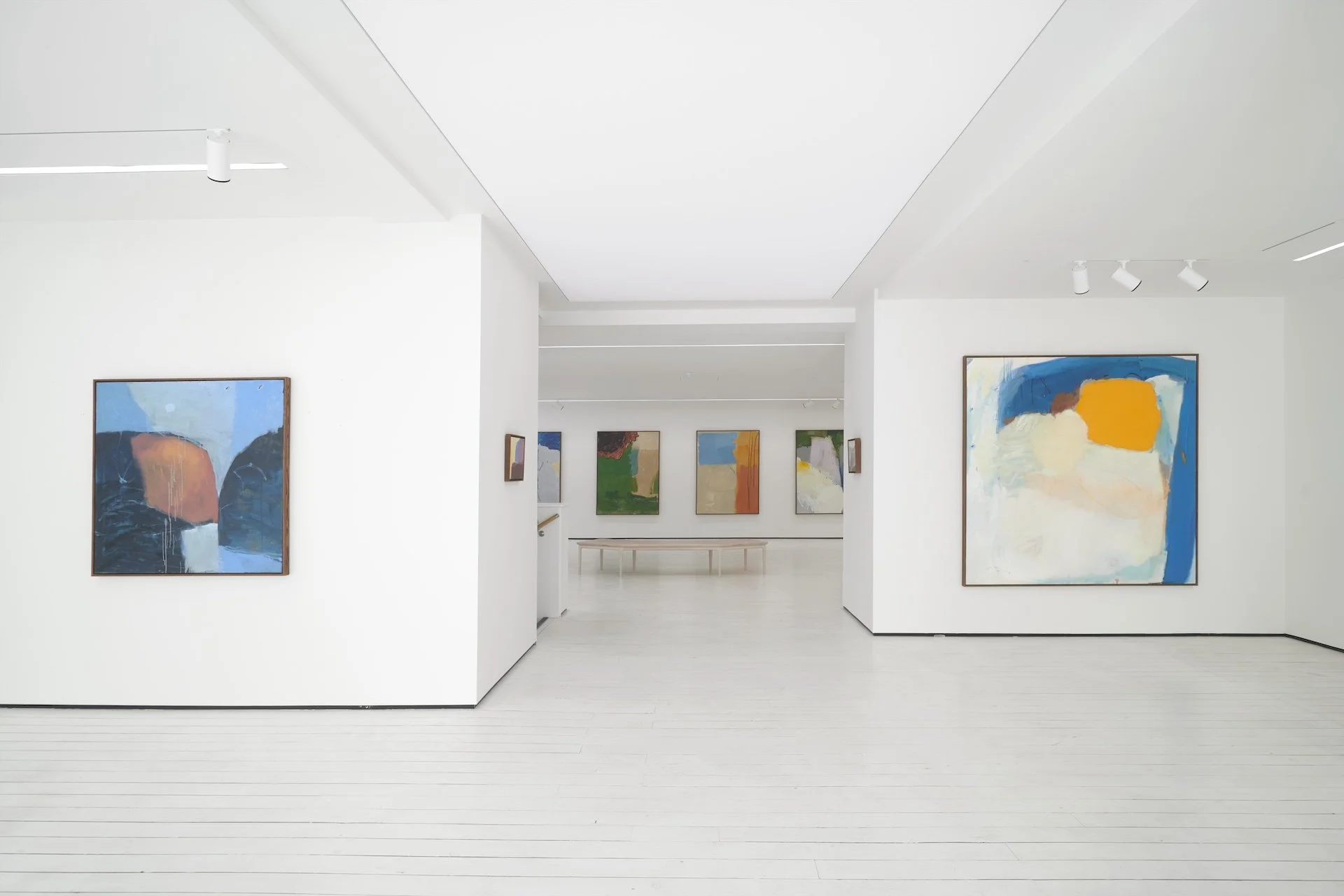
Richard Hearns: No Ruined Stones at Cadogan Gallery, London. © Richard Hearns. Photo: Andy Keate. Courtesy of the artist and Cadogan Gallery.
None of these canvases rejects the landscape, and none settles on what it is. In Firmament, the ultramarine mass suggests a headland, a mountain, or a sail. In Blue Holds the Sun, the title calls the orange a sun while the paint loosens the claim. In Green Monolith, the block on its dark base evokes several readings: a monolith, a fortress, a ship under sail. Thin lines trace the interim edges in many of the paintings on view, the hand marking where a form begins and stopping short of saying what it is. Maurice Blanchot put this plainly: "Everyday language calls a cat a cat, as if the living cat and its name were identical, as if it were not true that when we name the cat, we retain nothing of it but its absence, what it is not."¹ Hearns's paintings work the same way. Scottish iconoclast Hugh MacDiarmid wrote the poem "On a Raised Beach" during the years he spent on Whalsay, in the Shetland Islands, stripped down to bare stone and weather. And this passage carries the same refusal to let naming have the last word: "There are plenty of ruined buildings in the world but no ruined stones." Hearns names every canvas, but in the gap between title and pigment, the paint repeatedly slips past each name.
Note
Maurice Blanchot, "Literature and the Right to Death," in The Work of Fire, trans. Charlotte Mandell (Stanford, CA: Stanford University Press, 1995), 325, quoted in Gerald Bruns, review of Maurice Blanchot and Fragmentary Writing: A Change of Epoch, by Leslie Hill, Notre Dame Philosophical Reviews, November 8, 2012.Harold Rosenberg, “The American Action Painters,” Art News 52 (December 1952), pp. 22-23 and 48-50.
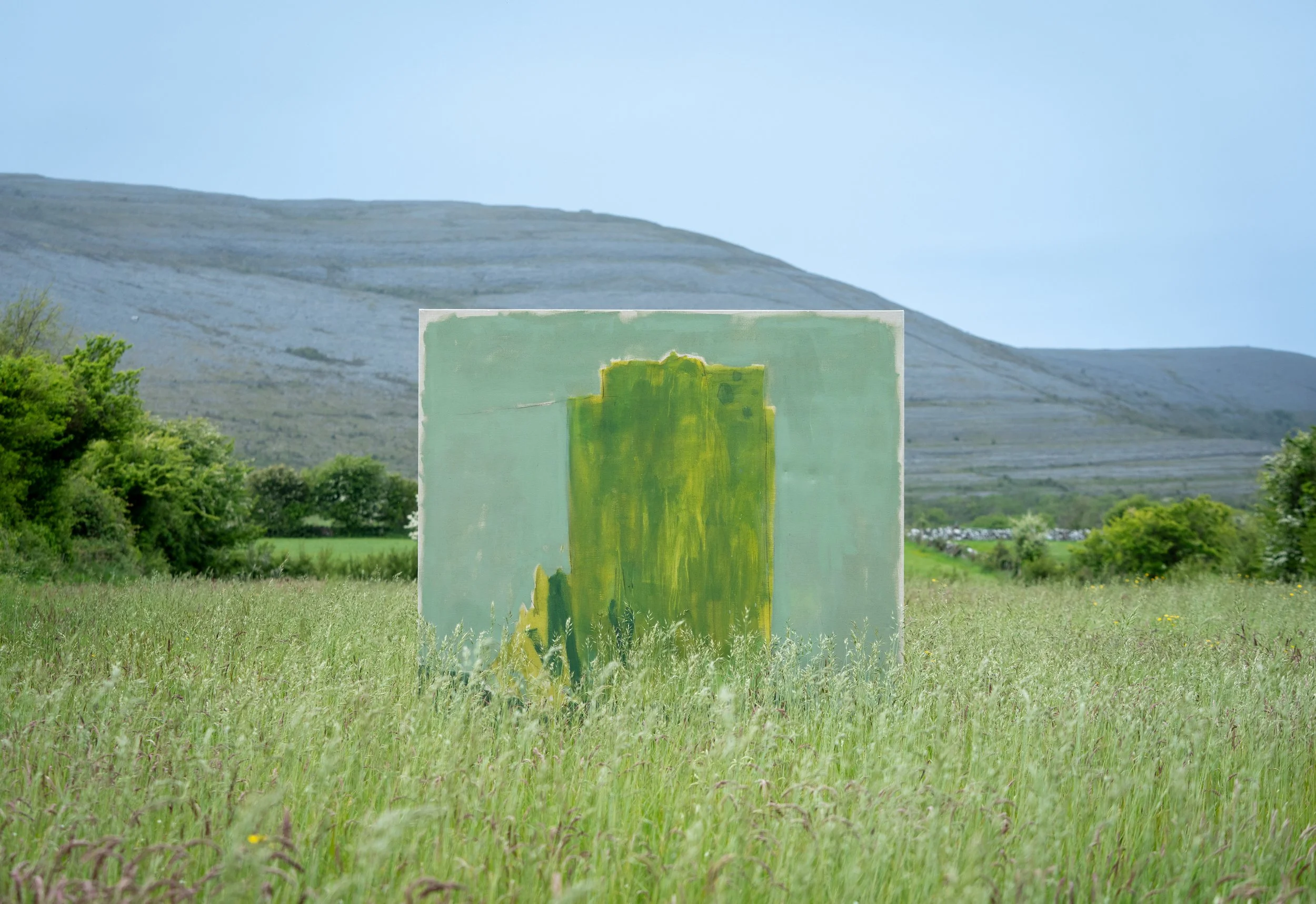
Photo: Eoin Collins.