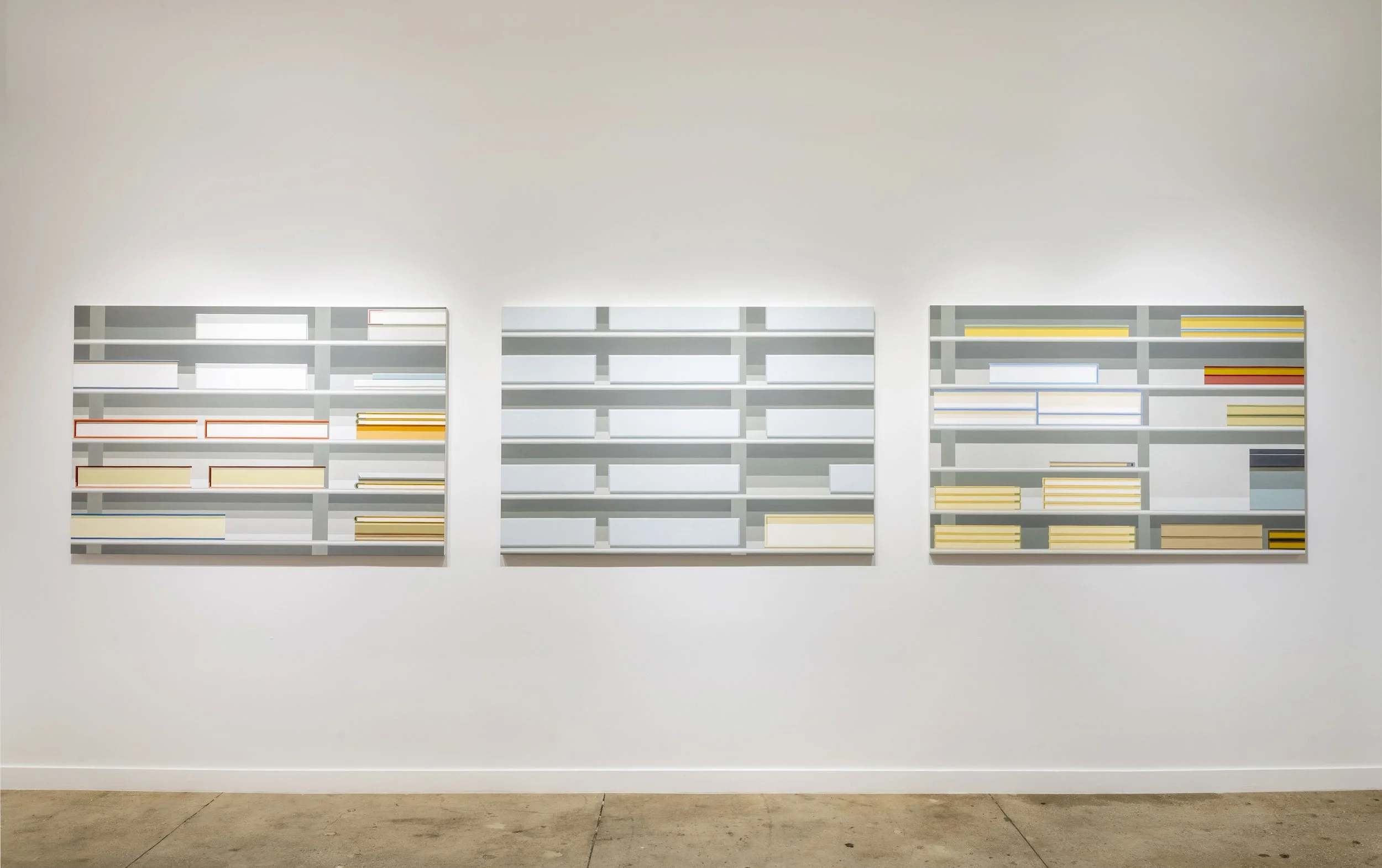
Making Order: Antonietta Grassi and Richard Pasquarelli
Project: ARTspace
September 30, 2025 through January 16, 2026
Exhibition Review by Raphy Sarkissian
Don’t think, but look!
—Ludwig Wittgenstein, Philosophical Investigations §66
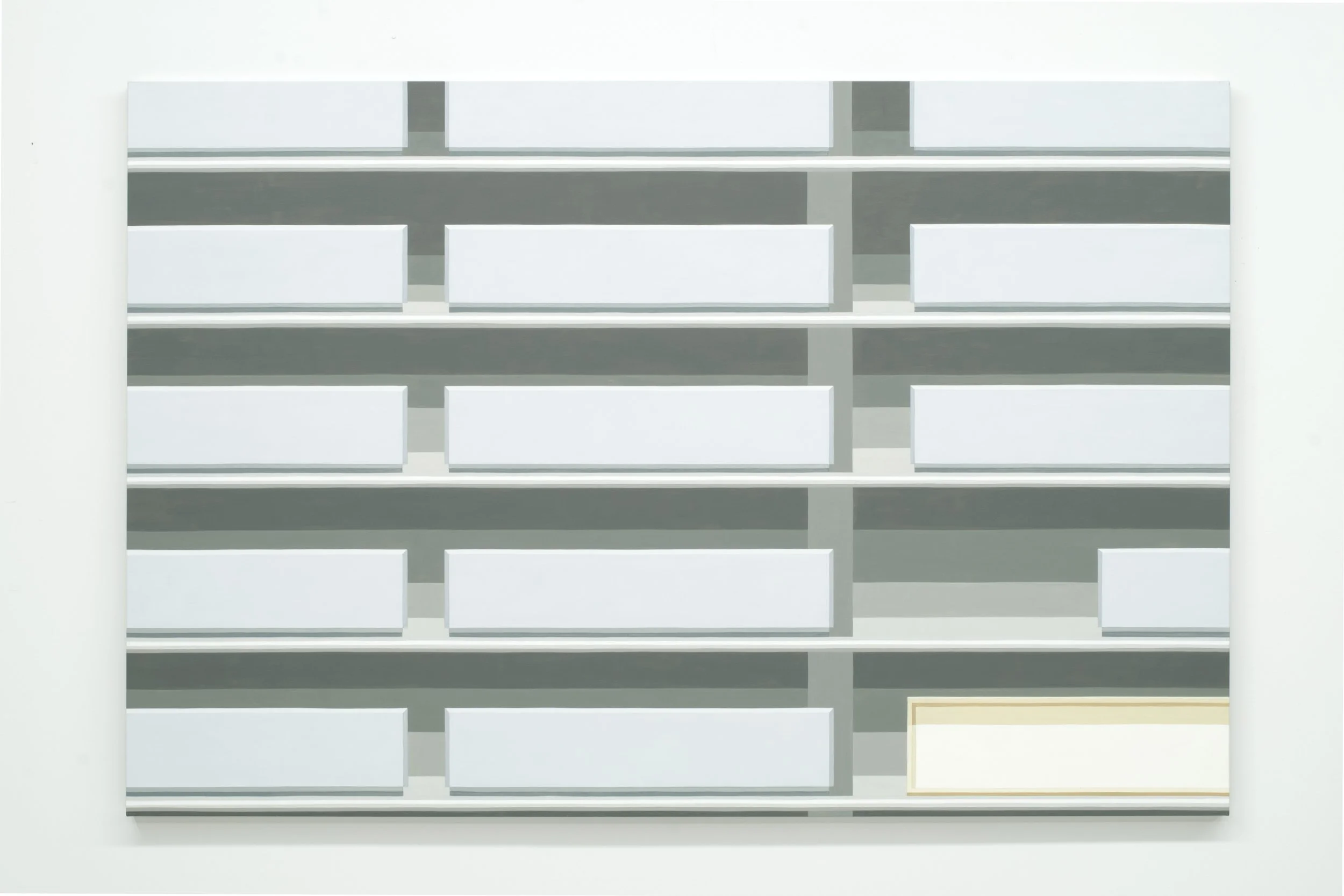
Richard Pasquarelli, Watson No. 5, 2022. Oil on canvas, 40 by 60 inches. Courtesy of the artist and Project: ARTspace.
In Making Order, the paintings of Antonietta Grassi and Richard Pasquarelli establish an uncanny dialogue that explores methodically antithetical directions the grid can take—in both material and optical dimensions. While these works share a geometric framework, they utilize it to navigate distinct registers of the visible. Pasquarelli operates as a magician of flatness, using the grid to conjure an illusionistic archival space that playfully acknowledges its own two-dimensional reality. Conversely, Grassi’s grid functions as a material loom, generating a vibrant, non-perspectival depth—a shimmering accumulation of color that feels, at once, primordial and beyond language. In this context, order is not a problem to be solved, but an active condition that the eye is invited to test, revise, and question.
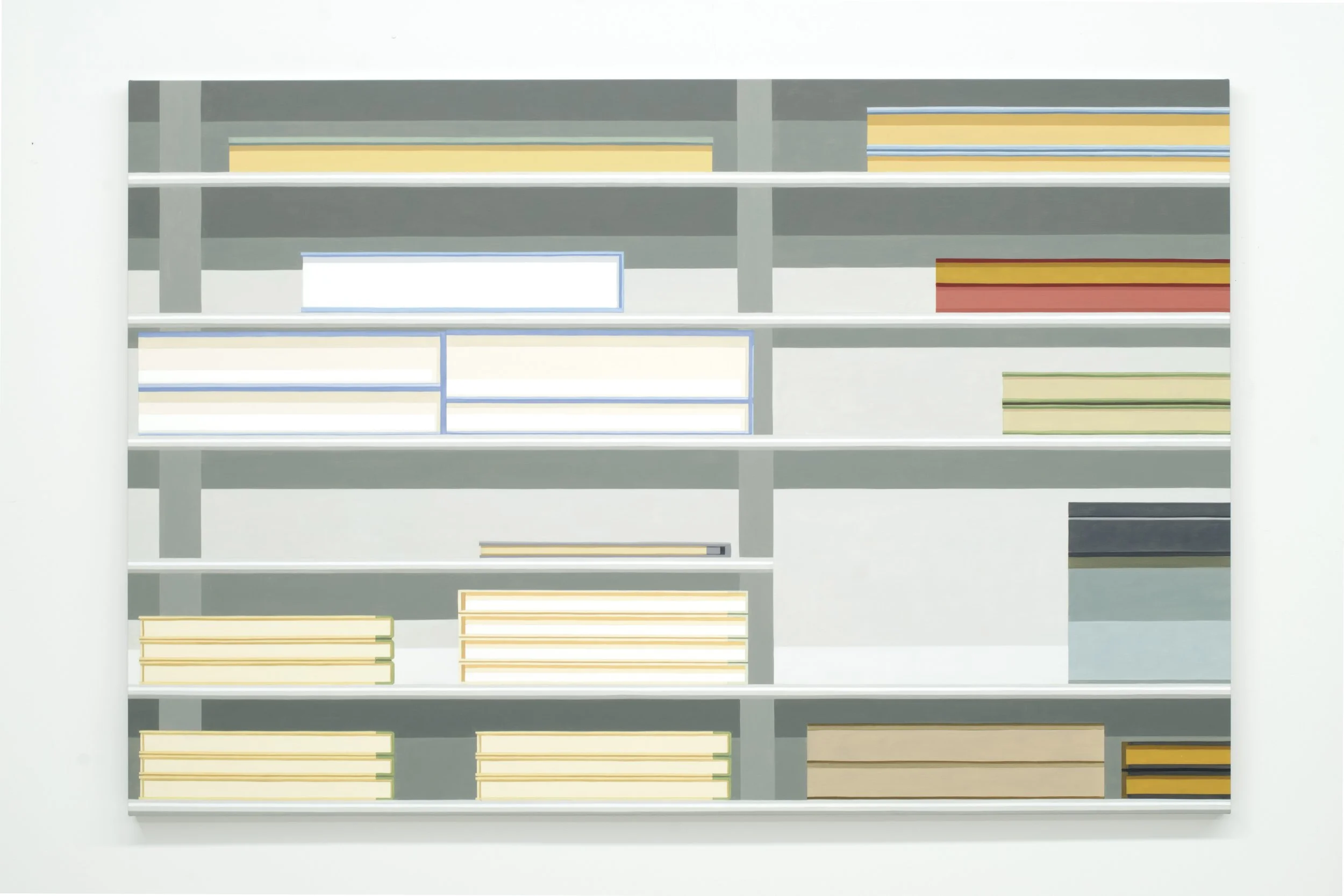
Richard Pasquarelli, Watson No. 2, 2022. Oil on canvas, 40 by 60 inches. Courtesy of the artist and Project: ARTspace.
Pasquarelli’s works initially read from a distance as disciplined, idealized geometries, recalling the paradigms of modernist abstraction and its faith in visual clarity. Yet this first impression is inseparable from what the paintings actually depict: photorealistic renderings of shelves and archival cases—objects that already carry an inherent abstraction through sameness and repetition, through flatness and the grid, through regular patterns punctuated by modulated variations. As one moves closer, this impression soon dissolves. Pictorial irregularities, minute misalignments, and figure-ground interruptions assert themselves, while geometry begins to lose its certainty. What appeared systematic reveals hand-wrought vulnerability; structure takes on an almost organic, tissue-like quality. The eye oscillates between coherence and contingency, between seeing form as diagram and as matter. Distance, in this case, is not neutral—it actively reshapes the work’s perception. Seen from afar, the shelves carry the austere authority of modernist geometry, with Mondrian edging back toward a Renaissance illusion of space and depth. As the viewer moves closer, illusion gives way to abstraction. Now the geometry softens into something manual, time-bound, and quietly resistant to its own precision.
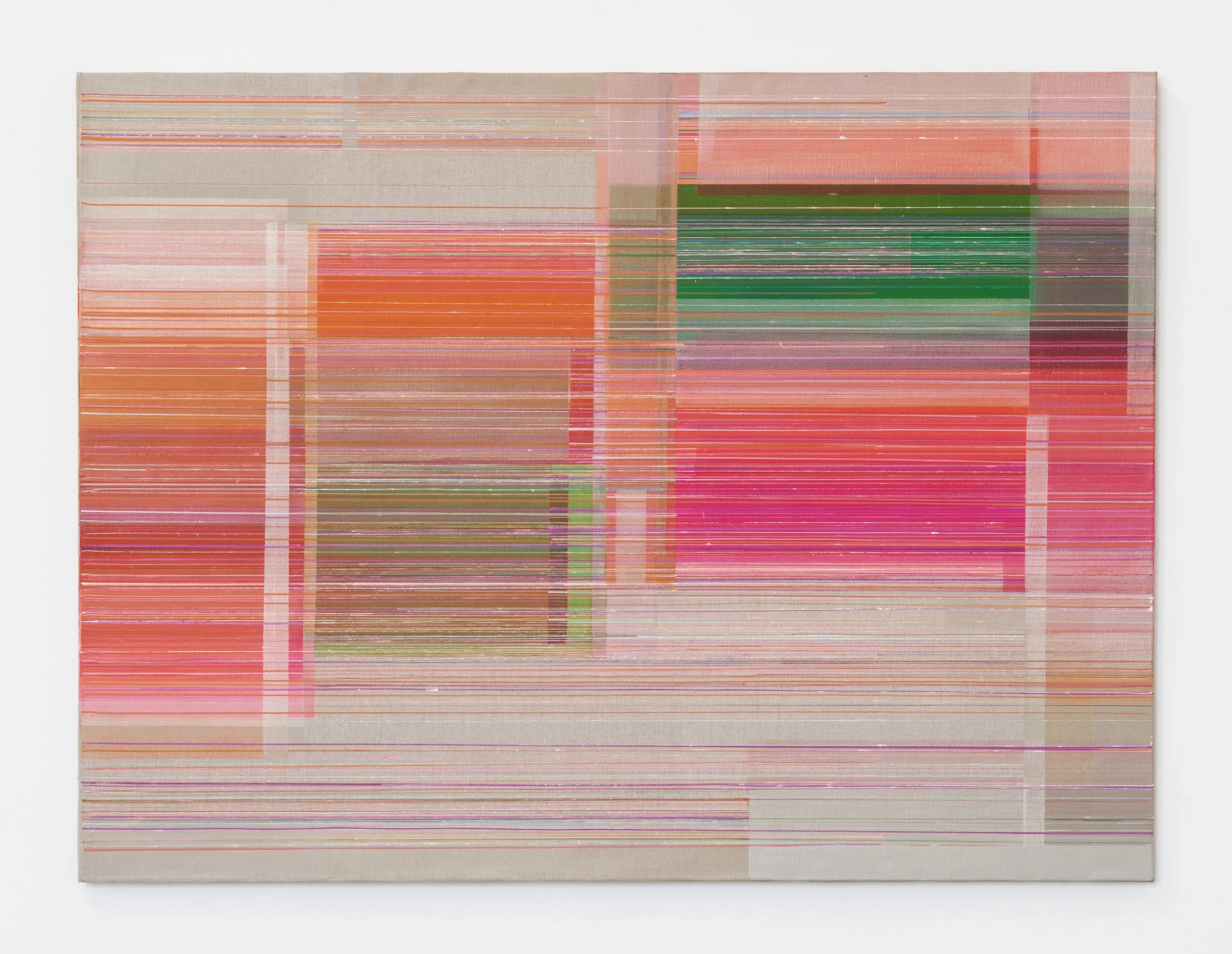
Antonietta Grassi, Modulations for Contemplation, 2024. Oil, acrylic and ink on linen, 36 by 48 inches. Courtesy of the artist and Project: ARTspace.
Grassi’s paintings command a different optical presence. Despite their intricate layering of extraordinarily thin lines, they seem—at least to my eye—remarkably indifferent to the viewer’s distance.. Despite their intricate layering of extraordinarily thin lines, they seem—at least to my eye—remarkably indifferent to the viewer’s distance. Whether encountered from across the room or up close, the works maintain a consistent visual intensity. Their impact lies less in optical changes or revelation than in absorption: the way light catches on gold lines like filaments of threads, the way color operates as a persistent chromatic resonance (an unapologetic radiance) rather than a set of decipherable signals. Rhythmic layering of fine lines builds into vivid blocks of oranges, pinks, and greens against horizontal stripes. The paintings resist being “read” spatially; they insist instead on duration and attention. If her shimmering lines invite comparison at all, it is less to Byzantine gold grounds than to the rhythmic intelligence of Moroccan textiles, where abstraction does not resolve into image or symbol but persists as pattern, light, and sensation—indifferent to whether the viewer approaches through optics or touch.
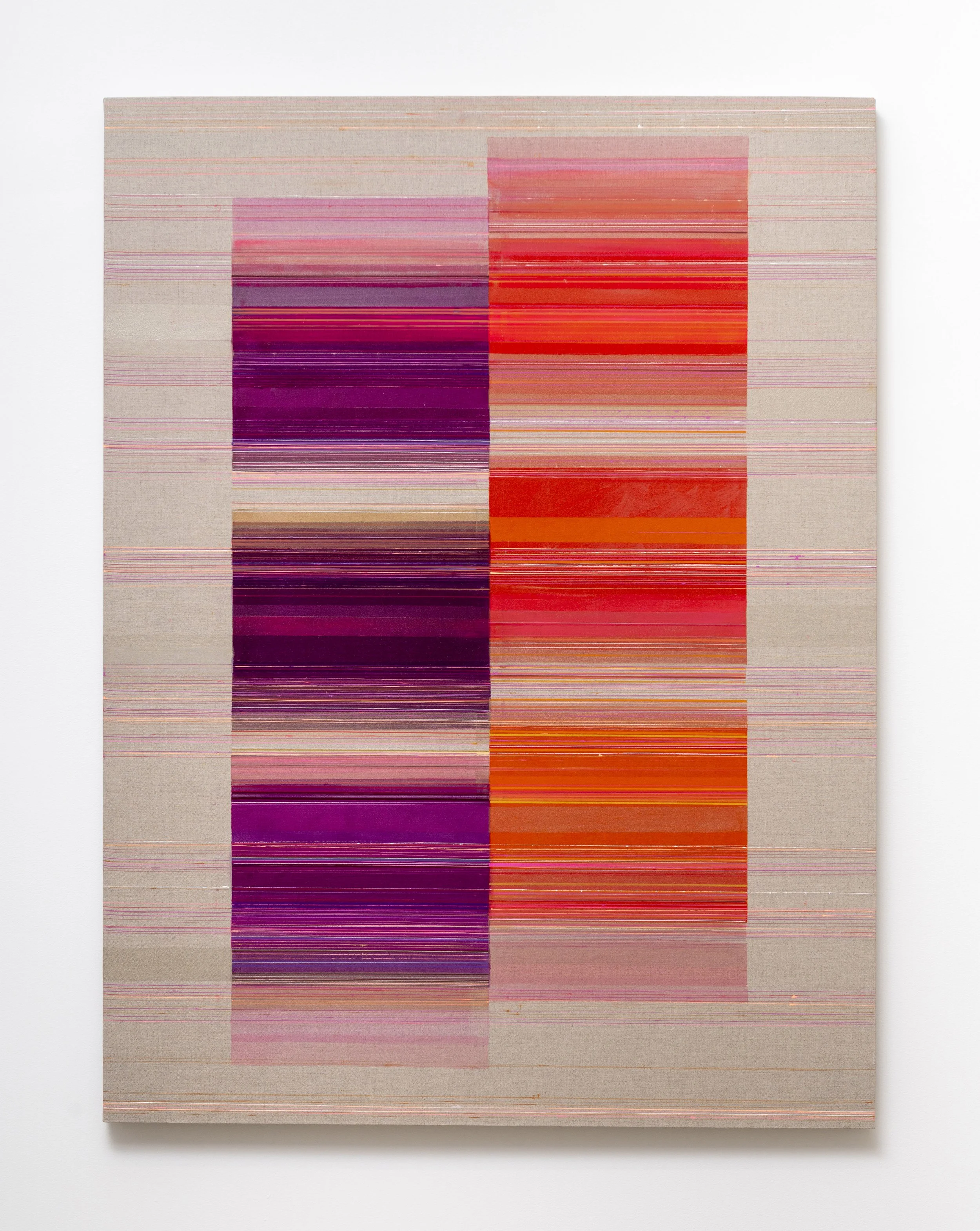
Antonietta Grassi, Bagua Modulations (Water, Earth, Wind, and Fire), 2024. Oil, acrylic and ink on linen, 36 by 36 inches. Courtesy of the artist and Project: ARTspace.
Placed in proximity, the works of Antonietta Grassi and Richard Pasquarelli produce entirely distinct, yet equally rewarding experiences in the act of viewing. At Project: ARTspace, I found myself returning repeatedly to the question of distance—how much it promises a legible clarity in some instances, and how quickly that clarity evaporates in favor of materiality and hapticity in others. I found myself less certain about what binds these practices than about why such a binding was expected in the first place. The exhibition neither resolves this ongoing formal dialectic nor seeks to disguise it; its strength lies precisely in allowing this static to remain productive. The show’s lack of resolution becomes its own elegant conclusion—a paradox that leaves the viewer not with easy answers, but with a sharpened awareness of how meaning is tenuously constructed through the persistent act of looking.
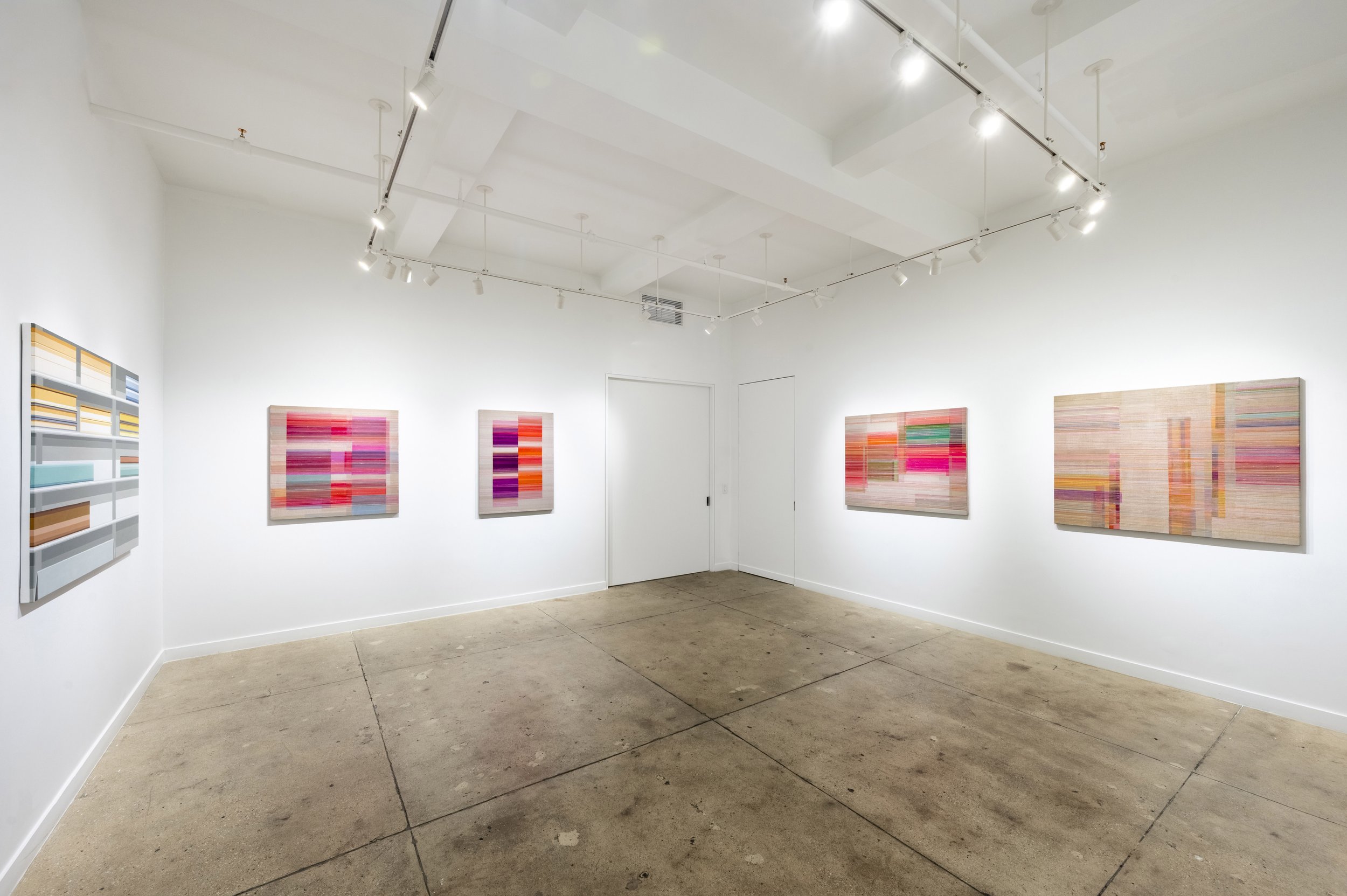
Installation view of Making Order: Antonietta Grassi and Richard Pasquarelli. Photo by Michael Hnatov. Courtesy of the artists and Project: ARTspace.