Light and Time in Leef and Hodgkin at ERCO, London
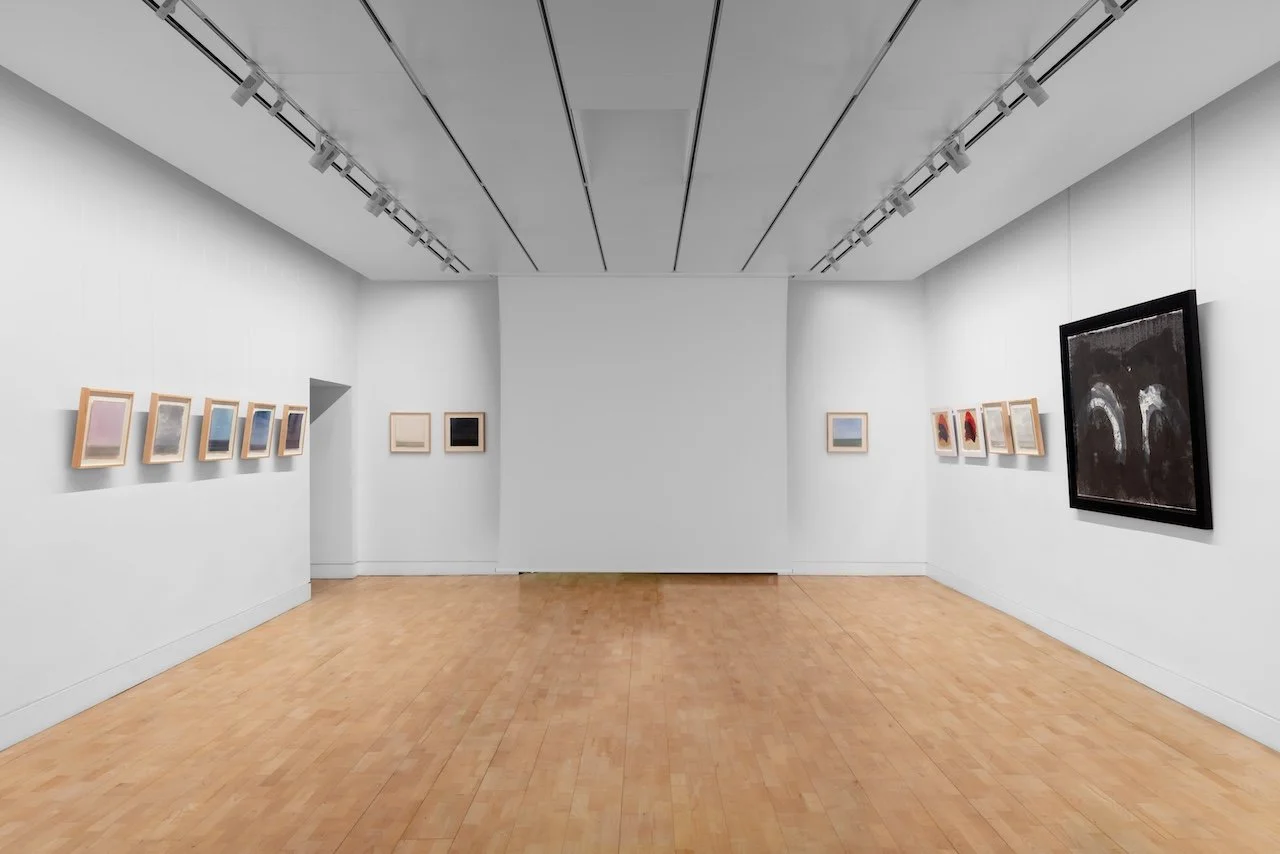
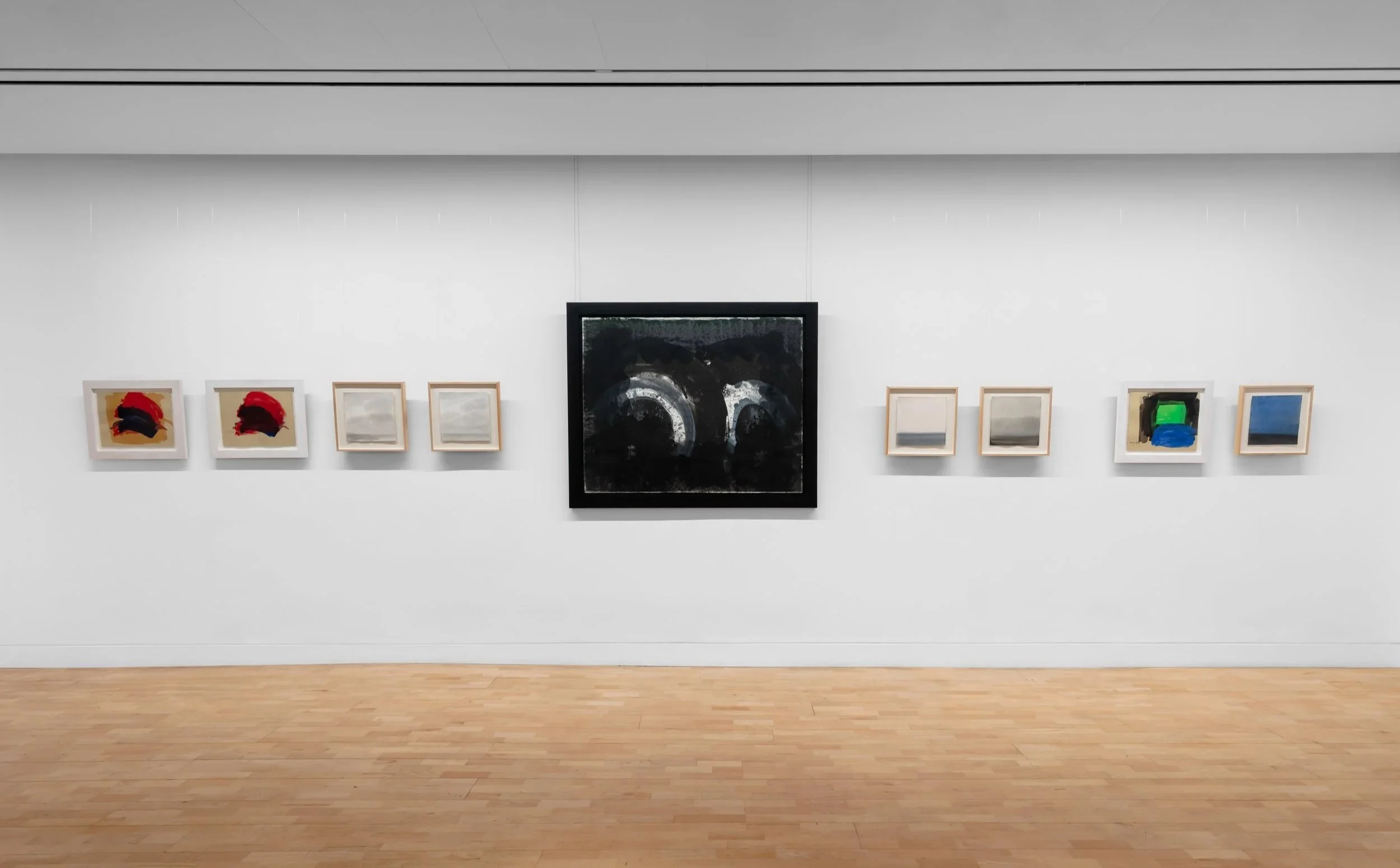
Installation view of the exhibition Framing Light, curated by Maya Binkin, at ERCO, Dover Street, London, 2026. All works by Howard Hodgkin © Estate of Howard Hodgkin, courtesy Estate of Howard Hodgkin and Cristea Roberts Gallery, London. All works by Adam Leef © Adam Leef, courtesy the artist.
Framing Light: An ode to British landscape tradition
Adam Leef / Howard Hodgkin in partnership with ERCO Lighting
Curated by Maya Binkin
ERCO Showroom, Dover Street, London
October 8 – November 7, 2026
Review by Raphy Sarkissian
Within an architecturally lucid space, Adam Leef’s square watercolors and Howard Hodgkin’s prints face one another across the room or hang side by side, held under overhead light, a phenomenon that gradually alters their surfaces and binds luminosity to temporality. Where Hodgkin’s unbridled, if not riotous, compositions command the wall through concentrated weight, Leef’s watercolors operate as a sequence of patient equanimity—measured and restrained—relying on tonal shifts to draw the eye along the line, from sheet to sheet.
The outdoors has made its way into ERCO’s Dover Street gallery, as a counterpart to the light over nearby Green Park, now cloudy, now sun-dappled. The installation, conceived by Maya Binkin in collaboration with ERCO, is a genuine curatorial invention, even a surprising one. Through the company’s Tunable White system, the fixtures along the ceiling tracks run a brief, repeating cycle that moves the room between cooler and warmer color temperatures.
Gotthold Ephraim Lessing’s 1766 division, which confined painting to “the single moment of time” and assigned duration to poetry, is suspended here at the level of perception. [1] Each sheet remains a still, held in moving light. It is the looking that acquires an added duration in Framing Light.
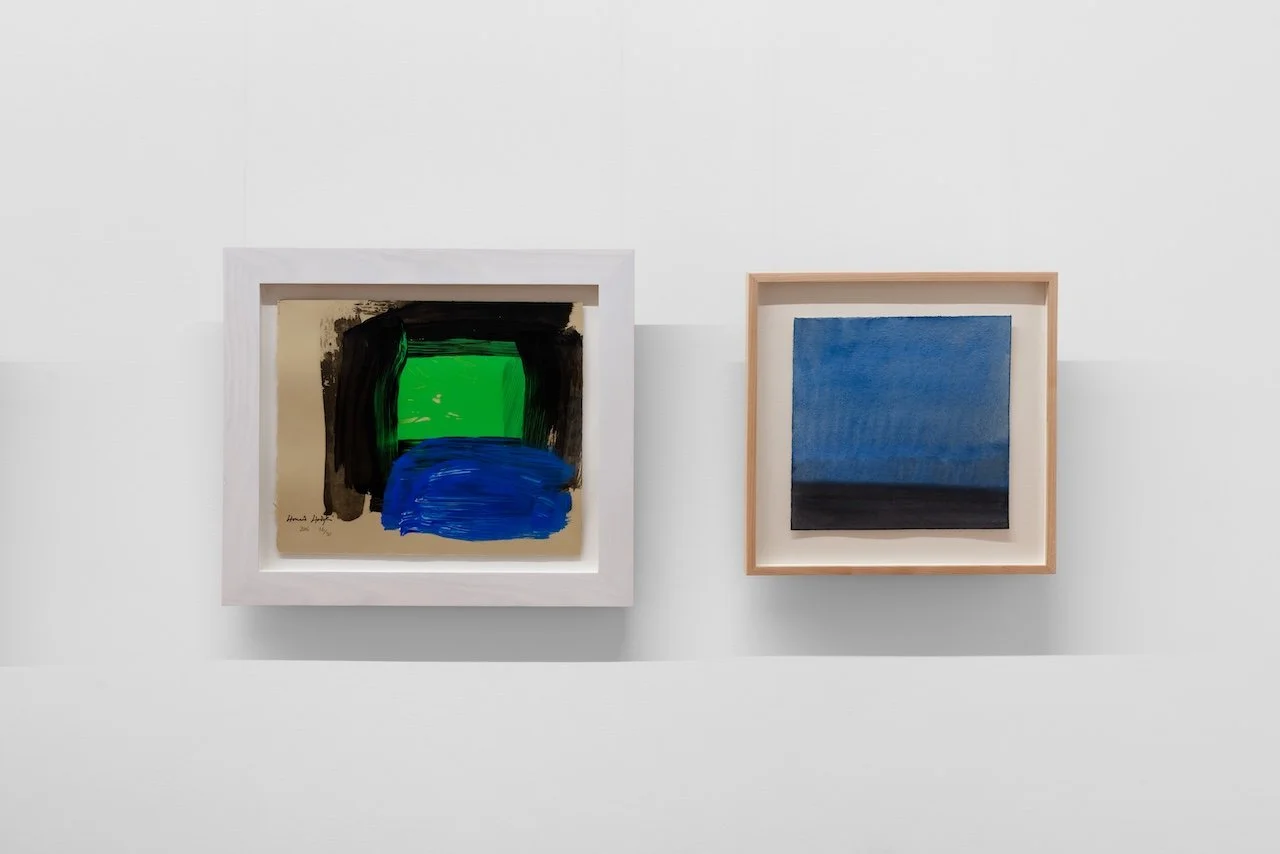
Left: Howard Hodgkin, Springtime, 2015–16, sugar-lift aquatint with hand-coloring on Velin Cuve BFK Rives Tan 280gsm paper, 36 by 42 cm. Right: Adam Leef, English (Hampshire) Suite 28.11.2024, 2024, watercolor on paper, 30 by 30 cm.
If Lessing insisted on the stillness of the picture, two distinct visual registers produce the illusion of light in Hodgkin’s Springtime and Leef’s English (Hampshire) Suite 28.11.2024. In Hodgkin’s hand-colored print, the window remains a painted construct, an aperture framed by dense, gestural black marks that hold a vivid core of green in place, while the blue sweeps across the frame’s lower edge and spills beyond it. The green bears out Goethe’s observation that color arises where light meets darkness. Whereas Matisse’s French Window at Collioure filled the opening itself with black, Springtime returns that black to the frame, leaving the view to glow.
In Leef’s translucent watercolor, a low band of dark land grounds a wash of blue, and the paper itself becomes the atmosphere. Faint vertical strokes run down the sky where the brush crossed the damp paper. Only the band of land gives up even that impression of translucence: tilted almost imperceptibly, higher at the left, and layered into near-black, the wash becomes matter rather than light. It is here that Leef’s watercolor approaches the density of Hodgkin’s black. Hodgkin builds a room around the sky, while Leef leaves the light in open space.
With blues that shimmer in tonal interplay, this pensive square brings to my mind the small oil seascapes of Lucas Arruda’s Deserto-Modelo series. Yet the Brazilian painter’s pictorial language suggests the hermetic, where horizons seem to trace back to no place at all. Leef arrives at a similar horizon by another route and through a different medium, anchoring each view in time and titling every sheet with the day on which he painted it.
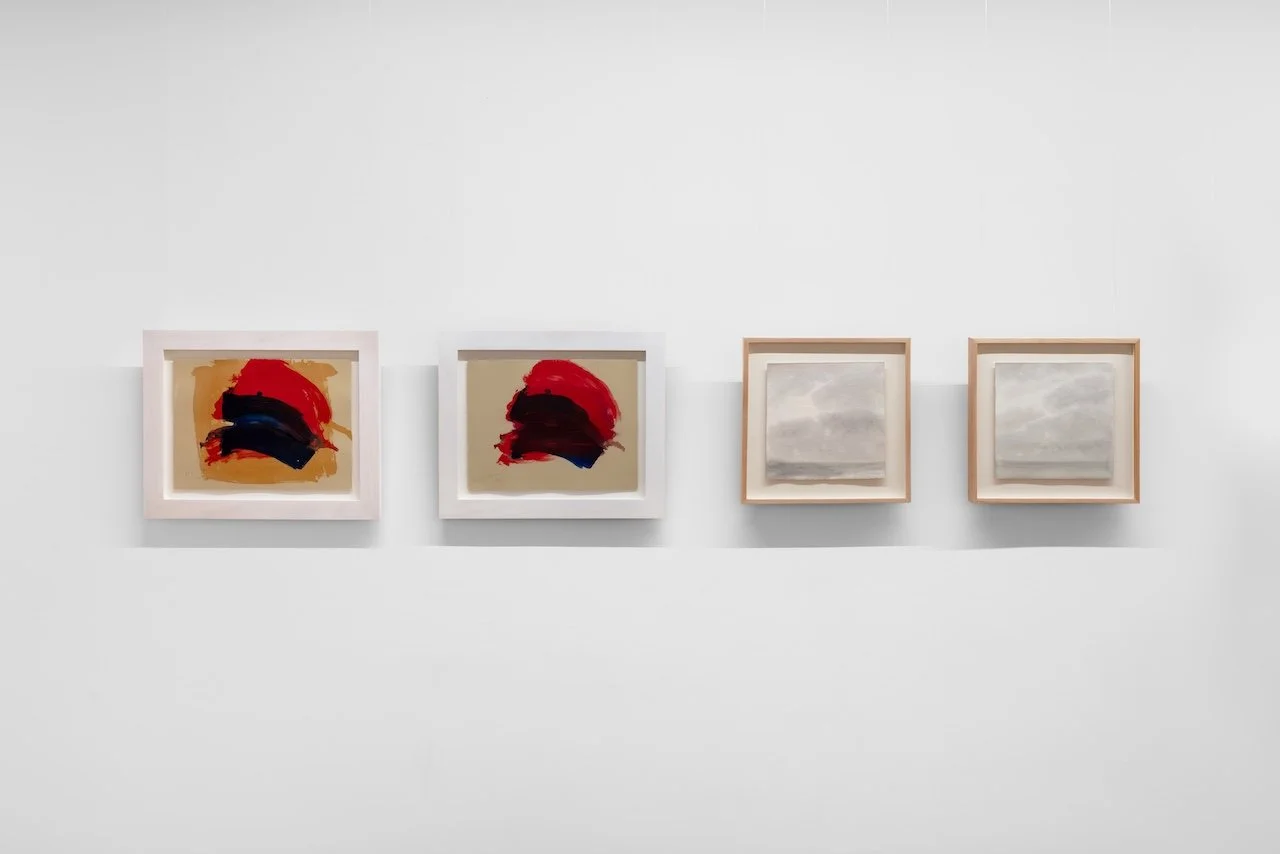
Left to right: Howard Hodgkin, Dark Rainbow, 2015–16, sugar-lift aquatint with hand-coloring on Velin Cuve BFK Rives Tan 280gsm paper, 33.5 by 44 cm; Blue Evening, 2015–16, carborundum relief with hand-coloring on Velin Cuve BFK Rives Tan 280gsm paper, 33.5 by 44 cm; Adam Leef, English (Hampshire) Suite 10.12.2024, 2024, watercolor on paper, 30 by 30.1 cm; and English (Hampshire) Suite 9.12.2024, 2024, watercolor on paper, 30.1 by 30 cm.
The four-sheet hang approaches provocation, setting the printed multiple beside the single sheet. Hodgkin developed his painterly idiom on wood by painting over the frame, obliterating the boundary between picture and room. On paper, however, it is a different story. In Dark Rainbow and Blue Evening, dense arcs of red, black and blue sit well within the edge of the sheet, one backed by a brushed ochre ground, the other pressed onto bare tan paper. A single gesture recurs across both, and because each impression is colored by hand, no two of the thirty in either edition are alike, rendering each print a variation in its own right.
To their right, two gray watercolors from Leef’s English (Hampshire) Suite temper the wall with the half-light of an overcast sky. Leef, too, repeats himself, returning to one sky under slightly different weather, each subdued sheet carrying its own sentiment across its horizon. His grays, ranging widely in tone, take on each change in the room’s light.
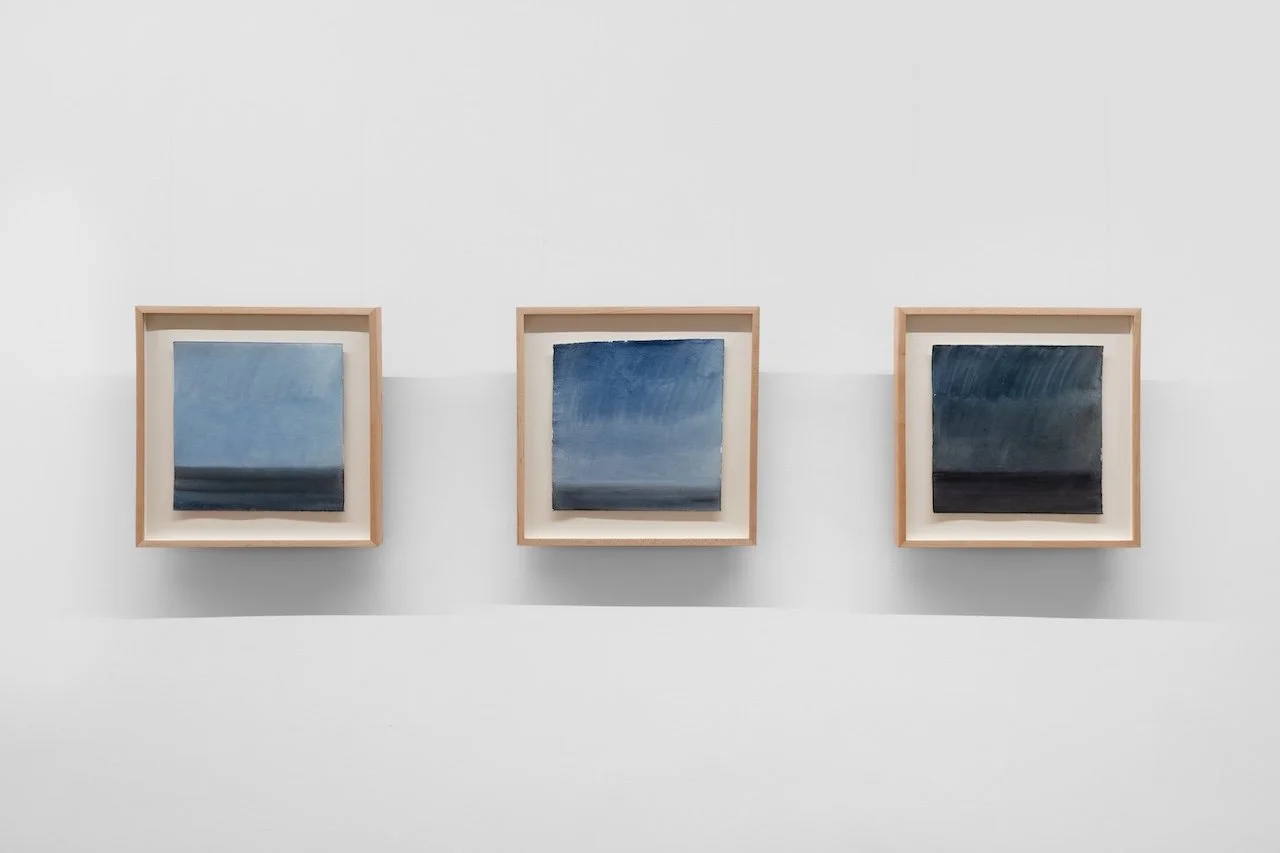
Left: Adam Leef, English (Hampshire) Suite 29.11.2024, 2024, watercolor on paper, 30.1 by 30 cm. Center: English (Hampshire) Suite 28.11.2024, 2024, watercolor on paper, 30.1 by 30.6 cm. Right: English (Hampshire) Suite 28.11.2024, 2024, watercolor on paper, 30 by 30 cm.
Three blue sheets from Leef’s English (Hampshire) Suite hang in a row, the same view returned to over two days in late November. From left to right they darken, the pale blue of the first giving way to a sky that has almost closed over the land. Each is a new reading of one horizon, and the dated titles do not prescribe a method for looking: they record, as Hans-Georg Gadamer’s note on understanding reminds me, what happens to perception “over and above our wanting and doing.” [2]
At the National Gallery, a short walk away, Claude Monet’s The Thames below Westminster offers a precedent for this structure, its hazy sky anchored by the dark horizontals of a jetty and a bridge. Monet breaks the river’s light into shifting strokes that carry it across the surface. In Leef’s watercolors the light comes to rest on a single band of land, absorbed into its darkness.
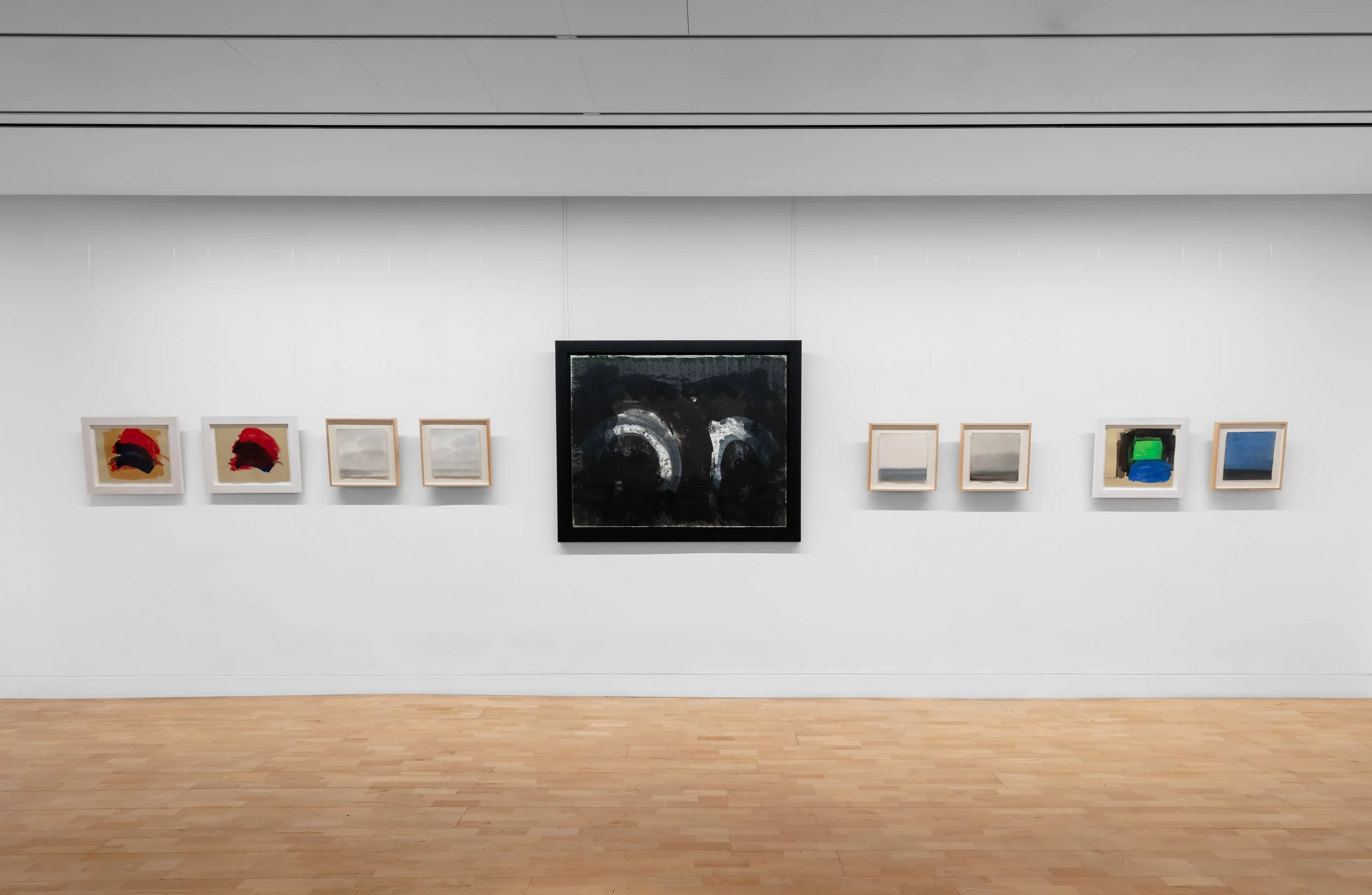
Left to right: Adam Leef, two works from English (Hampshire) Suite, 2024; Howard Hodgkin, Storm Cloud, 2014; and Adam Leef, five works from English (Hampshire) Suite, 2024.
On the frontal wall, Hodgkin’s Storm Cloud hangs within a long row of Leef’s watercolors. A dark brown border, slathered around the edges with the haste of a house painter, corrals a field of burning orange-red, across which a black mass heaves up from the lower left with a broken arc of blue running through it, while bare paper flares at its right like light from behind a cloud.
The storm is a recollection, as Hodgkin’s subjects so often are. To its right, Binkin’s hang resumes Leef’s row of skies, each sheet held to the day on which it was painted, their grays carrying what the artist calls “nuanced shifts that require time and attention to reveal themselves.” Hodgkin returns to weather through memory, Leef does so through the dated record, and under ERCO’s fixtures both arrive in the same present, where the light keeps turning from warm to cool and back again.
Notes
Gotthold Ephraim Lessing, Laocoon: An Essay upon the Limits of Painting and Poetry, trans. Ellen Frothingham (Boston: Roberts Brothers, 1890), 16.
Hans-Georg Gadamer, Truth and Method, 2nd rev. ed., trans. Joel Weinsheimer and Donald G. Marshall (London: Continuum, 2004), xxvi.