Anish Kapoor:
Primordiality
Lisson Gallery New York
February 11 through April 25, 2026
Exhibition Review by Raphy Sarkissian
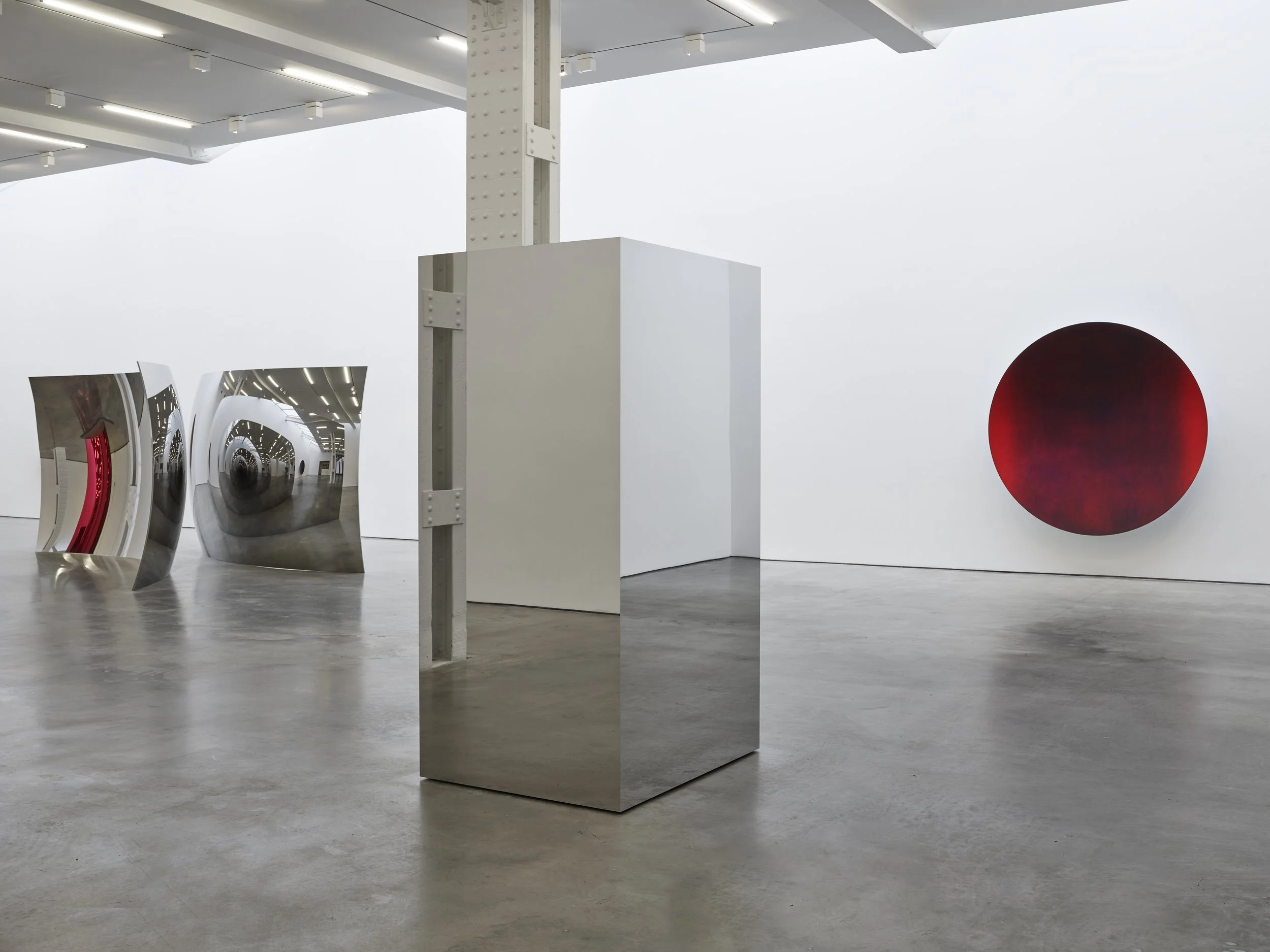
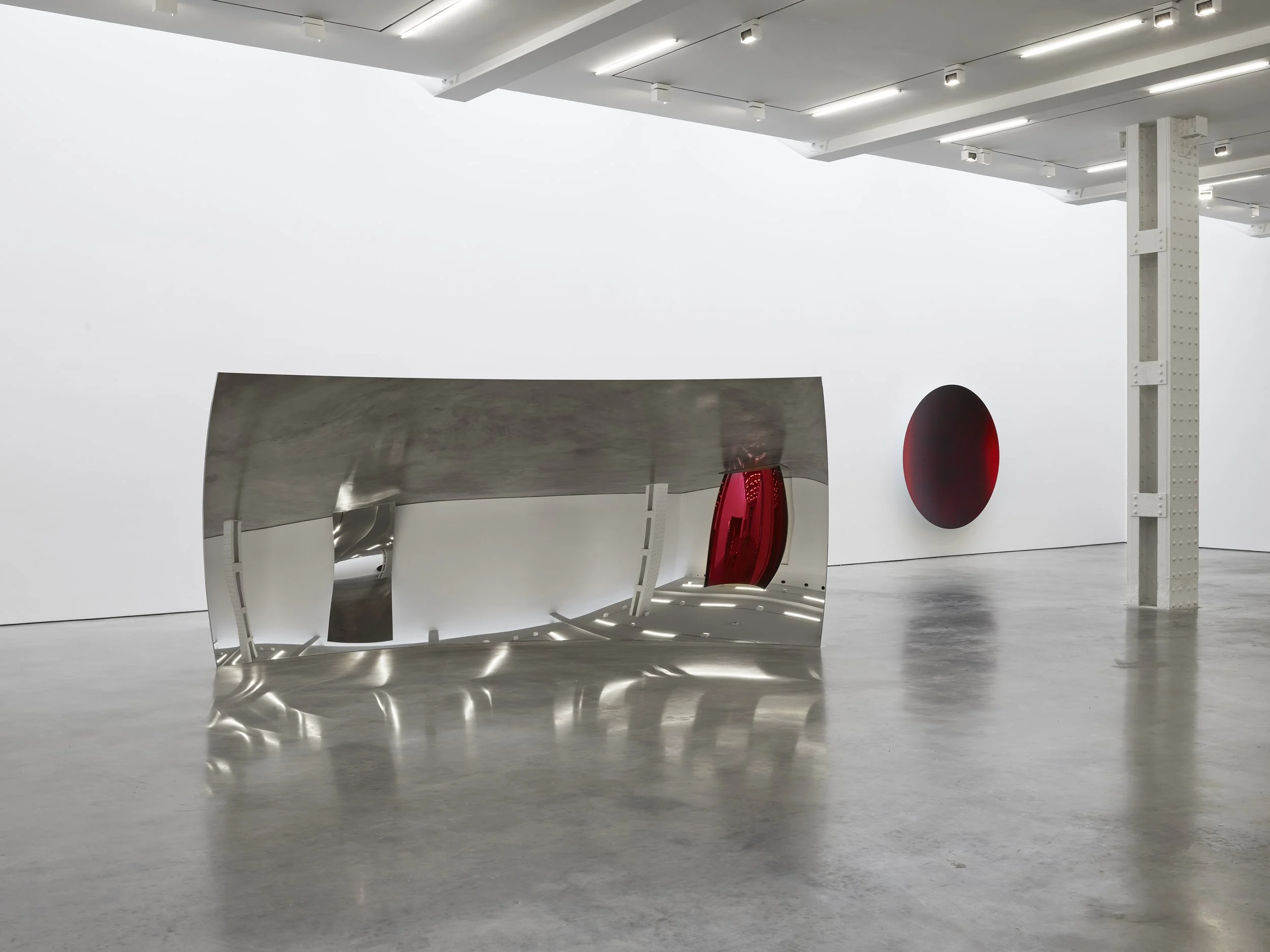
Installation view, Untitled, 2023 in the foreground. Stainless steel, 91 by 50 by 42 inches. © Anish Kapoor. Courtesy of the artist and Lisson Gallery.
A primordial volatility seizes the mobile beholder upon entering Lisson Gallery, where the impossibly absolute mirrors of Anish Kapoor hold the room in thrall. Above, the equidistant architectonic cross-beams and neon line segments provide a visual basso continuo: an insistent, serial undertone that the sculptures catch, warp, and return in flux—restless whether punctuated by spectators or abandoned to passing headlights. Here, the mathematical rigor of a Bach fugue meets the electric pulse of Muse. In unison, the reflective steel performs an optical broadcast of the West Chelsea skylights, opening to the horizontal expanse of the east and the poised, angular geometry of the west. Mirrors here gather the concrete floor, the riveted steel posts of the old High Line, and the ceiling's own rhythms of luminosity—compressed, elongated, and faithful to the mind's doubt of the eye's own testimony. The beguiling and the epistemic converge, briefly and brilliantly, before the mirrors move again.
The space itself is a collaborator. Lisson Gallery's 504 West 24th Street interior—contextually and seamlessly conceived by the architect Markus Dochantschi of Studio MDA—deploys equidistant steel beams and the fluorescence of ceiling-mounted neon, conjuring two canonical figures of twentieth-century art: the modular repetitions of Donald Judd and the luminous interventions of Dan Flavin. Yet where Judd's cantilevered verticals impose their relentless intervals upon the wall and Flavin's tubes baptize the room in colored light, Kapoor's mirrors absorb and redirect both impulses—structural and luminous—into something altogether more destabilizing: a deluge of perpetual optical shifts and pulses. This is anamnesis of the near past: not homage, not quotation, but a sculptural trajectory returning to the beholder uninvited—the ghost of Minimalism lingering long after the steel has stilled.
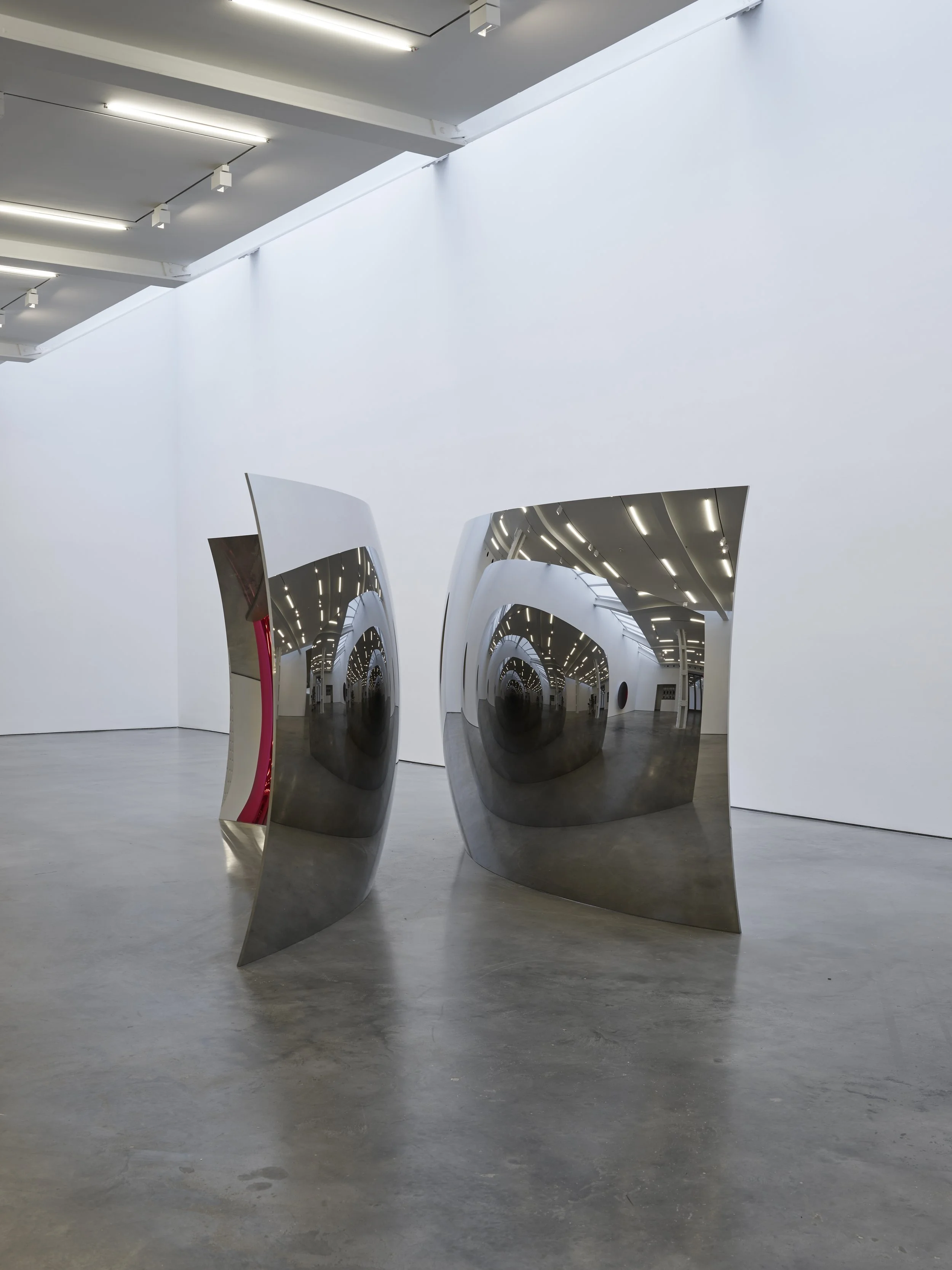
Anish Kapoor, Double Vertigo, 2012. Stainless steel, 86 by 189 by 40 inches each part. © Anish Kapoor. Courtesy of the artist and Lisson Gallery.
Immaculately manufactured and maintained—not a fingerprint, not a breath of interference—the three flat mirrored surfaces of Untitled (2023) achieve a commanding planarity that anchors the viewer within the work. Photographic, unflinching, as unsparing and precise as an unmitigated image, they offer the most convincing representation the tradition of mimesis can deliver. One moves slowly around the work—tracking eye to face to torso to limb, then to adjacent visitors, to the room's own stratified architecture—as if auditioning for one's own likeness. The passage of time is all but frozen; this work restages Quattrocento’s perspectival experiments in steel—the empirical self held briefly still. Only upon turning to the fourth side, with the viewer facing north, does the work deliver its quiet ambush. Here the empirical clarity of the first three surfaces is surrendered to a cubist fragmentation—the beholder's assembled identity dissolving into fractured planes that no longer obey the coherent logic of reflection. What was confirmed is now disputed. What was held still is now set adrift. This experience is not unlike confronting Caravaggio's Narcissus at Palazzo Barberini—a doubled image where one face is mirror-precise, while its reflection is darker, partial, and ghostlike—except here the reflection continues to shatter. Narcissus’s pond here deliquesces into a specular cascade.
To engage with Kapoor's work is to navigate a tension between the topology of its foundational forms—the mathematics of surfaces in transformation—and the perceptual instability of visuality. Through a restless topological rigor, Kapoor exceeds the very surfaces and volumes that define the material form—exteriority and interiority held in perpetual tension between not only the pictorial and the abstract, but the body in relation to the world around it. This duality finds an unexpected precursor in Artemisia Gentileschi's semi-abstract Self-Portrait as the Allegory of Painting in the Royal Collection. Just as Gentileschi bears her whole body into the work—poised between the intellectual demand of vision and the muscular labor of the brush, the void behind her neither resolved nor escaped—Kapoor's sculptural mirrors subsume us through their own temporal illusionism, for they enact optical transfigurations that exist only in the present tense. Kapoor's mirrors map themselves onto a Baroque lineage of the visually unresolved body—one alerting us that figuration and abstraction are always simultaneous conditions of vision. Here the mind perpetually negotiates the haptic and the visible, between body and world, between sense and nonsense. This negotiation is the exquisite albeit puzzling condition of eyesight itself—the architect of Albertian perspective—dissolving into the illogical through its very physiological mechanism. A given sculpture of Kapoor prompts us to experience it as a convergence of its engineering and phenomenology—those precise instants when a curve collapses into a recursive involution of space.
Anish Kapoor, Double Vertigo, 2012. Stainless steel, 86 by 189 by 40 inches each part. © Anish Kapoor. Courtesy of the artist and Lisson Gallery.
If Borromini's San Carlo alle Quattro Fontane is a stone's throw from Palazzo Barberini, the distance from Rome to Double Vertigo (2012) is not much further—a specular iteration of that same undulating masonry, now restated in steel. Facing one of the concave interiors, the body is drawn into the hollow of a polished, hemispheric slice. Because these interior surfaces face away from one another, they demand isolated encounters. Yet facing the convex exteriors—the inverted backs of these same slices—reveals the work’s most uncanny effect. Here, the two outward faces reflect not only the beholder but one another, capturing the gallery’s own architectural anatomy within a nested infinity: the concrete floor, the stark white walls, and the steel beams above. In this self-referential loop, the architecture and the observer are compressed into an apparition—a spatial theatricality and ocular melodrama that momentarily evoke the soaring, voyeuristic rotunda of Frank Lloyd Wright’s Guggenheim as it spirals down an abyss—atavistic and occult. This is a Duchampian rotorelief reimagined as a funhouse mirror: a high-velocity jolt of optical disequilibrium where the empirical self is caught in a cyclical, humorous subversion.
While Borromini's Rome provides the formal logic for Double Vertigo, its spectral precursor remains in Vienna, at the Kunsthistorisches Museum: Parmigianino's hauntingly coded Self-Portrait in a Convex Mirror. Standing before Kapoor's work, we encounter a distortion that has finally shed its wooden panel for the unfailing coldness of steel. Like Parmigianino's knowingly enlarged hand reaching out to bridge the gap between the reflection and the original, Kapoor's mirrors reveal every pictorial reflection as an ongoing transubstantiation and a perpetual postponement. Upon the warped surfaces of Kapoor, there is a suspense—almost a delight—as if the anamorphic skull of Hans Holbein's The Ambassadors has followed us from the National Gallery in London, shadowing the exhibition as an uninvited phantom that thrives precisely where vision and knowledge refuse to cohere.
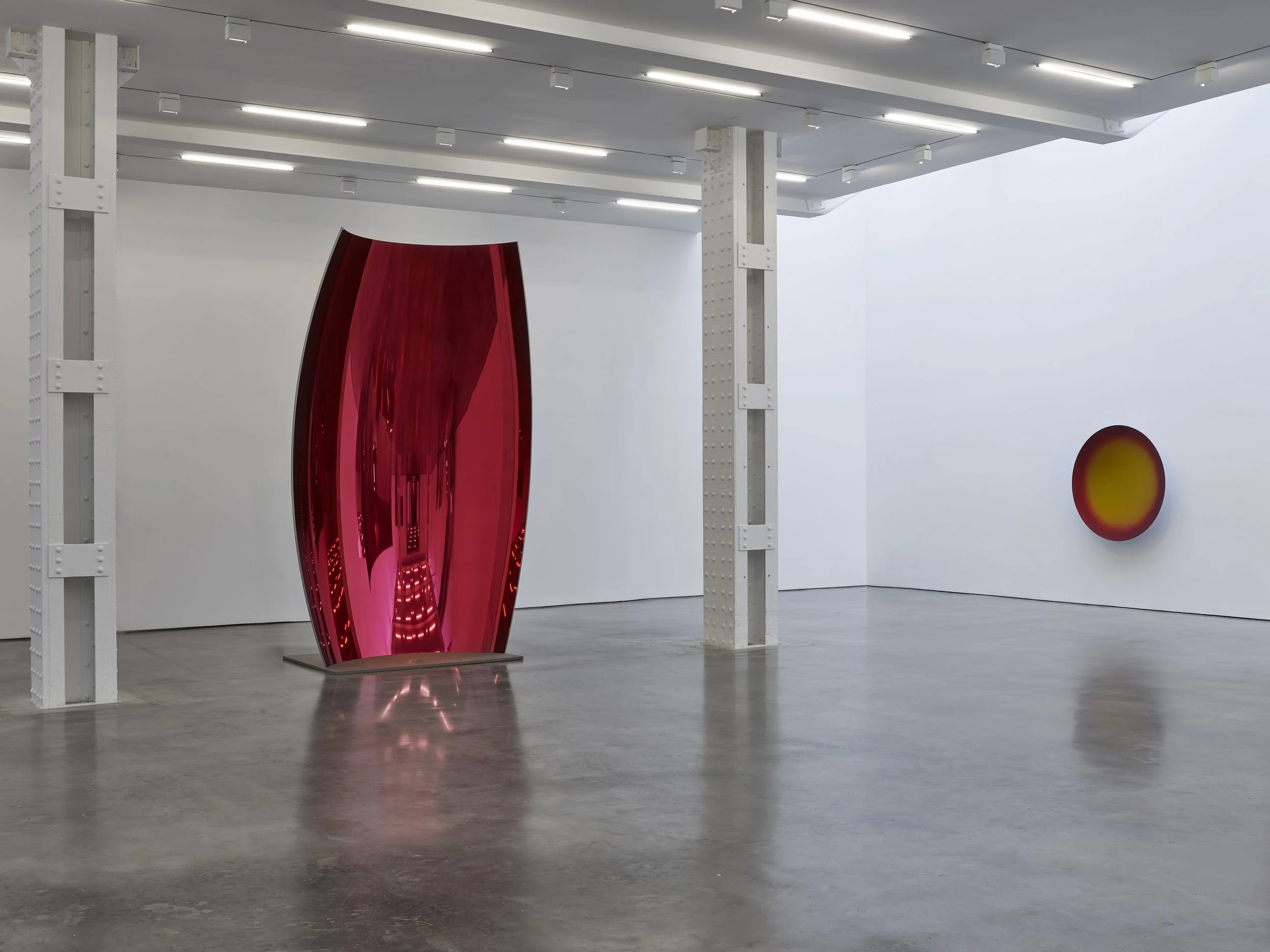
Anish Kapoor, Stave (Red), 2015 on the left. Stainless steel and lacquer, 145 by 86 by 39 inches. © Anish Kapoor. Courtesy of the artist and Lisson Gallery.
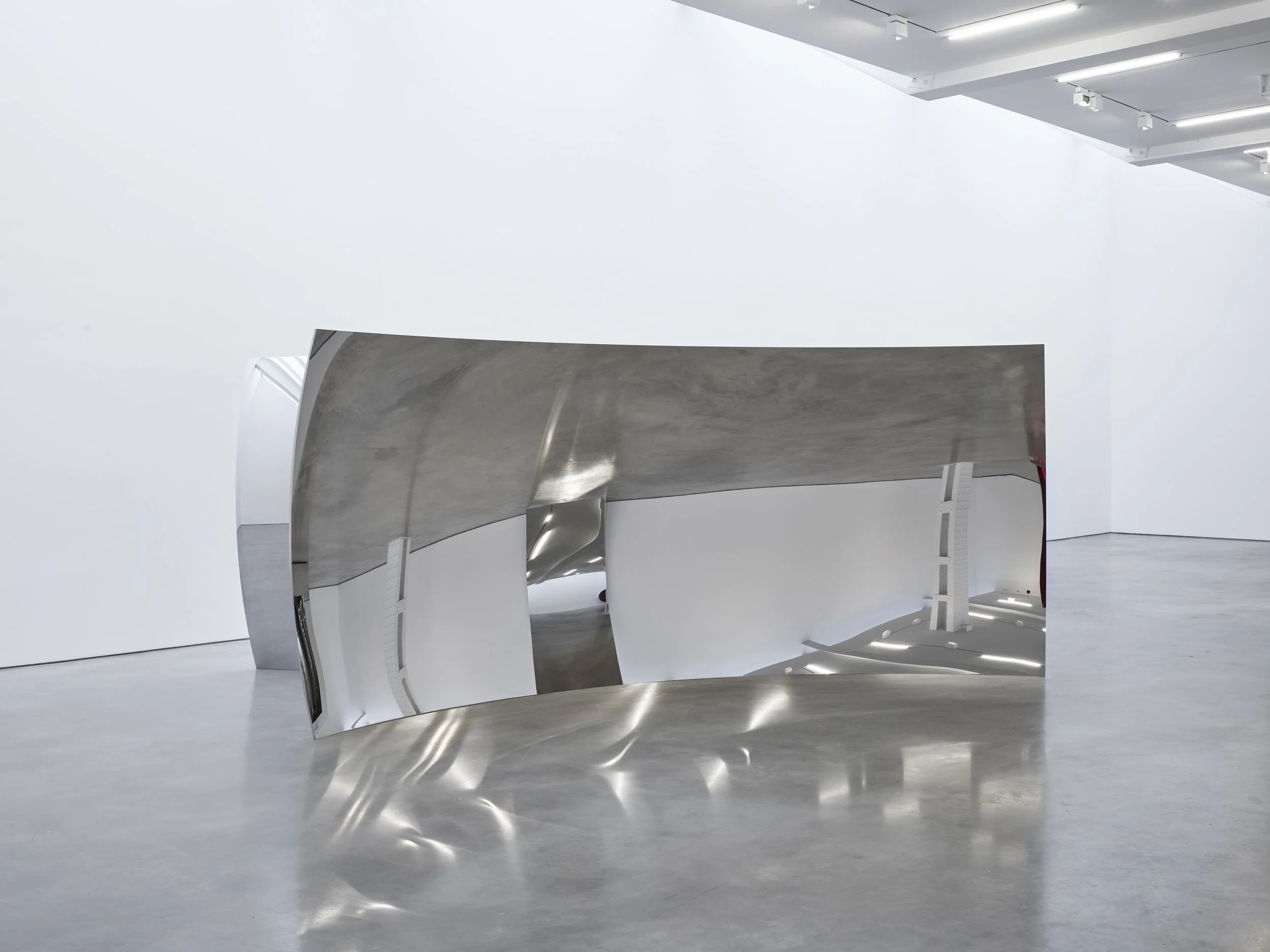
The exhibition revolves around three formal archetypes: first, the unfailingly lucent mirrors that enact a cinematic simulacrum of the room; second, the concave discs that abstrusely allude to our visual faculties; and third, the monumental, lacquered interior surface of Stave (Red) (2015) that mirrors the optical instability of the steel through pigments. Upon this towering ovular form, the concave interior generates a chromatic iridescence—the luminous ceiling grid somberly reflected upside down, in shades of silver, burgundy, and pink dissolving into one another with every shift of our vantage point. Along with this iridescence, a spatial dialogue emerges between the freestanding mass of Stave (Red) and the C-shaped curve of Non-Object (Plane) (2010). This frontally concave and soaring plane, tangent to the wall, hovers between freestanding sculpture and relief—its verticality providing a corporeal surrogate for the spectator's own presence. Whereas the freestanding and leaning sculptures counterpoise human postures—erect, leaning, surrendered—the pair of incurved lenses attached to the wall incarnates vision itself, incorporating the somatic and sensory realities of the body’s optical members into the gallery's own anatomy: the architecture thus maps itself to a body that stands, reclines, slumbers, and attempts to outstare.
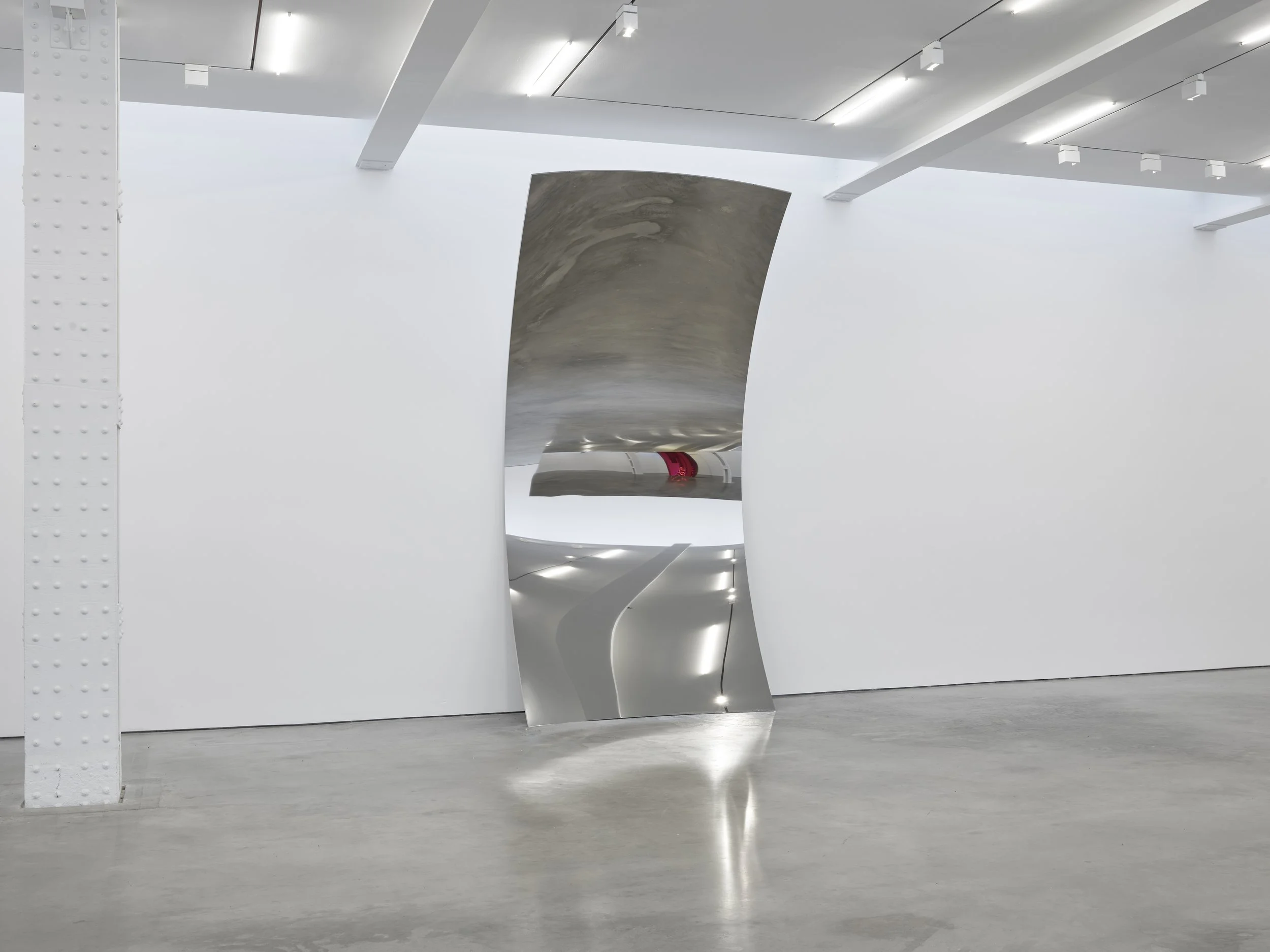
Non-Object (Plane), 2010. Stainless steel, 184 by 86 by 30 inches. © Anish Kapoor. Courtesy of the artist and Lisson Gallery.
After the visitors have vanished and the gallery has subsided, the steel remains—indifferent, expectant, awake. Through the indiscreet glass of the storefront, the ambient light of West 24th Street continues its quiet migration across the surfaces. It is here, in the vacancy of the closed gallery, that something ontological becomes visible: the unintelligible origin of the cosmic system that precedes us and will outlast us. Sight, sound, and time overlap here in a synesthetic loop: Muse’s soundtrack “New Born” dissolves into a phantom of Kapoor’s Newborn—which imperiously usurped this space in 2019—summoning Brancusi’s 1920 Newborn at MoMA. In this instant, the distance between the street and the history of form collapses. The vertigo is the same: in a Bach fugue, voices orbiting one another without touching; in Kapoor, a warping of selfhood; and in Brancusi, the inference of a surface where the anthropomorphic and the abstract have not yet decided to part ways. Together they destabilize the horror vacui of our logical meditations—those anxious frameworks we erect against our ontological limits. And it is precisely in that destabilization, in the gap where vision and knowledge once again decline to integrate, that Anish Kapoor’s work finds its enduring strength, if not its primeval voice: not in what it reflects, but in what it withholds.