Line, Light and Thought
Encounters at the Met on November 23, 2025
Students of the School of Visual Arts entered the European Painting Galleries at The Metropolitan Museum of Art and encountered works that demanded sustained looking and interpretive rigor. The paragraphs gathered here reflect their firsthand engagement with these paintings, bringing together description, historical context, analytical inquiry, and critical commentary, all with a stance of reflexive critique and open discussion.
Guided by Heinrich Wölfflin’s foundational Principles of Art History and Laurie Schneider Adams’ A History of Western Art—within the established lineages of Gardner, Janson, Stokstad, and Honour and Fleming—each student developed a focused reading. Through the application of various methodologies—formalism, iconography, feminism, Marxism, biography, semiology, deconstruction, and psychoanalysis—their interpretive process was uniquely shaped by their own encounter with the object.
The results form an exploratory dialogue linking student, artwork, and reader, offering concise glimpses into the Met’s vast holdings: from Fra Carnevale’s structurally complex Birth of the Virgin to Chardin’s phenomenologically grounded Soap Bubbles.
—Raphy Sarkissian
Between Likeness and Abstraction
Madonna and Child by Ling Huang
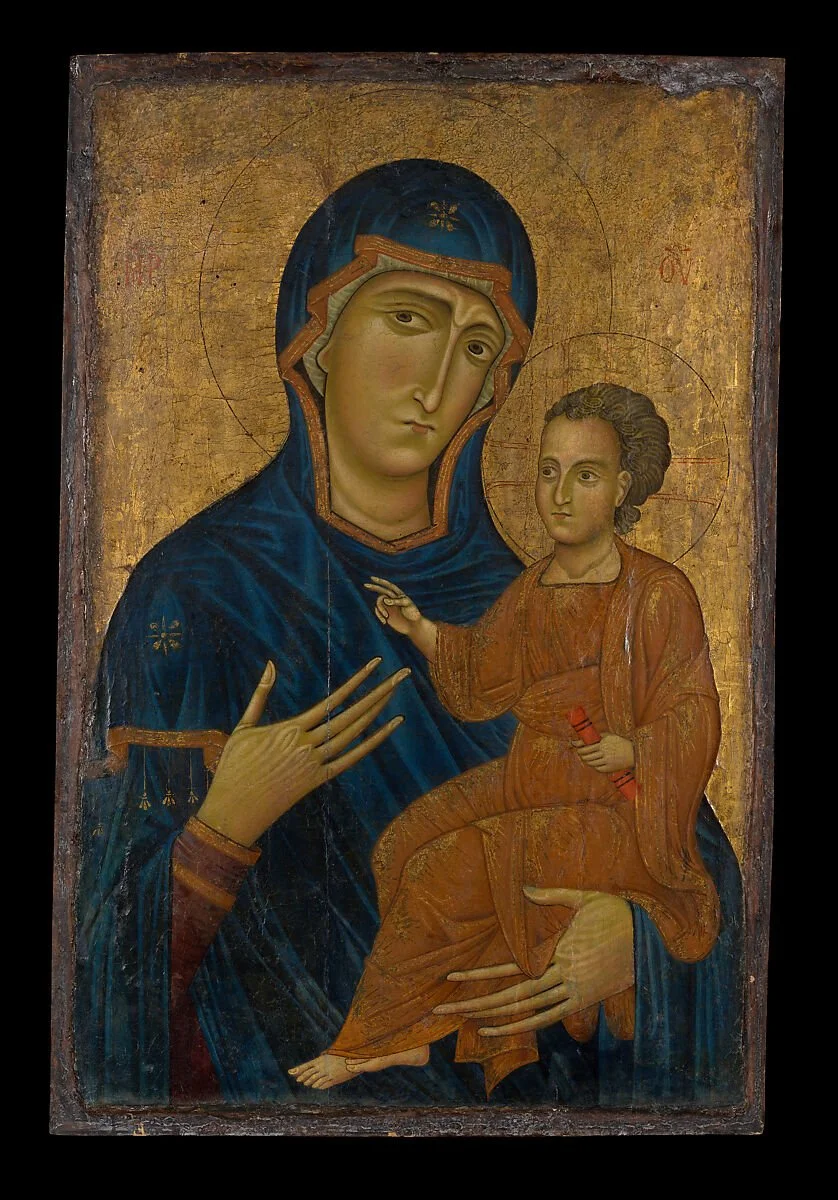
Berlinghiero, Madonna and Child, possibly 1230s. Courtesy of the Metropolitan Museum of Art.
Berlinghiero’s Madonna and Child, on view in the gallery now titled European Painting: A Starting Point, captured my attention with its formal economy and the stark simplicity of its composition. The continuous gold background actively denies recession, flattening the image into a seemingly unified spiritual plane. In the Byzantine tradition, also known as maniera greca, this gold ground serves as the codified pictorial representation of the sacred, eternal light of the divine. Yet Mary’s mournful expression and outward, arresting gaze confront the panel’s inherent flatness, suggesting a human narrative set against the gold-leaf surface. Mary’s highly stylized eyes and hands, along with her expressive gaze, contrast with the less stylized depiction of Christ, clothed in a gold-brown garment and holding a red script. This contrast adds layers of narrative and spatial illusion, as if the figures protrude from the flattened plane—reminiscent of art historian Michael Podro’s observation that in gold-ground panels, central figures may occupy an indeterminate space relative to the viewer, while surrounding figures, when depicted on a platform, appear more firmly grounded. This interplay between likeness and abstraction, between illusion and flatness, became even more striking when I reflected on the later humanistic and perspectival logic of Giotto, whose Adoration of the Magi—displayed nearby within a vitrine—introduces bulk and shallow, stage-like space. Berlinghiero utilizes a style that Heinrich Wölfflin would later define as resolutely linear, and this pre-Renaissance commitment to the surface strips away worldly distraction, enabling a concentrated, psychological engagement with the sacred image. While the museum defines this gallery as European Painting: A Starting Point, my own pivotal journey began on the ground floor: it was the memory of the Studiolo from the Ducal Palace in Gubbio—that immersive fifteenth-century puzzle of linear perspective—that provided the necessary contrast, making me realize that Berlinghiero’s gold surface does not simply precede Renaissance illusion but participates in a long, recurring formal phenomenon of the pictorial plane across time and space.
Saints, Signs, and Saussure
The Adoration of the Magi by Harleigh Harcum
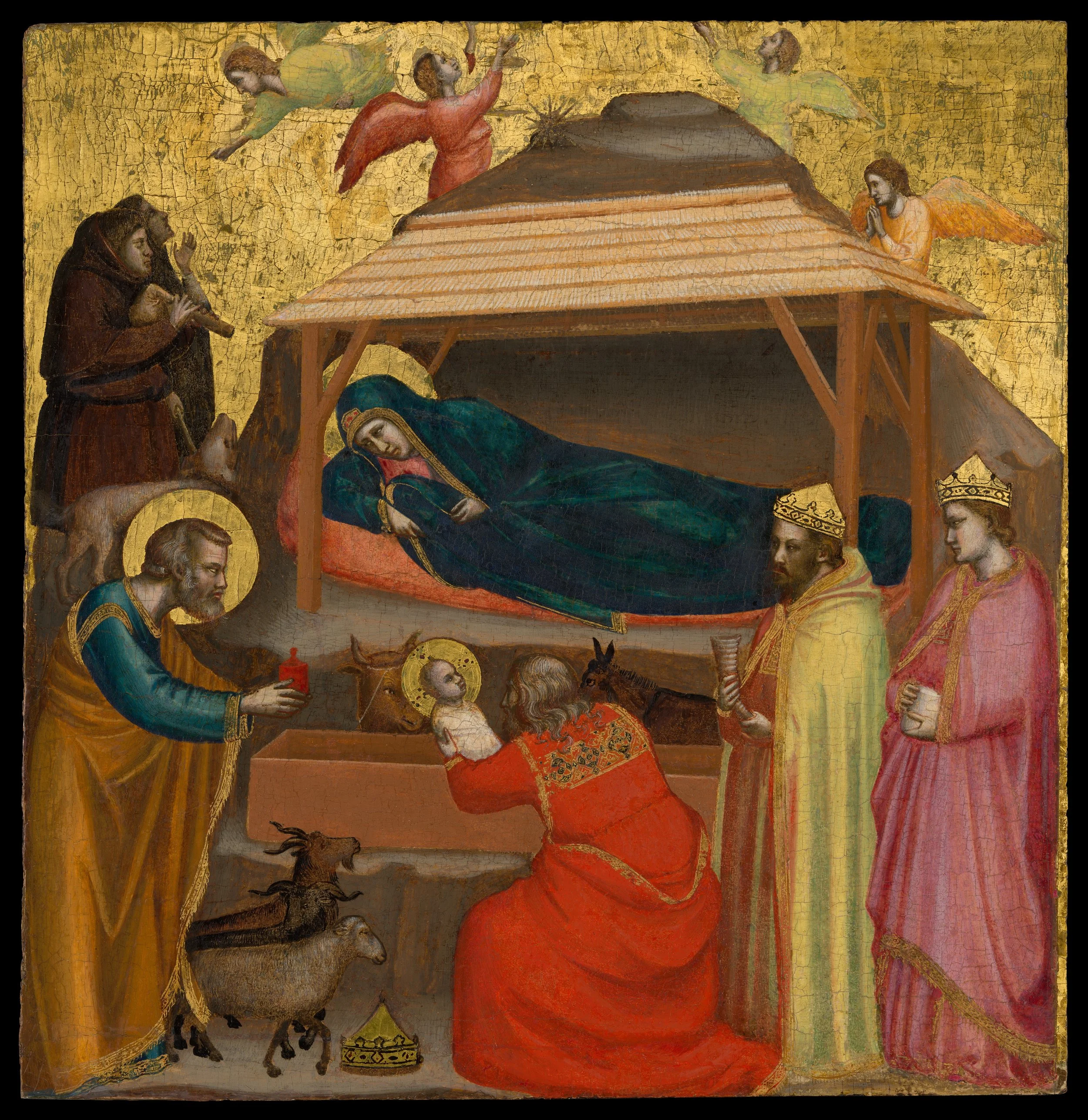
Giotto di Bondone, The Adoration of the Magi, possibly c. 1320. Courtesy of the Metropolitan Museum of Art.
Standing before Giotto’s Adoration of the Magi, I found myself drawn into the Precursors of the Renaissance, when artists explored spatial depth, naturalism, and human experience. Giotto, a pivotal initiator of these aspirations, demonstrates a visionary approach to perspective that organizes the scene intuitively into foreground, middle ground, and background. The shimmering gilded sky dominates the top of the composition, creating a sacred space that unifies the scene and elevates the narrative. Moreover, the geometric framework of the stable organizes the figures methodically within the architectural space, creating recessive depth that enhances the story. Compared with Masaccio’s Holy Trinity, painted about a century later, which opens its space through strict architectural perspective, Giotto’s work remains more contained yet achieves perceptible depth through the arrangement of figures beneath the gilded sky. Each figure has volume and presence, their faces significantly free of Cimabue’s stylization, suggesting distinct characters while clearly conveying their religious roles. Mary lies beneath the humble architecture, turning slightly from the infant Christ, while celestial angels are portrayed above, performing their divine tasks against the golden background. The Magi, Joseph, and even the animals direct their attention toward the newborn, and golden crowns and halos reinforce both importance and sacredness. Each halo and crown functions as a sign of the sacred or the powerful. In Saussure’s structural terms, a sign consists of a signifier and a signified. In language, the relation between signifier and signified is arbitrary, whereas in iconography it relies on resemblance, making holiness and authority immediately legible. The three crowns, with one placed humbly on the floor, and the three golden halos stage a tension between material and ideological authority: crowns as material objects, halos as ideological symbols. What does power mean if men are bowing to a newborn? Are material and ideological forms of power inseparable?
Volume Against Gold
The Adoration of the Magi by Josh Hwang
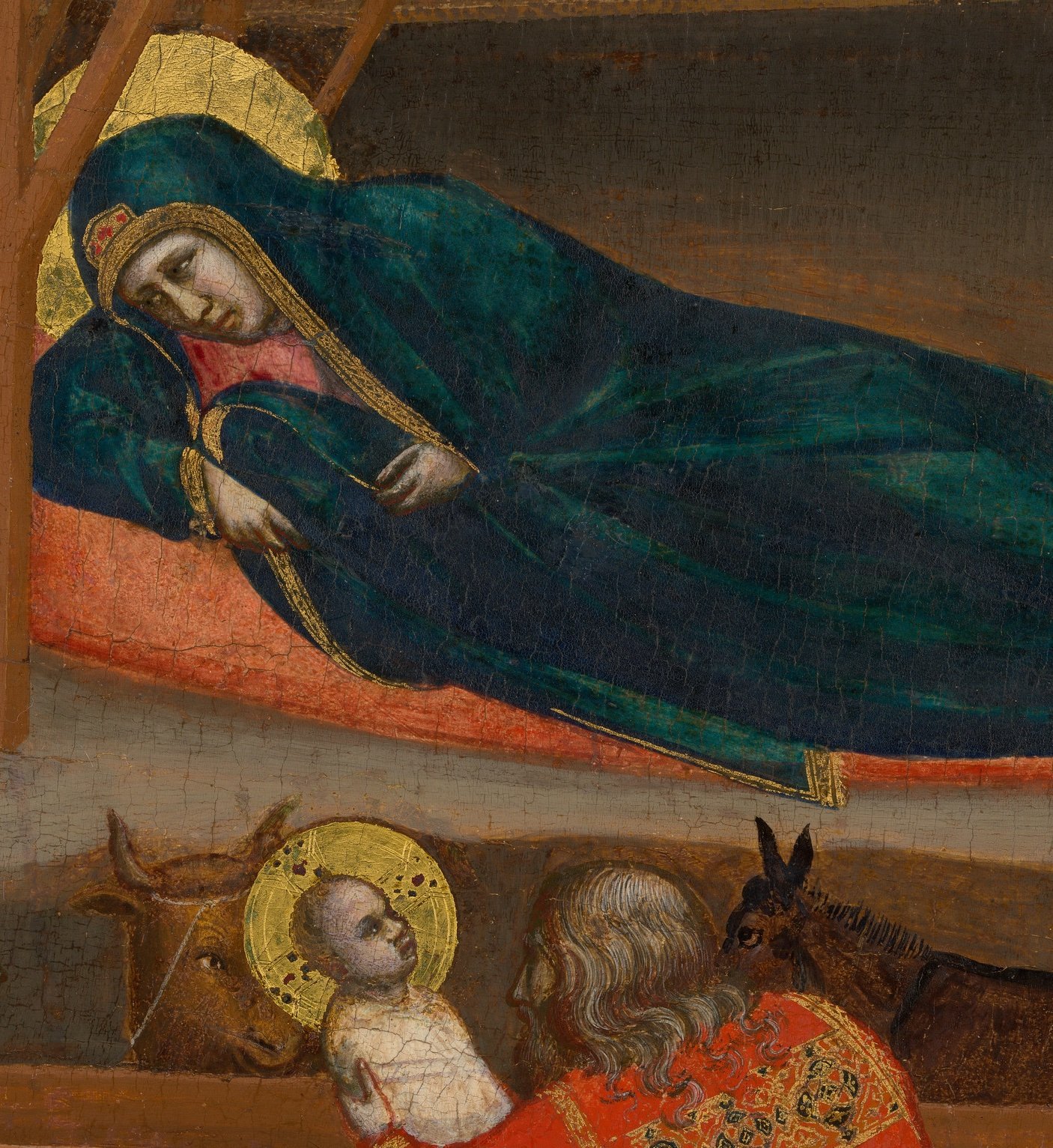
Giotto di Bondone, The Adoration of the Magi (detail) possibly c. 1320. Courtesy of the Metropolitan Museum of Art.
The Adoration of the Magi, a painting attributed to Giotto di Bondone and dated around 1320, functions as a seminal marker in art history. The intimately scaled painting, aptly displayed within the context of European Painting: A Starting Point at the Metropolitan Museum, initially presents the composition as an expected medieval icon, anchored by the splendor of its gilded ground on wood. However, reflecting on the historical placement of this work as a proto-Renaissance innovator, I began to notice the revolutionary shift occurring beneath the traditional surface. The work quickly revealed itself as a decisive starting point for Western illusionism. Where earlier medieval figures often presented as planar and symbolic, I observed Giotto’s sophisticated use of modeling—the nuanced application of chiaroscuro—to imbue each figure with profound three-dimensionality. This technical mastery of drapery and corporeality grants the forms an astonishing volumetric reality, establishing their iconicity through lifelike resemblance. Beyond technique, the composition’s power lies in its psychological intimacy. The naturalistic poses and Virgin Mary’s gentle, emotional gaze toward the Christ Child elevate the scene from formalized ritual to a deeply felt human experience. This sense of realism is compellingly juxtaposed with the work's symbolic elements: the flat, gilded background, the non-naturalistic halos, and the crowns of the Magi all serve as conventional signs of divinity and status. This synthesis of distinct visual codes is what I found most meaningful about this transitional work. If Giotto’s bridge was built with tempera and gold leaf, what specific artistic materials or conceptual ruptures—such as code, data, or blockchain—are building the bridge between contemporary and purely digital art?
Rational Order and Social Space
The Birth of the Virgin by Yiwen Li
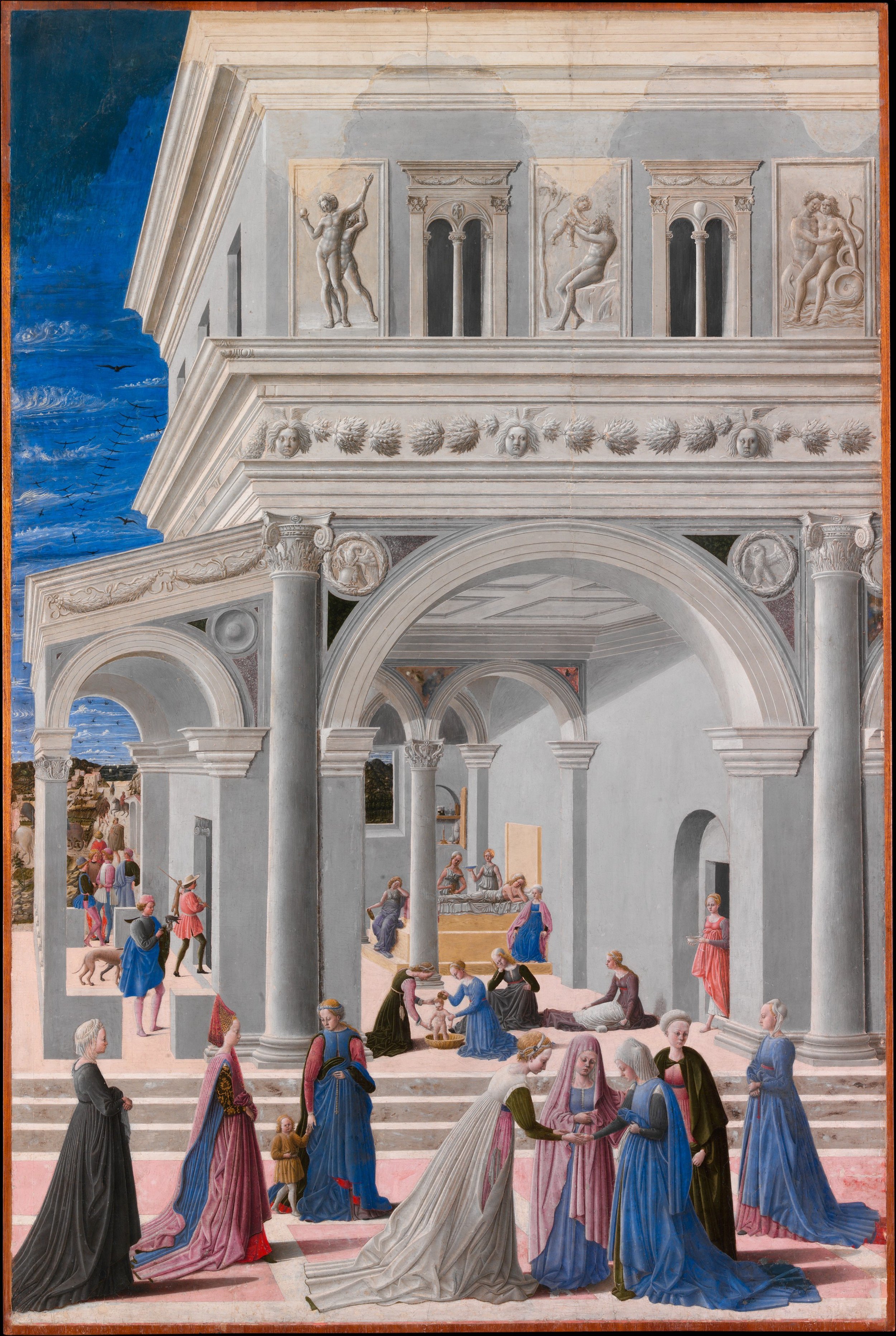
Fra Carnevale, The Birth of the Virgin, 1467. Courtesy of the Metropolitan Museum of Art.
As I entered the gallery titled The Home in Renaissance Italy at the Metropolitan Museum of Art, two paintings immediately came to mind. Both are insightfully discussed in our textbook, A History of Western Art by Laurie Schneider Adams. These works help illuminate the interplay of domesticity and architectural order that I observed in Fra Carnevale’s The Birth of the Virgin at the Met: Filippo Lippi’s tondo Madonna with Scenes from the Life of Saint Anne and the Ideal City in Urbino. Carnevale’s The Birth of the Virgin positions a biblical birth within a domestic space envisioned within a grand palatial framework, blending intimate human activity with architectural grandeur. The painting’s high degree of perspectival depth is organized through the precise application of linear perspective, a system pioneered by Brunelleschi and formulated by Alberti. Its spatial composition, articulated through majestic arches and columns, indicates Carnevale’s mastery of architectural perspective. Fashionably garmented figures occupy this carefully sectioned space, imbuing the narrative with ordered clarity that reflects the principles of linear perspective. This focus on clear outlines and highly defined spatial planes exemplifies the linearity and planarity characteristic of early Renaissance composition as described by Wölfflin. The painting’s even distribution of light across interior and exterior spaces complements the architectural balance of the setting and reinforces its overall sense of depth and order. Iconographically, Carnevale depicts both human activity and its domestic context, integrating the biblical narrative with everyday life. Viewed through structuralist and feminist lenses, the painting markedly emphasizes the centrality of women within religious and familial frameworks. Though framed by a rigid architectural structure, which I interpret as masculine, a visual marker of patriarchal order, the composition centers on the birth of the female body and experience. The painting seems to highlight the cultural significance of motherhood and female domestic space, reflecting contemporary social constructs of family and gender. The painting combines the rational order and symbolic function of its architecture with the narrative function of its iconography within a complex visual composition that embodies Renaissance ideals while also reflecting the gendered contexts of its time. I look forward to visiting Florence and Urbino to encounter Lippi’s Madonna and the Ideal City in person.
Deceitful Splendor
Studiolo of the Ducal Palace at Gubbio by Emily Davidson
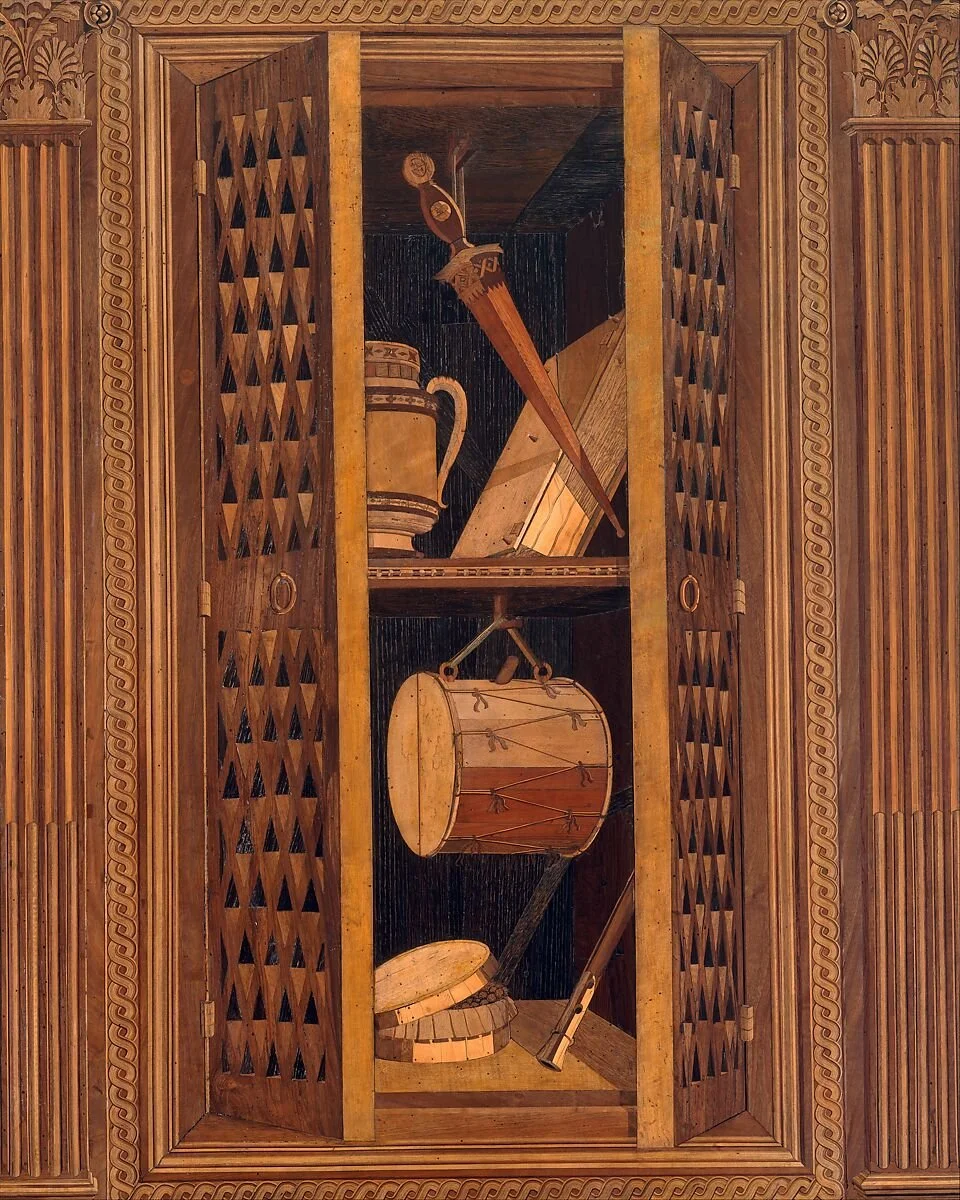
Studiolo (detail) from the Ducal Palace in Gubbio, 1478–82. Detail. Courtesy of the Metropolitan Museum of Art.
From a distance, the Studiolo from the Ducal Palace at Gubbio, dated 1478-82, appears to be covered in monochromatic murals brushed to resemble wood grain—a convincing illusion that initially led me to believe the walls were painted rather than built. It is surprising, then, to learn that the entire room is constructed from wood and that every detail is formed through the demanding techniques of intarsia and marquetry. The perspectival rendering of the cabinets is remarkably effective, making the walls seem to contain real shelves filled with instruments and mathematical devices—an illusion that recalls Brunelleschi’s development of linear perspective and Alberti’s codification of it in his 1435 book On Painting. The contrast between darker woods for the cabinet interiors and lighter tones for their edges further enhances this sense of depth. While the absence of human figures limits the iconographic reading, the placement of objects suggests the presence of Duke Federico da Montefeltro, his family, or members of the court, transforming a still life into a living genre scene. The carefully rendered cittern—alongside dividers, a candleholder, a sandglass, and books—shows how art and geometry were inseparable in Renaissance thought, shaping the portrayal of the world. Yet it is the representation of a bird within an intricately rendered cage that pictorially expands the genre's conceptual boundaries, as if to declare that life, knowledge, and art can be compellingly synthesized upon a two-dimensional surface through geometric perspective and trompe l’oeil.
Linearity and Intensity
Three Miracles of Saint Zenobius by Jeremy Martinez
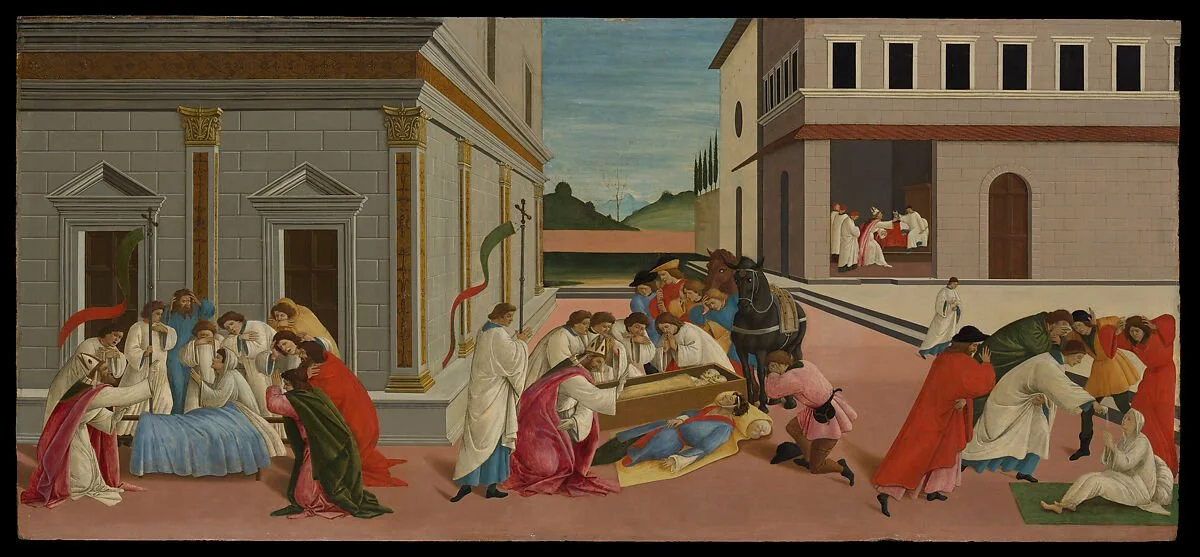
Botticelli, Three Miracles of Saint Zenobius, c. 1500. Courtesy of the Metropolitan Museum of Art.
From a formalist perspective, Botticelli's Three Miracles of Saint Zenobius of around 1500 is a compelling study of High Renaissance principles. The painting, executed in tempera on wood, employs linear perspective—the technique invented by Brunelleschi—to construct an elaborate, theatrically deep architectural stage. Botticelli uses the receding pilasters and the strong convergence of the walls to anchor the four vignettes on the solid pink ground plane. The overall composition is a masterclass in linearity: figures are rendered with sharp, defining contours—a style that deliberately avoids the hazy, atmospheric modeling of sfumato—and remain distinctly modeled from the illusionary background, adhering strictly to the period’s prevailing taste for graphic precision. Iconographically, the narrative—Zenobius resurrecting the dead at a funeral, resurrecting a casket bearer, and giving blessed water to Saint Eugenius—is executed using a continuous narrative technique, establishing the bishop as a clear Christological type by compressing multiple miraculous actions into a single frame. While the painting adheres formally to Renaissance decorum, the dramatic compression of these four miraculous moments into a single visual frame creates an undeniable narrative tension and rhetorical force. Encountering the work at the Metropolitan Museum of Art, I found its compelling emotional pitch challenged the balanced ideals of the period. This connection is visually justified by Botticelli’s emphasis on highly active, expressive contours and the evident pathos of the resurrection scenes, where the emotional intensity anticipates later formal concerns. Despite adhering to Renaissance principles, the powerful gestural focus and high dramatic content lead to a critical hypothesis: Could the concentrated, emotionally charged narrative and linear style of Three Miracles of Saint Zenobius be read as a stylistic precursor to the formal and expressive tensions of the forthcoming Mannerist period?
Geometry and Illusion
Madonna and Child Enthroned with Saints by Alyssa Weston
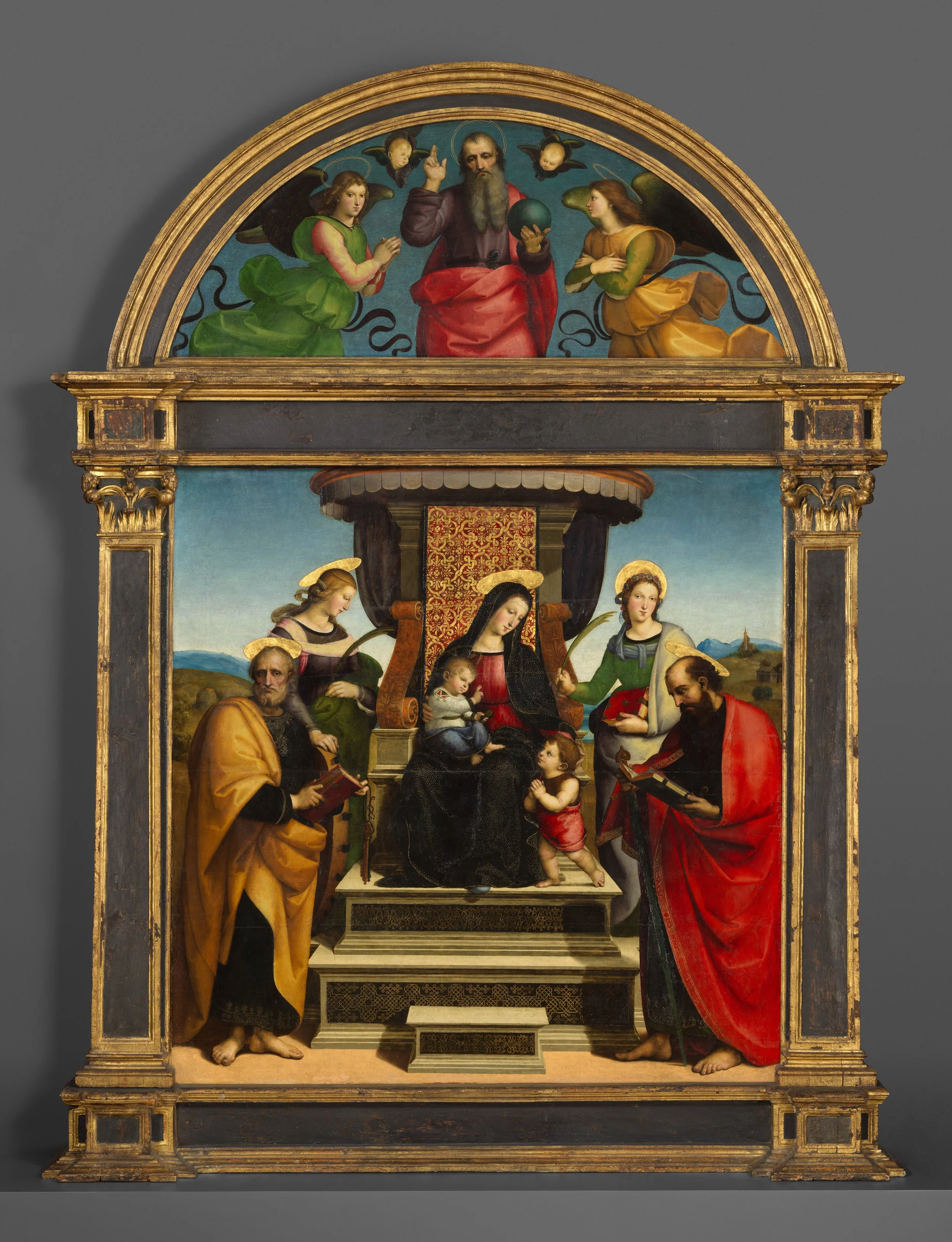
Raphael, Madonna and Child Enthroned with Saints, c. 1504. Courtesy of the Metropolitan Museum of Art.
Standing in the gallery titled Sacred Images and the Viewer, my observation of Raphael’s Madonna and Child Enthroned with Saints shifted immediately from iconography to its formal mechanism. This altarpiece, executed in oil and gold, provides the ideal visual evidence for Wölfflin’s theoretical concepts of High Renaissance classicism. The composition is characterized by principles of linear definition, evident in the crisp contours of the figures and the architectural setting. It is further structured through planar layering, where figures exist on distinct, readable spatial planes. The closed form, carefully contained within the arched frame, achieves absolute clarity in its illumination and arrangement, allowing for multiple yet balanced focal points among the figures. This rational structure is further enforced by the architectural throne: I observe how the orthogonal lines of the marble platform recede toward a precise vanishing point, seemingly located at the tip of Christ’s index finger, controlling the spatial recession. This visual system of controlled geometry is the direct legacy of Filippo Brunelleschi’s empirical discoveries, later codified as doctrine by Leon Battista Alberti in his treatise On Painting (1435). This shared foundation in rational geometry is the critical theoretical link connecting Raphael’s works. The measured placement of the idealized figures within this defined space structurally parallels the elegant containment of The Betrothal of the Virgin in the Pinacoteca di Brera in Milan. Likewise, this painting at the Met fundamentally anticipates the rigorous architectural organization governing the vast setting of The School of Athens in the Stanza della Segnatura in the Vatican. The Metropolitan’s panel thus exemplifies how Renaissance painters utilized architecture as the primary vehicle for formal order, achieving a deeply architectonic clarity and stability throughout the composition. The act of standing before this controlled Renaissance space compels the observer to become a critical participant in art history’s major stylistic shifts. As I proceeded to examine paintings by Caravaggio, Rembrandt, Rubens, and Velázquez, a question that came to my mind was: Could it be that Raphael attempted to capture a tactile reality based on idealized perception, whereas the upcoming generation attempted to represent the optical imagery within the phenomenology of perception?
Power in Painting
Venus and Adonis by Kellen Zeng
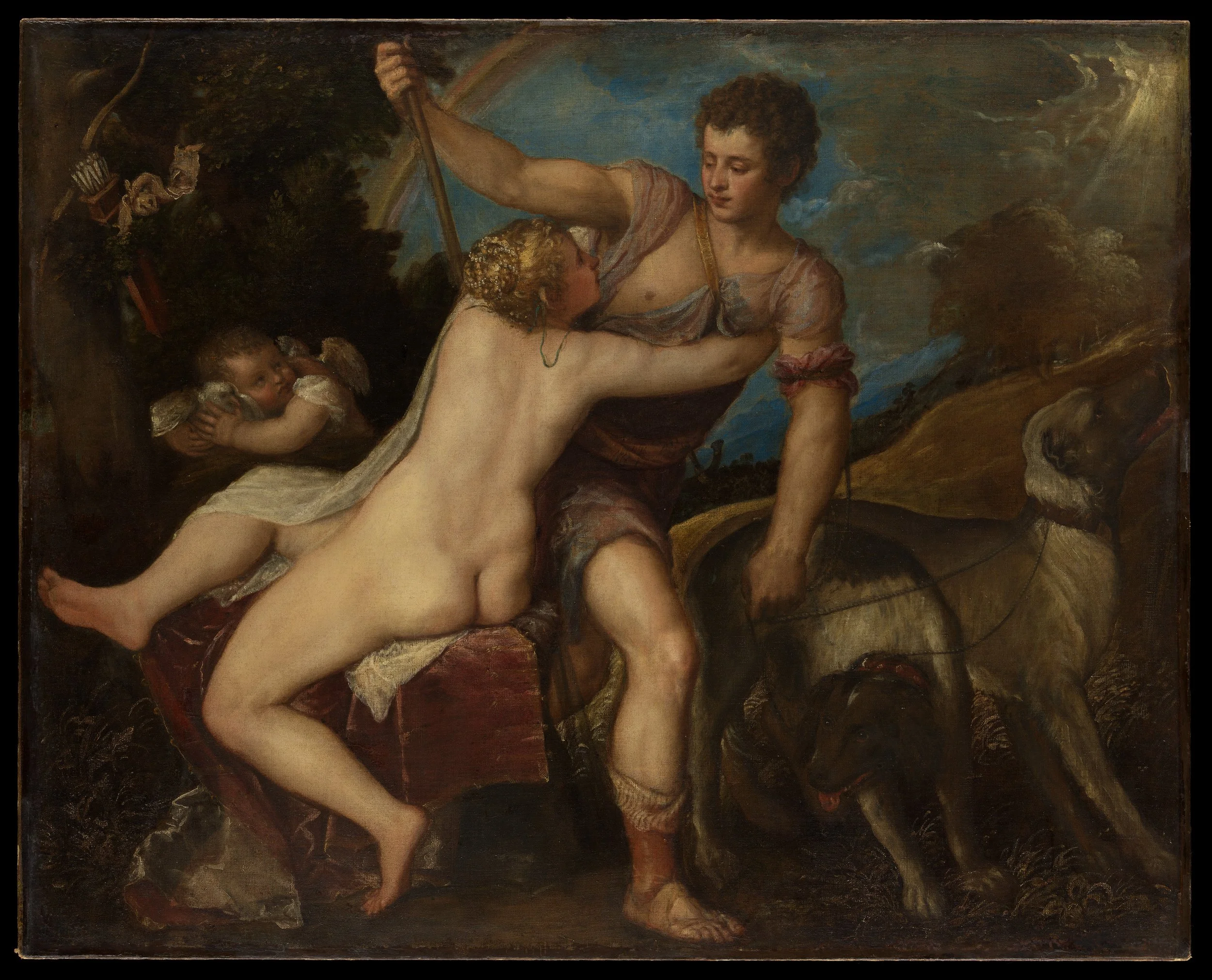
Titian, Venus and Adonis, c. 1553-1560. Courtesy of the Metropolitan Museum of Art.
When I first saw Titian’s Venus and Adonis in the Metropolitan Museum's gallery Faith and Love in Venice, I was immediately captivated by its warm, luminous palette and a painterly style that anticipates later developments. Beyond its surface beauty, however, the painting raises critical questions about gender, desire, and who controls the story within classical myth. Venus is nude and emotional, reaching toward Adonis, who is fully clothed and moves away with clear resolve. Historically, myth often casts women as obstacles to male duty; seeing this in person reveals how power and attention are coded visually through the composition. Venus’s glowing skin and central placement make her the focus of the viewer’s gaze, while Adonis’s cooler tones and partially shadowed figure suggest purpose and will to act. Even as a goddess, Venus appears vulnerable, a contrast to the convention that male gods remain commanding even when drawn to mortals. This prompts reflection: Is her nudity purely for sensual effect, or does it signal assumptions about women’s place in art and myth? How do desire, action, and storytelling intersect in Renaissance painting? Experiencing the work firsthand highlighted how compositions often reflect male fantasy more than female experience. The painting thus invites questions about the male gaze, the narratives we inherit, and the ways women’s power is imagined—or erased—across centuries. Rather than offering definitive answers, Venus and Adonis encourages viewers to reconsider assumptions about mythology, power, and representation. The painting prompts reflection on what art both reveals and conceals about women's lives and perspectives, echoing Linda Nochlin’s enduring questions about power in art history.
Linear Luxury
Portrait of a Young Man by Kayden Zhu

Bronzino, Portrait of a Young Man, 1530s. Courtesy of the Metropolitan Museum of Art.
The quiet yet sumptuous luxury of this painting is immediately enthralling. Bronzino’s Portrait of a Young Man displays the nobility of the era with a subtle touch of detachment and mystery. The muted and warm colors work in tandem with a careful control of values, drawing the eye to the cool gaze, an expression of austere composure, of the nobleman; however, iconographically, the details delineate a conflict between public image and private reality. The book held by the sitter signals intellect, yet his rigid pose creates tension between the hardness of the posture and the softness of the face. Most telling are the grotesque heads carved into the furniture. These monstrous masks serve as a symbolic foil to the youth’s composed features, suggesting the necessity of sprezzatura—the effortless grace and emotional concealment required by courtly life. Moreover, compositionally, the painting gives way to complex theoretical suggestions. Bronzino has made use of Renaissance architectural perspective yet has limited its application dramatically. The brushstrokes are virtually invisible, and the style is highly linear—fitting Heinrich Wölfflin’s characterization of the Renaissance style. However, a spatial shift is occurring. While the work remains linear rather than painterly, on the level of planar versus recessive, Bronzino has reduced the clear planes of the High Renaissance. This ambiguous, compressed space can be read as an uncanny anticipation of the upcoming elimination of perspective found in the Baroque era. Ultimately, it is as if Bronzino has used highly edited architectural details, haberdashery, furniture, and a book to fuel a philosophical debate of status. Within the somewhat compressed space, the subject appears imprisoned by the very finery that elevates him. Are we to love this luxury and aspire to obtain it, or are we to reject it for its cold, detached indulgence?
Representing Sculpture
Aristotle with a Bust of Homer by Yiby Seo
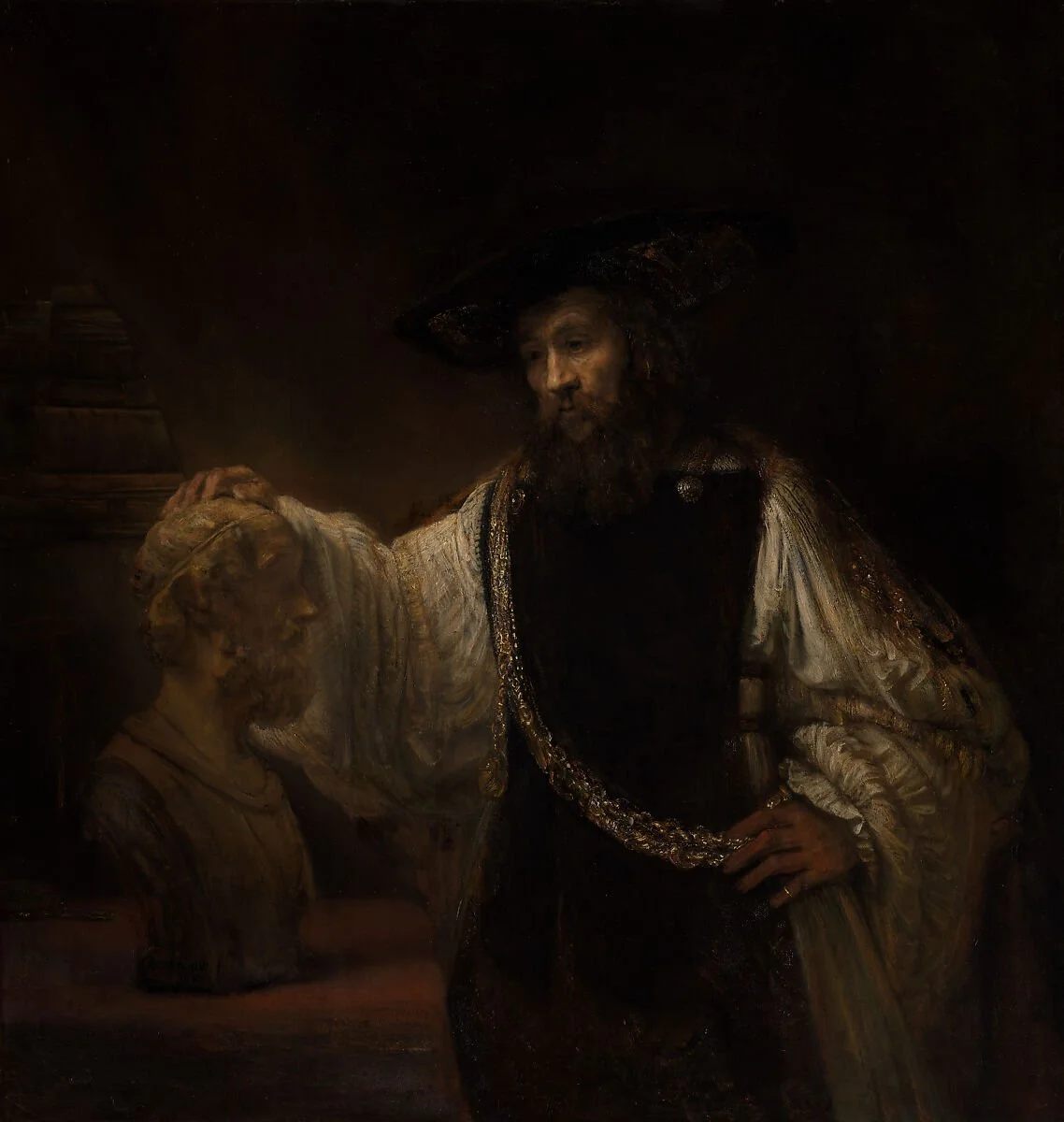
Rembrandt, Aristotle with a Bust of Homer, 1653. Courtesy of the Metropolitan Museum of Art.
At the Met, in the gallery named Painters, Critics, and Rivals in the Age of Rembrandt, I felt surrounded by equally arresting paintings. Yet it was Rembrandt’s Aristotle with a Bust of Homer that held my attention the most, as it was the painting on a checklist in my hand. Aristotle appears to emerge from the shadows, his hand resting on Homer’s marble bust. This visual arrangement establishes an incredible dialogue in representation: sculpture represents the three-dimensional body using a three-dimensional medium, while painting, a two-dimensional medium, captures the eye’s perceived image of the object, not the object itself. Broad brushstrokes and diffused light merge forms rather than sharply defining them, most evident in the impasto of Aristotle’s sleeves and the gold chain, where texture and atmosphere dominate over precise contours. Spatially, the composition is open and deeply recessive; the background dissolves into darkness, suggesting a space that extends infinitely beyond the frame. Observing the painting through Wölfflin’s formalist methodology, one notes his assertion that “Classic art achieves its unity by making the parts independent as free members, and that the baroque abolishes the uniform independence of the parts in favour of a more unified total motive.”* This Baroque principle of unified motive translates visually: when human vision focuses sharply on details like the hand or face, surrounding details necessarily blur and become abstracted. Rembrandt edits his points of focus, highlighting hands (tactile) and eyes (optical) and segments of bodies as bridges between these two human senses. This deliberate focus on the act of perception is the painting’s phenomenological aspect. Light and shadow diffuse across the figures, blurring forms so that they seem to emerge gradually from darkness (sfumato), directly resonating with the experience of human perception itself. The textured brushstrokes make certain details perceptible as illusions, while simultaneously reinstating their materiality as pure abstraction (paint on canvas). Through Aristotle’s living body and Homer’s artificial bust, Rembrandt positions himself as both painter and critic, a dynamic perfectly captured by the gallery title.
* Heinrich Wölfflin, Principles of Art History: The Problem of the Development of Style in Early Modern Art, trans. Jonathan Blower (Los Angeles, CA: Getty Publications, 2015), p. 191.
Dialectic of Bust and Painting
Aristotle with a Bust of Homer by Daniel Tiburzi
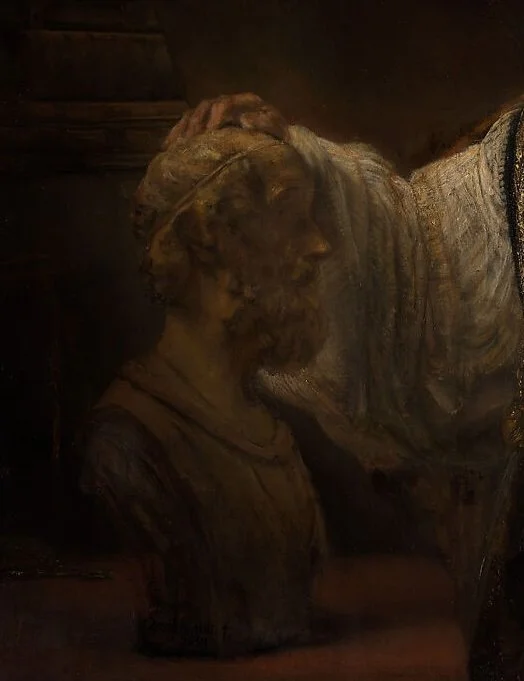
Rembrandt, Aristotle with a Bust of Homer (detail), 1653. Courtesy of the Metropolitan Museum of Art.
Rembrandt’s Aristotle with a Bust of Homer stages an intriguing dialogue between painting and sculpture, bringing the two mediums into a shared space of thought. The painting establishes the dilemma of representing sight upon a two-dimensional surface, where figures must counteract the flatness of the surface through the illusion of volume. This illusion is a form of pure opticality conditioned by the soberly lit and orchestrated tonalities of color. Yet, the tactile presence of Homer’s bust asserts the reality of three-dimensional space, even though our observation remains confined to a two-dimensional surface. By juxtaposing the living figure and the sculptural form, Rembrandt reconciles the physical reality with its perceived image, generating a compelling tension between distinct phenomena while enabling them to coexist pictorially. This meeting of tactility and opticality opens up multiple ways of considering how we perceive the world around us. The dark, undefined background further expands this effect, leaving the surrounding space open for the viewer’s imagination. In this indeterminate atmosphere, the viewer is encouraged to extend Rembrandt’s ideas beyond the frame, engaging in the phenomenological process of questioning representation. I realized that Rembrandt’s rejection of the flat picture plane is the very paradox of what seems to be a formalist phenomenology that Wölfflin addressed in the dialectic of space, noting, “The block-like planar arrangement [of the Renaissance] is no longer desirable, just as it is no longer desirable that the figure should consolidate into a dominant silhouette.”* Indeed, the heavily impastoed, murky white fabric of Aristotle’s left arm entirely dissolves into the pure darkness of the canvas's right corner, as if to represent what is outside the observer’s point of focus at a given moment in time. This capacity for phenomenological questioning—the paradox of the flat surface and the perceived volume—is why the painting, currently hanging against the deep blue wall in the Painters, Critics, and Rivals in the Age of Rembrandt gallery, continues to generate powerful alternative readings for contemporary audiences.
* Heinrich Wölfflin, Principles of Art History: The Problem of the Development of Style in Early Modern Art, trans. Jonathan Blower (Los Angeles, CA: Getty Publications, 2015), p. 191.
Allegory of Painting
A Soap Bubble by Songyeon Lee
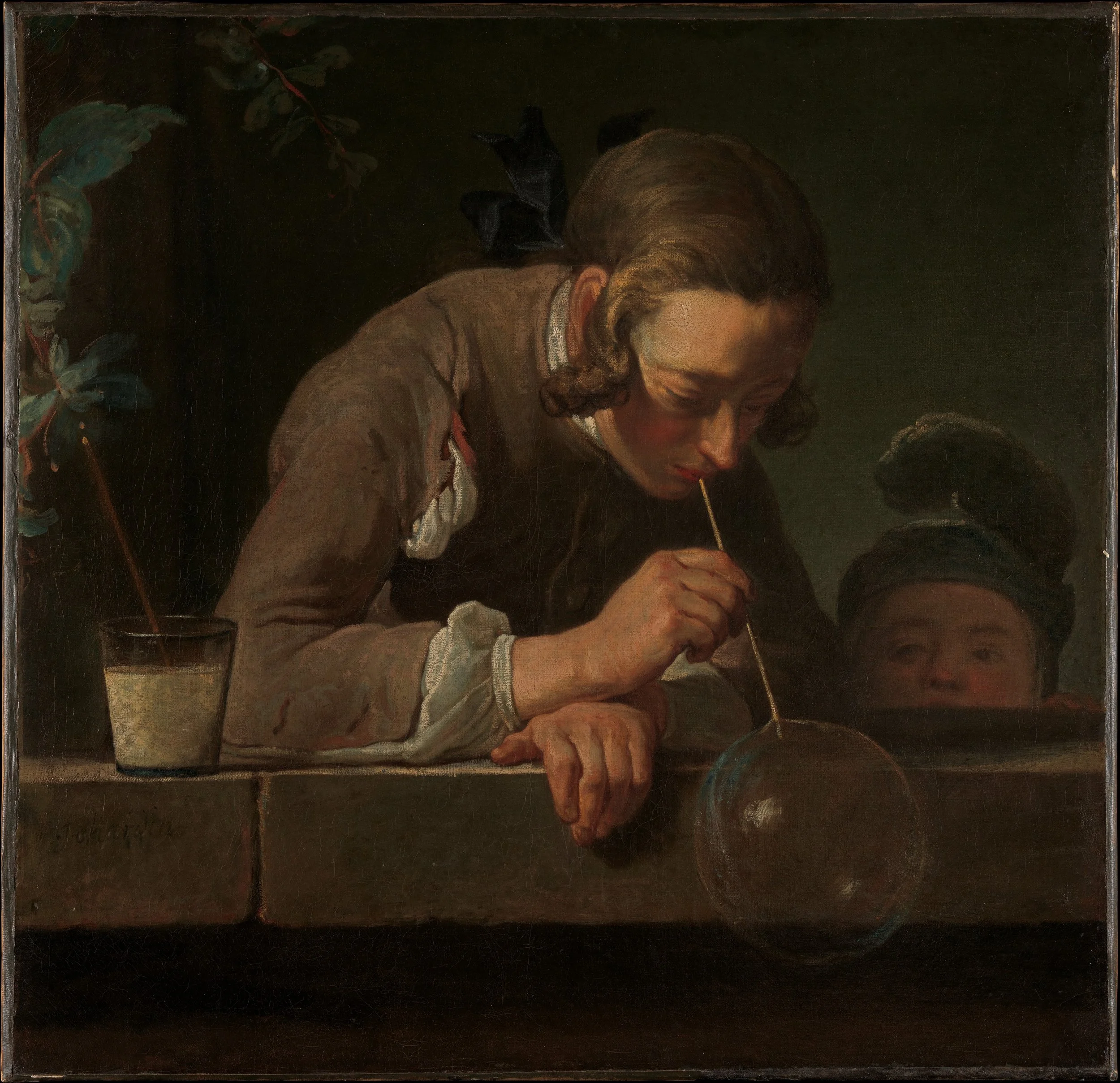
Jean Siméon Chardin, Soap Bubbles, c. 1733-34. Courtesy of the Metropolitan Museum of Art.
At the Met I found Jean Siméon Chardin’s Soap Bubbles to be a highly poetic genre scene, turning an ordinary childhood pastime into a quiet meditation on observation and time. The composition shows a boy leaning out of a window ledge, carefully blowing a bubble through a simple straw. His expression is focused but serene, and the half-shadowed setting intensifies the sense of stillness. Chardin’s handling of light is especially striking: the soft illumination catches the fragile surface of the bubble, giving it a shimmering presence that contrasts with the muted tones of the interior. Every object—the stone ledge, the small glass vessel, the boy’s clothing—is painted with a gentle realism that feels both tangible and calm. The work doesn’t overwhelm viewers; instead, it lingers, asking you to notice fragility, transience, and the quiet beauty in ordinary moments. Isn’t it remarkable how a fleeting bubble can hold our attention longer than the many solid, lasting things around it? One could imagine the boy as an allegorical self-portrait of the artist at work. Just as the bubble forms from a mixture of soap and water, Chardin’s brushstrokes blend pigments with fluidity. Luminous flesh tones emphasize the boy’s points of touch and sight: the hand guiding the bubble and the face intently focused. The evanescent bubble parallels the processes of seeing and painting: both are fleeting and in constant transformation. As the boy shapes the bubble with careful breath, the artist negotiates pigments on the canvas. The eye perceives form in a temporal instant. Each moment is dependent upon timing of sight and hand, of mind and brushstroke. In this sense, the painting becomes a meditation on the interplay of perception, touch, and methodical labor in the production of art. Each gesture exists momentarily before moving into something new. By integrating observable realism and our imagination, Chardin’s Soap Bubbles encourages reflection on the delicate intersection of material, vision, and time at the heart of artistic practice, where each work emerges from process rather than as a fixed outcome. The ordinary and the allegorical coexist in this painting. Within the gallery titled Outside Court Strictures, for a moment I felt I was outside the formalist strictures of Fra Carnevale, Botticelli, Raphael, and Bronzino. This painting by Chardin felt much closer to those of Vermeer I had just seen.
Letter as Canvas
The Love Letter by Makenzie Parrish
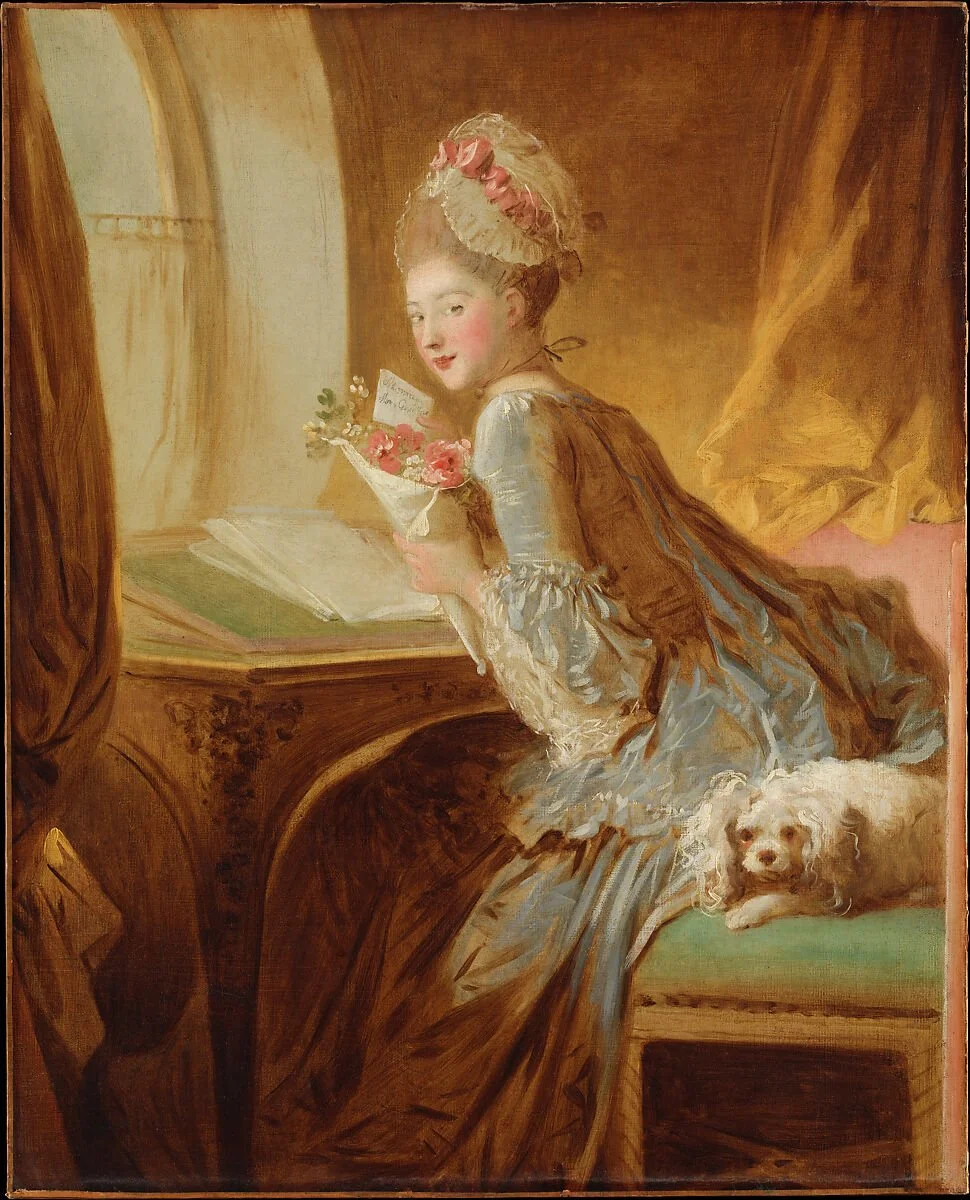
Jean-Honoré Fragonard, The Love Letter, early 1770s. Courtesy of the Metropolitan Museum of Art.
Jean-Honoré Fragonard’s The Love Letter presents a world where likeness and abstraction press against each other, inviting a phenomenological engagement reminiscent of Maurice Merleau-Ponty, where perception is enacted through the body as well as the eye. The surface dazzles with strokes of brown, gold, yellow, beige, grey, pistachio, and pink. These strokes shape the sitter, yet they also assert their own material life. The young woman’s face, illuminated but never secured by contour, flickers between presence and disappearance; she feels less like a fixed subject than a figure rising out of light. Her lively, direct gaze anchors the scene, while the looseness of Fragonard’s hand keeps her in motion, as though the act of painting has not fully closed around her. The surrounding details—the soft cushion, the gleaming fabrics, the tremor of fur on the dog—share this restless immediacy, each mark declaring itself as both representation and paint. This doubleness produces a phenomenological encounter in which seeing becomes an embodied act: the viewer senses the sitter through the rhythm of the brush as much as through her depicted features. In this way, the portrait turns toward the painter himself. The freedom, speed, and luminosity of the handling record his presence as vividly as the sitter’s. The painting becomes a kind of self-portrait, not of his face but of the optical and tactile registers of his perception. These registers are shaped into material form through the very process of glancing and painting, where the surface becomes the site of his presence. The letter the woman holds echoes this logic. It stands as a metaphor for the work itself, a message now being delivered through touch and color rather than language. In The Love Letter, sitter, painter, and medium converge, and the painting reveals itself as both an image of desire and a record of the act that made it.