Line, Light and Thought
Encounters at the Met on November 23, 2025
Students of the School of Visual Arts entered the European Painting Galleries at The Metropolitan Museum of Art and encountered works that demanded sustained looking and interpretive rigor. The paragraphs gathered here reflect their firsthand engagement with these paintings, bringing together description, historical context, analytical inquiry, and critical commentary, all with a stance of reflexive critique and open discussion. Guided by Heinrich Wölfflin’s foundational Principles of Art History and Laurie Schneider Adams’ comprehensive yet accessible A History of Western Art—with its methodological approaches of formalism, iconography, feminism, Marxism, biography, semiology, deconstruction, and psychoanalysis—each student developed a focused reading shaped by their own encounter with the object. The results form an exploratory dialogue linking student, artwork, and reader, offering concise glimpses into the Met’s vast holdings, from Fra Carnevale’s structurally complex Birth of the Virgin to Watteau’s enigmatically contrived French Comedians.
—Raphy Sarkissian
The Mathematical Eye
By Kaili Ortiz
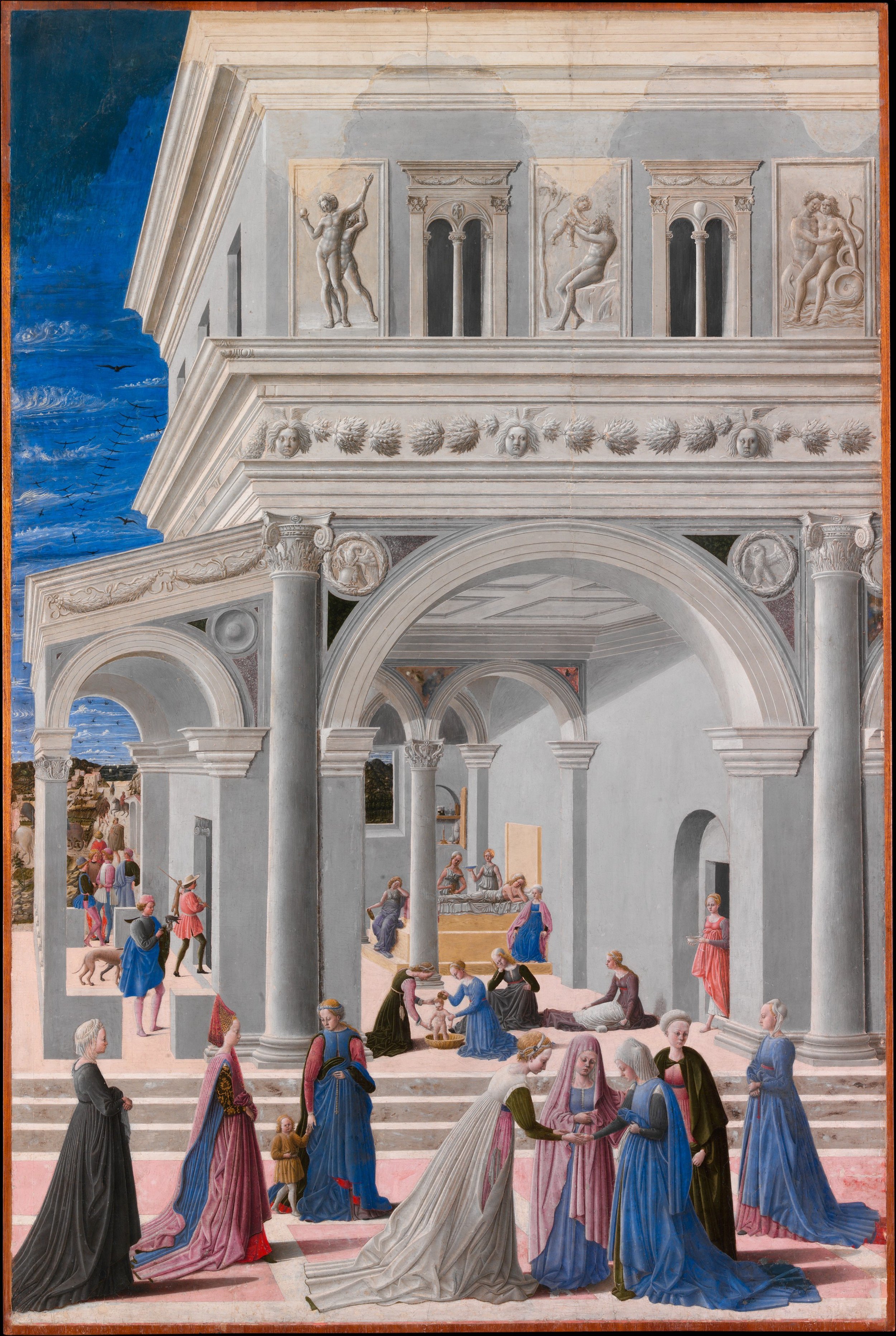
Fra Carnevale, The Birth of the Virgin, 1467. Courtesy of the Metropolitan Museum of Art.
Architecture, antiquity, and elegance. Standing before Fra Carnevale’s 1467 eye-catching and formally rigorous painting The Birth of the Virgin at the Met, my attention was immediately drawn to the concepts of the Early Renaissance—that crucial time when art began to be developed on both a theoretical and practical level, pioneered by Filippo Brunelleschi around 1425 and formalized by Leon Battista Alberti in his seminal treatise De pictura (1435). Carnevale, working approximately four decades after this invention, applies this mathematical approach with precision. This precision, when viewed closely, immediately recalls Brunelleschi’s experiments, where the stability of architecture is set against the movement of the clouds. The commanding presence established by the women's sumptuous fabrics, with their architectural folds and fluid cascade of robes, creates a fascinating dialogue of rich pinks and blues. This visual study of volume and weight, which seems almost lifted from a Vogue magazine of its time, is a deliberate contrast with the flatter, patterned style of the Italo-Byzantine period. Moments later, I contrasted the work with Berlinghiero's panel, located a few galleries away, and Cimabue’s much flatter Madonna Enthroned of the Uffizi. Carnevale’s use of drapery here conveys volume and chiaroscuro, directly opposing the earlier focus on linear patterns and gold abstraction. The illusion of three-dimensional reality is here achieved by the perspective system, which meticulously organizes the unfolding narrative: St. Anne's delivery in the background, the washing of newborn Mary in the middle ground, and the material figures engaging the viewer in the foreground. Seen through the lens of Heinrich Wölfflin’s Principles of Art History, the painting’s firm outlines and clearly separated figures stand out. These features sharply contrast with the emotional sweep and blended color of Peter Paul Rubens’ Holy Family with Saints Francis and Ann, which I encountered a few minutes later in the gallery “Flesh and Spirit in the Age of Rubens.” As Wölfflin notes, “linear sees in lines; color sees in masses.”
Surreal Perspective
By Mariel Weitsman
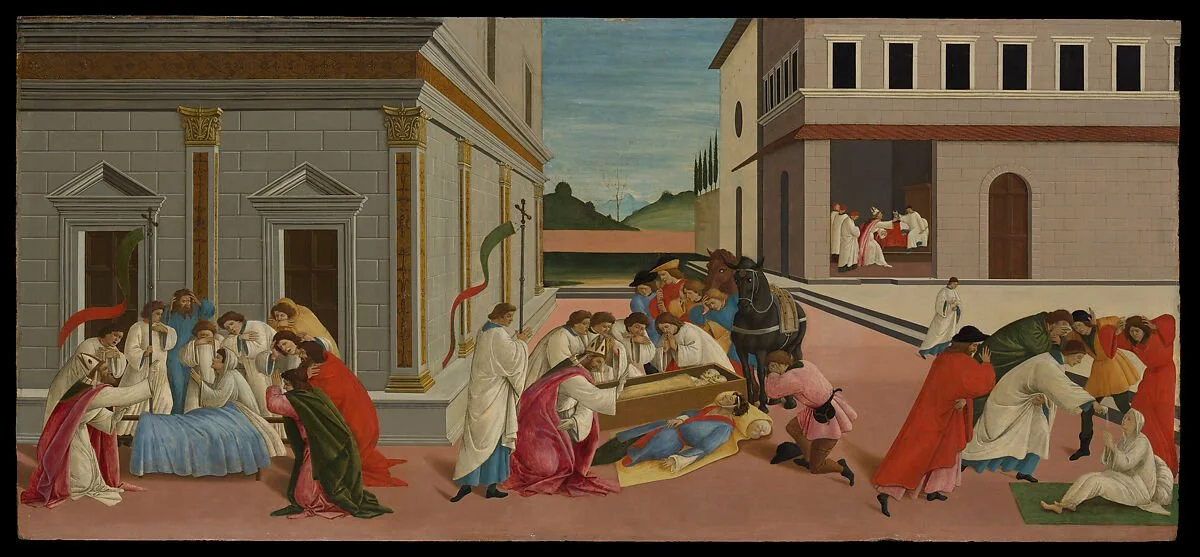
Botticelli, Three Miracles of Saint Zenobius, c. 1500. Courtesy of the Metropolitan Museum of Art.
Upon seeing Botticelli’s Three Miracles of Saint Zenobius (c.1500), I felt the painting’s weightless clarity make its four episodes of resurrection seem suspended between narrative and vision. As I looked more closely, I noticed how the streets and architectural settings are rendered with unusual spareness: aside from the clustered figures, the background remains strikingly empty, creating for me a surreal atmosphere that separates the sacred event from everyday Florentine life. This simplicity allowed Botticelli’s highly linear style—what Wölfflin defines as the Renaissance preference for contour, clarity, and separable forms—to stand out with particular force in my experience of the work. As I followed the perspectival recession, organized through principles that stem from Brunelleschi’s discovery and Alberti’s codification of pictorial space, my eye was drawn toward the central vanishing point, where a single leafless tree stands. I read this centered perspective as echoing the structural logic of Masaccio’s The Tribute Money, where linear depth establishes the illusion of architecture and the natural world with theological purpose. I also recognized that trees in Christian imagery often symbolize cycles of death and renewal, yet what gave this one its force, to me, was not only that symbolism but its strategic placement within the perspectival field. Rather than experiencing the painting as a simple continuous narrative of four episodes from the saint’s life, I found Botticelli using linear precision, architectural alignment, and spatial clarity to shape the miracles within a measured visual world—one that, in my view, reflects both the authority of the Church and the intellectual ambitions of early Florentine painting, reminding me how essential architecture was for constructing Renaissance illusion.
Toward the School of Athens
By Yifan Wang
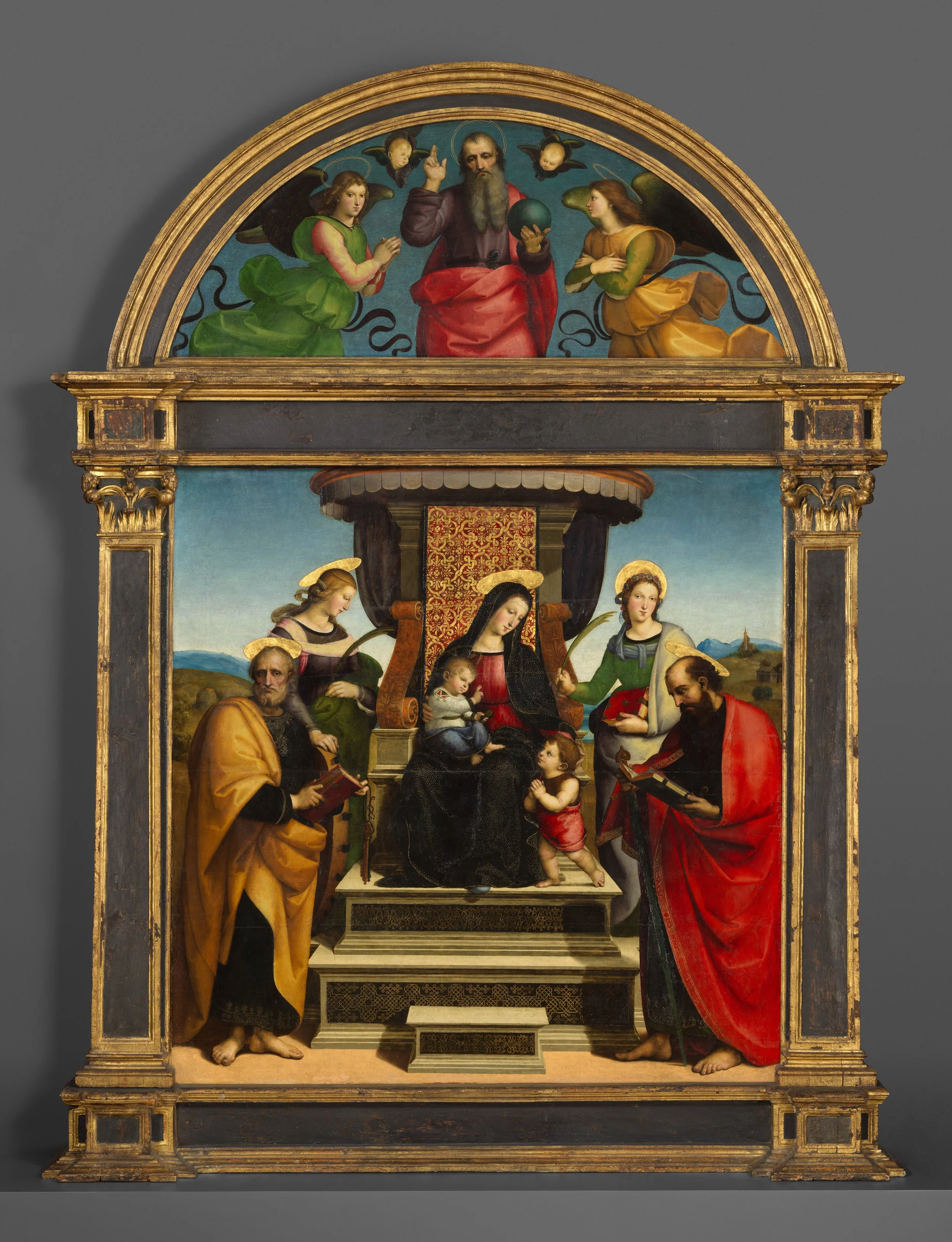
Raphael, Madonna and Child Enthroned with Saints, c. 1504. Courtesy of the Metropolitan Museum of Art.
Entering the gallery Sacred Images and the Viewer at the Met, the gold dots in Raphael's Madonna and Child Enthroned with Saints (c. 1504) brought to my mind the pointillism in Seurat’s A Sunday on La Grande Jatte. Though separated by four centuries, both painters use discrete points—Raphael through decorative gilding, Seurat through pointillist chromatic units—to construct perceptual form. In Raphael’s case, these gilded points operate as a modeling device that echoes earlier precedents in Cimabue’s Santa Trinità Maestà while simultaneously anticipating a modern interest in the mechanics of vision. From this shimmering surface treatment, the painting opens onto the lineage that anchors it: the Trecento and Quattrocento foundations Raphael both inherits and transforms. Comparing the altarpiece to Giotto’s Ognissanti Madonna clarifies the transition from Early to High Renaissance technique. Giotto first pioneered volumetric modeling and placed the Madonna upon a receding throne; Raphael advances this legacy through the soft transitions of sfumato, heightened realism, and an expansive landscape that articulates foreground, middle ground, and distance. His idealized figures show the imprint of Classical antiquity, yet he preserves elements of Byzantine splendor, creating a dialogue between tradition and innovation. The work’s spatial structure—its figures, throne, and landscape—unfolds through a rigorously organized geometric system rooted in Brunelleschi’s discoveries and exemplified in Masaccio’s Holy Trinity. What emerges is a vision of the world rendered coherent, stable, and intelligible through humanistic principles. For me, the central panel feels like a window onto not only sacred narrative but also onto the three foundational treatises of Alberti on painting, sculpture, and architecture. I realized then that Raphael’s altarpiece became more than a devotional image: unquestionably, it was a step on the path toward his definitive School of Athens, where artists would be staging the past just as we attempt to stage them now.
Turquoise Clouds and Entangled Bodies
By Savanna Fisher-Torres
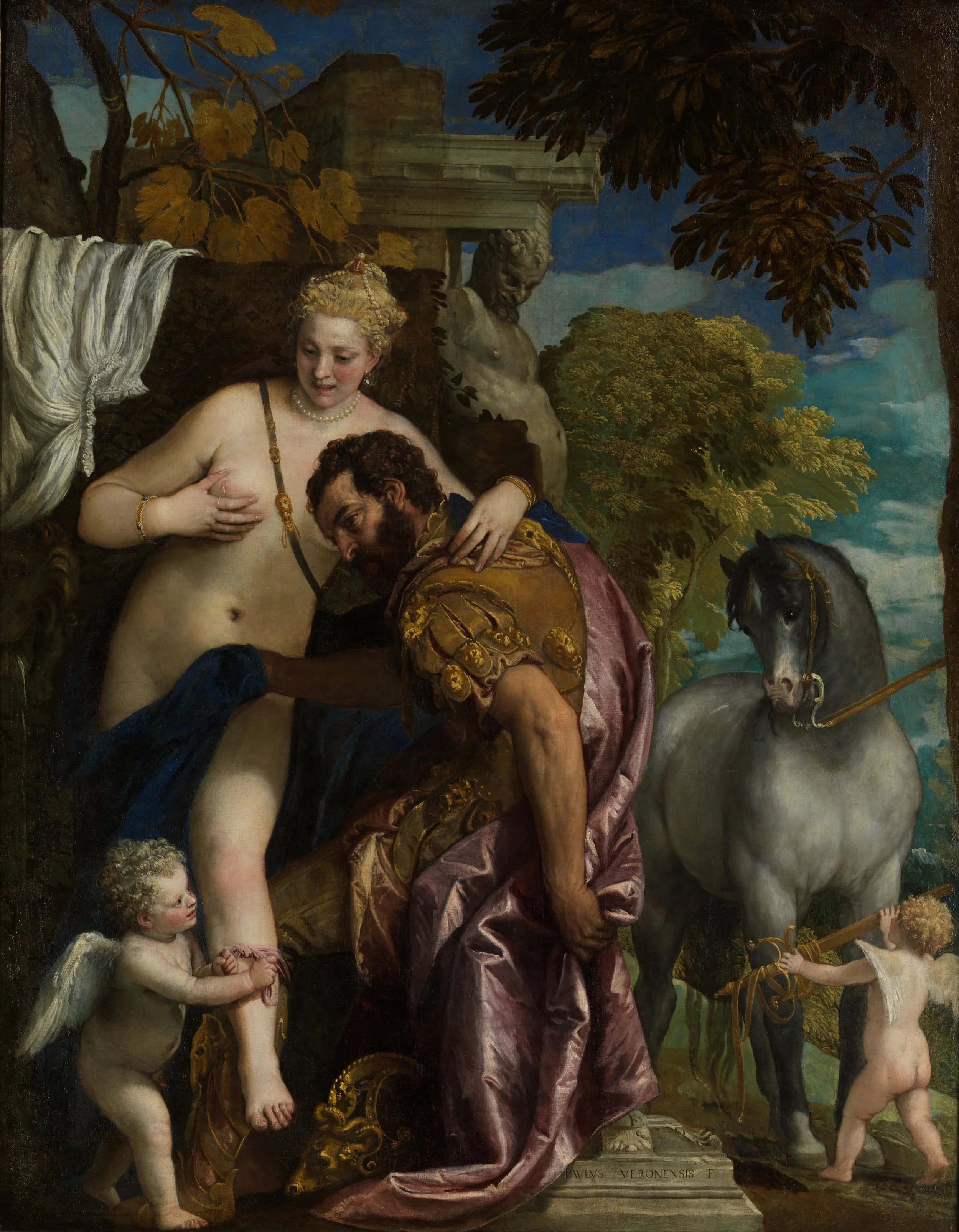
Paolo Veronese, Mars and Venus United by Love, 1570s. Courtesy of the Metropolitan Museum of Art.
Upon standing before Paolo Veronese’s Venus and Mars in the gallery titled Faith and Love in Venice, I realized that what first drew me in was not only the unapologetic sensuality of the scene but the way Veronese stages that sensuality formally. Venus, nearly nude, leans away from Mars’s attempt to cover her, while Cupid mischievously ties Mars’s cloak to her ankle—a small but decisive action that gives the moment its sense of inevitability. Simultaneously, Venus lifts her right breast, and a few drops of milk appear to fall from it, a tender gesture associated in Renaissance art with the nourishing and civilizing power of love—linking sensuous desire to care, abundance, and the softening of Mars’s warlike nature. Examining the painting, I moved between formalism, iconography, and early feminist lenses, considering how the contrast between Venus’s exposed body and Mars’s rigid garment heightens the dynamic between power and desire. The force of the scene lies as much in its visual structure as in its symbolic content. In Wölfflin’s terms, Veronese’s signature Venetian painterly style—glowing skin tones, soft transitions, and atmospheric depth—contrasts with the firmer architectural lines behind them, which creates a lively interplay between contour and recession. The diagonal sweep of Venus’s body and the taut pull of Mars’s cape guide my eye across the canvas, emphasizing movement and emotional tension rather than static harmony. Even Cupid’s intervention becomes part of this rhythm: his knot acts as a pivot around which the composition turns. The surrounding architecture casts pockets of shadow that heighten the sense of secrecy, reinforcing the feeling that I am witnessing a private moment I was never meant to see. Seeing the painting poised between Wölfflin’s categories of the linear and the painterly—between Renaissance clarity and the atmospheric fullness that would define the Baroque—I realized that its most urgent question was not stylistic but thematic: Does Veronese frame sexuality and romance as choices made by individuals, or as the inescapable workings of fate?
Philosophy of Forms
By Emma Shanahan
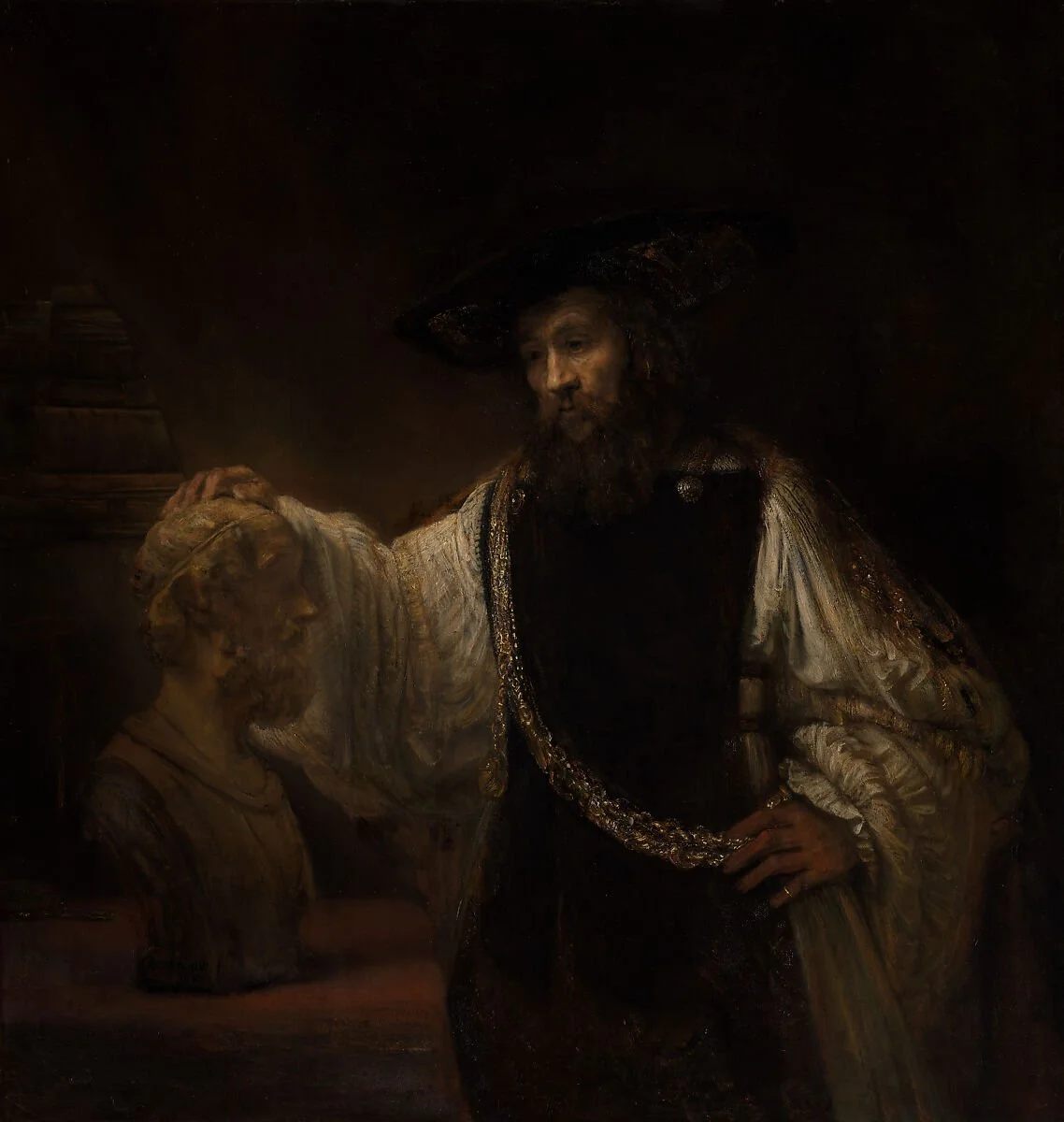
Rembrandt, Aristotle with a Bust of Homer, 1653. Courtesy of the Metropolitan Museum of Art.
A diagonal shaft of light illuminates the subjects in Rembrandt’s Aristotle with a Bust of Homer, bathing the scene in a gentle golden glow. Set in a gallery dedicated to Rembrandt, for me personally this painting gave the impression it was made to be the centerpiece. Acknowledging the debated title, Rembrandt illuminates Aristotle and the bust, granting the philosopher a mythic status comparable to the heroes Homer immortalized. His mastery of tenebrism is evident: the painting is theatrical, dramatic, and exceptionally well-rendered. The skin is rich with life, the delicate fabrics are fluid, and Aristotle’s gold adornments glitter amidst the darkness. The pure darkness gives a sense of depth, and the figures feel lifted off the abstracted background. With figures dramatically illumined within a selectively lit space, the work presents an intriguing dichotomy between two mediums: sculpture and painting. Sculpture is fundamentally spatial and tangible, occupying volume and physically sharing the viewer's three-dimensional field, qualities a two-dimensional image cannot emulate. In essence, sculpture replicates three-dimensional models that exist in the world's space through three-dimensional materials; painting, by contrast, replicates merely the visible surfaces of those three-dimensional models from a given point of view upon a flat, two-dimensional surface. Because painting is restricted to a single, optical surface, it suspends the continuous flow of the three-dimensional world, capturing a single moment outside of time—here an image in highly reflective oil so close and yet so far from that in perception. Here Rembrandt's approach, characteristic of the Baroque movement and its emphasis on a unified "flow of the whole" as defined by Wölfflin, prompts an inquiry into how painting can truly depict reality. Although highly illusionistic, Rembrandt's embrace of a painterly representation shifts the work's focus.* His use of rich impasto and expressive brushwork creates a soft, hazy ambiance, providing a look into an intimate scene. The subject, Aristotle, a mortal man reflecting on his lasting impact, stands opposite Homer, whose literary achievements are permanently enshrined in stone. Via the medium of the canvas, Rembrandt bestows a degree of immortality upon Aristotle as well. This work, through its stylistic unity, stages a fundamentally formalist reflexive discourse between two distinct mediums—sculpture and painting—recontextualizing the titular narrative that has been interrogated.
*Heinrich Wölfflin, Principles of Art History: The Problem of the Development of Style in Early Modern Art, trans. Jonathan Blower (Los Angeles, CA: Getty Publications, 2015), p. 235.
Rubens: Anachronism, Visuality, Color
By William Avril
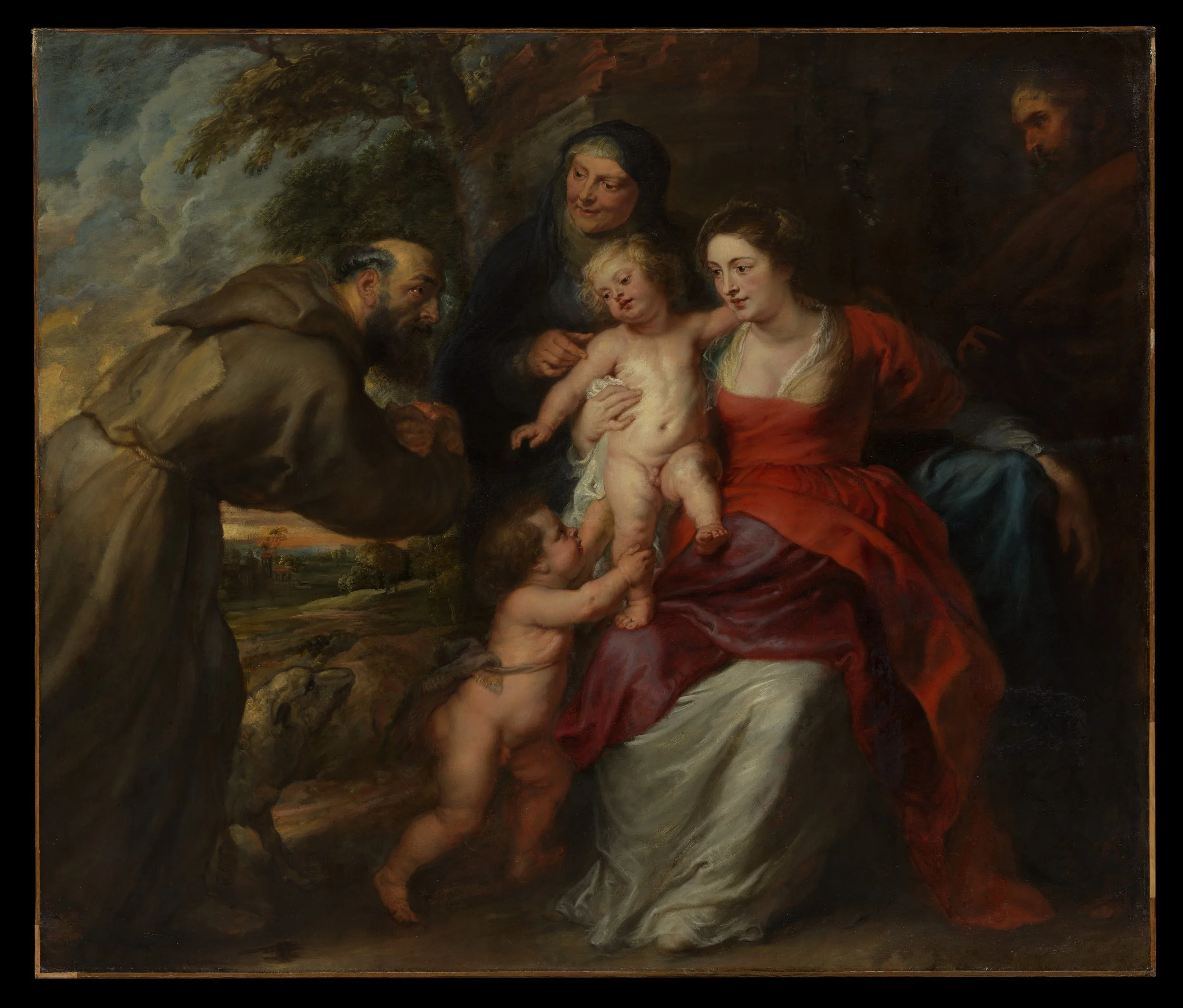
Peter Paul Rubens, The Holy Family with Saints Francis and Anne and the Infant Saint John the Baptist, early or mid-1630s. Courtesy of the Metropolitan Museum of Art.
Upon entering the Metropolitan Museum of Art and stepping into the Flesh and the Spirit in the Age of Rubens gallery, I encountered Rubens' The Holy Family with Saints Francis and Anne and the Infant Saint John the Baptist (1630–1636). My immediate questions centered on representation: If painting is fundamentally a form of representation, what exactly is Rubens representing here? I realized he is simultaneously representing an anachronistic religious event in which the Virgin Mary, Saint Anne, and the infant John the Baptist—figures of the first century—appear alongside Saint Francis of Assisi, who lived more than a millennium later. Rubens is also representing the very visual philosophy of his time, what Wölfflin phrases as painterly, recessive, open, unitary, and relatively clear. This Baroque worldview seems to have shifted from an idealized representation of external reality to the representation of the visual image as it forms within perception and, ultimately, the process of sight itself. Considered through this lens, and using the methodology of formalism and phenomenology as a guide, one might then ask what motivates Rubens to depict the vibrant clothing against the highly abstract, opaque background. I saw that bright colors and tenebristic luminosity selectively dominated his vision, indicating that the human optical faculty is drawn to a specific area of observation that is in focus while all else becomes out of focus at a given moment in time. This selective focus, combined with the abstract background, fundamentally represents a crisis of stable perspectival representation that destabilizes the image’s claim to unified space and fundamentally shifts the idealized definition of space characteristic of the Renaissance. The relationship between Rubens’ method and Wölfflin’s categories led me to consider why this painting so decisively favors the painterly over the linear and recession over the plane. I began to see that Rubens’ style evokes both the very process of seeing and that of painting, highlighting faces, hands, and human flesh. Ultimately, this painting of Rubens unmistakably demonstrates that our visual point of focus and the formation of imagery within our perception is a function of what light and color manifest at a given moment in time—the transience of visual perception. Here, the transience of perception meets the painting’s iconological and iconographic anachronisms, placing Saint Francis before an illuminated landscape and the Madonna within Baroque darkness. In the end, it is the painting itself that binds their disparate eras into a single perceptual moment.
Classical and Political
By Seongho Lee
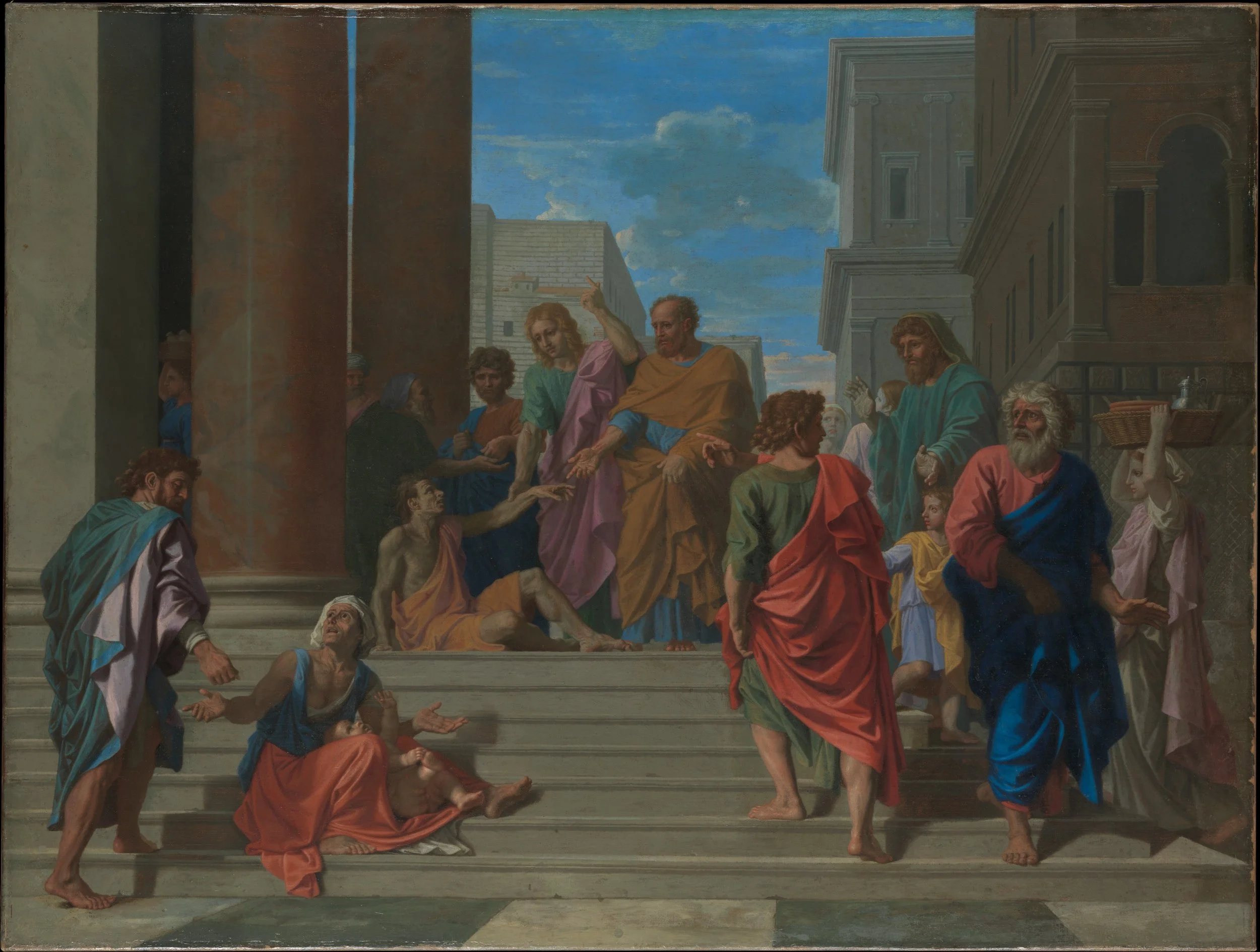
Nicolas Poussin, Saints Peter and John Healing the Lame Man, 1655. Courtesy of the Metropolitan Museum of Art.
I find the rational discipline of Nicolas Poussin’s classicism to be an act of symbolic resistance against the prevailing Baroque painterly syntax. In Saints Peter and John Healing the Lame Man (1655), Poussin constructs his pictorial space using three essential elements: architecture, human figures, and the sky. The composition masterfully maintains the stable, ordered structure of the High Renaissance, a choice implicitly resonant with the artist's personal circumstances during his self-imposed removal from France to Rome. This formal order provides a moral and ethical refuge, countering the emotional excess of the Baroque period. Monumental architecture, dominating the foreground with strong vertical and horizontal lines, displays Poussin’s mastery of Alberti’s perspective system. Right behind these forms, the sky is rendered with dramatic cloud movement, an element that recalls Brunelleschi’s revolutionary, theoretical acknowledgment of the transient, unmeasurable nature of atmospheric forms. Yet, the sky's volatility is subdued as a result of the architecture's stability and dominant role in the composition, clearly subordinating chaos to the rational tenets of Classicism. The figures feel solid and sculptural, their linear style directly opposing Baroque dynamism. The dramatic expressions on individual faces create a powerful tension that is ultimately stabilized by the overall classical framework. This structural emphasis, in contrast with the strongly illuminated drapery, reflects Poussin’s French audience's specific political and aesthetic concerns: they sought rational art as a means of settling the political turmoil in France. The painting, therefore, becomes Poussin’s powerful, tacit allegory of Stoic restraint against the volatility and emotional excesses of the French court he had abandoned.
Rococo Theatricality
By Maahit Preshant Jain
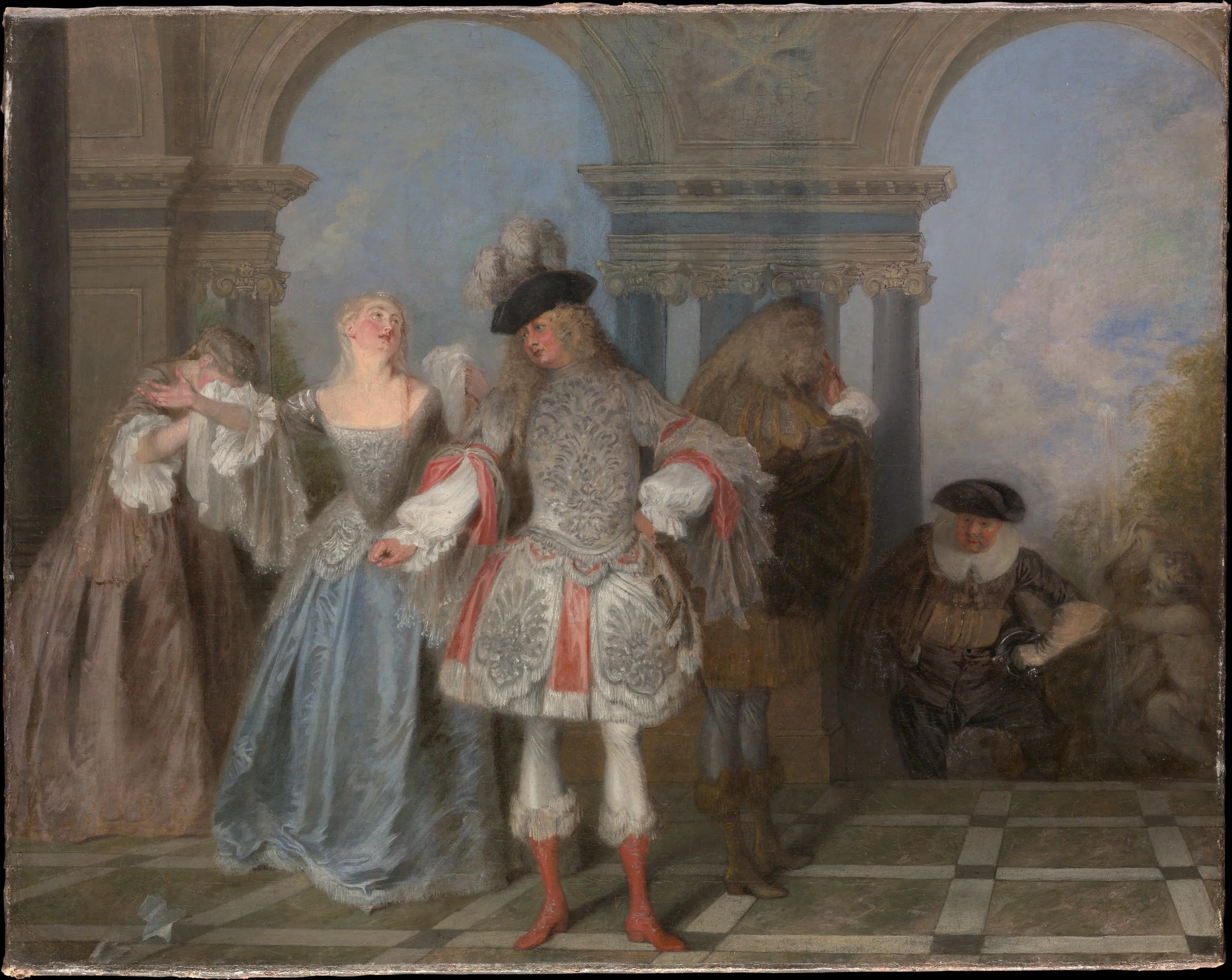
Antoine Watteau, The French Comedians, c. 1720. Courtesy of the Metropolitan Museum of Art.
Standing before Antoine Watteau’s The French Comedians of around 1720 in the Met’s Outside Court Strictures gallery, I was attracted to the tension between spectacle and gentle critique that Watteau orchestrates. The painting presents a carefully composed interplay of figures and setting: the richly attired performers in the foreground exude refinement and status, their costumes and gestures echoing the aristocratic ideals of Louis XIV’s court. Infrared reflectography shows the preparatory underpainting, emphasizing the careful construction of this social stage. Here, Watteau’s brush teeters between homage and wistful observation. The lavish and commanding frame reinforces the visual rhetoric of aristocratic authority while simultaneously setting the stage for subtle mockery. A quiet sarcasm is embedded in the composition: the very figures who embody the prevailing social hierarchy are also positioned as participants in a performance whose meaning extends beyond mere flattery. This tension—between reverence for and critique of antiquity and aristocracy—resonates across Watteau’s oeuvre, linking this work conceptually to his Pilgrimage to Cythera. Perhaps the center of attention is not the object of true admiration but a carefully staged commentary on how power and prestige are perceived by the public. Watteau’s work is not a simple celebration of aristocratic life; it is a subtle choreography of symbols, theatricality, and social critique—a precursor to the tensions that would later unfold in revolutionary France. The painting integrates clear formal criteria: Albertian perspective in the foreground, Wölfflin’s planar-recessive dialogue, and emotive brushwork and atmospheric effects that mark it as a precursor of Impressionism. Its structural subtlety and psychological depth, seen in its staged figures, also foreshadow the theatricality of such contemporary painters as Lisa Yuskavage. This highly curated gallery setting, painted in a rich sky blue, acts as a final layer of theater, ensuring the context of viewing is as complex and intentional as Watteau's composition itself.
Society and Sight
By Ana Alvarez Luz
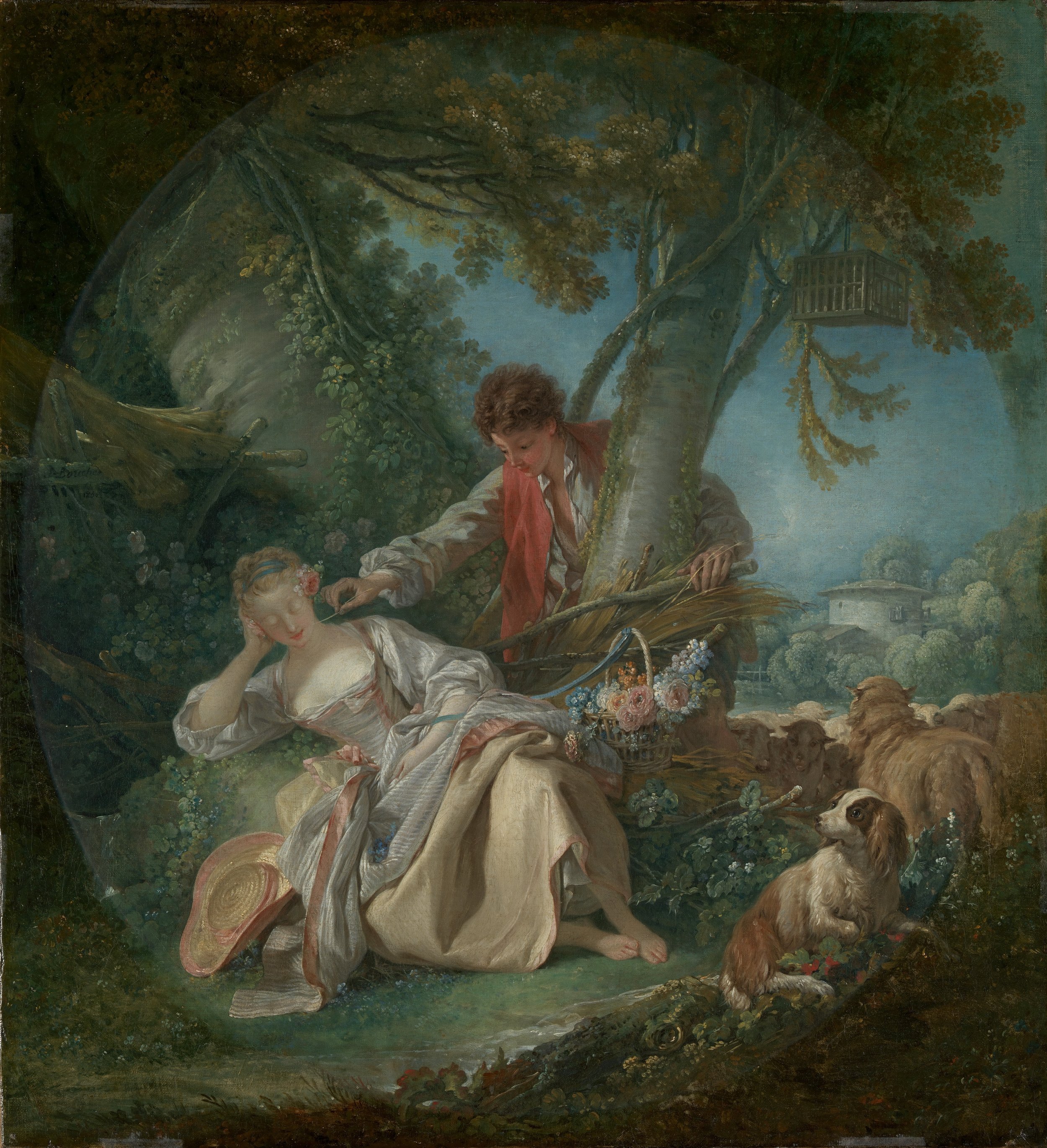
François Boucher, The Interrupted Sleep, 1750. Courtesy of the Metropolitan Museum of Art.
Within the Urban Luxuries of the Met Museum, I came across François Boucher’s The Interrupted Sleep, a painting in which the circular, vignette-like scene immediately captured my eye. The work drew me in not only for its quiet social critique but also for the way its visual structure relates to the act of seeing itself. As the museum caption notes, Boucher set aside the “dirt and labor of peasant life” in favor of elegant costumes and soft romance—visions shaped by pantomime and by the aristocracy’s own fantasies of rustic ease. In this scene, the shepherd’s spotless clothing and the young woman’s relaxed pose suggest not actual rural life but a courtly invention of it, the same impulse that would later animate Marie Antoinette’s faux-rustic hamlet at Versailles. What deepened my sense of this fantasy was the painting’s rounded, vignette-like format, which recalls the natural curvature of human sight, enclosing the scene in a way that makes the idyll feel complete, as though its softness were shaped by the act of looking. The relationship between their two bodies—her reclined position and his forward lean—tightens the scene’s small drama, while the pastel palette softens the tension it creates. I kept thinking about how none of this means Boucher anticipated the political ruptures to come—he was producing a luxury object for Madame de Pompadour’s Château de Bellevue, admired at the Salon of 1753 and perfectly aligned with the tastes of its time. Yet from my contemporary vantage point, the scene’s elegance makes clear how easily pleasure can mask what it leaves out. In that moment at the museum, the work felt less like an escape from reality than a delicately constructed veil over it, allowing me to see how fantasy and contradiction coexist within the same pictorial space. Perhaps this contradiction is even more apparent in later modifications of the work, where the delicate oval idyll is awkwardly squared off by non-Boucher additions, a visual dissonance that throws the original function of the “constructed veil” into stark relief.