I. Reality, Retina, and Relief
Encounters at the Met on February 10, 2026
Students from the School of Visual Arts entered the Egyptian and Greco-Roman galleries to examine the relationship between works of art and perception. The following texts document their engagement with the relief sculptures and paintings, tracing a set of formal and perceptual parameters within the museum's collection.
The primary framework for this inquiry is the shift from the tactile to the optical—a central tenet of the Vienna School of Art History. Introduced here as one working lens among others, this framework allows students to consider how surfaces are not only shaped but seen. As Benjamin Binstock notes, “Riegl follows a progression from the near view and tactile, static, volumetric, and symmetrical forms in Egyptian art, through the normal view and delicate balance of idealism and naturalism in classical Greek art, to the far view and optical, subjectively perceived, dynamic, and transient forms in Hellenistic and Roman art.”¹ These stylistic shifts represent fundamental changes in how human perception processes the surface: moving from the tactile and objective surfaces of the ancient Egyptian relief to the optical and subjective spaces of the Late Roman relief.
Each analysis is further informed by select engagements with the scholarship of Erwin Panofsky, Helen Gardner, H.W. Janson, Hugh Honour and John Fleming, Marilyn Stokstad, and Laurie Schneider Adams. By focusing on the physical reality of a given work of art—from the precise, low-relief outlines of the Old Kingdom to the deep undercutting and illusory depths of Late Roman art—these readings explore how the treatment of surface mediates the simultaneous interplay between material presence and optical illusion. This engagement assumes a degree of disciplinary liberty, positioning the formal requirements of the studio alongside the established boundaries of art historical inquiry.
These texts are offered as exploratory studies rather than definitive interpretations, as the identification of complex iconography remains open to further refinement and dialogue.
¹ Benjamin Binstock, "Foreword: Alois Riegl, Art History, and Theory," in Historical Grammar of the Visual Arts by Alois Riegl, trans. Jacqueline E. Jung (New York: Zone Books, 2004), 26.
Status: Technical Information & Bibliographic Verification in Progress.
II. The Studies
Will Baker | The Tactile Niche of Akhtihotep
Christina Mei | Formalism, Iconography, and Self-Reflexivity
Tan Nhat Nguyen | Space, Surface, and Hand
Kaizhong Tan | Surfaces: Toward the Optical
Steffany Yalong | The Luminous Wall
Yiping Zhao | Rhythmic Surface
Ziyan Zhong | The Severed Song: The Subjective Surface
III. Postscript
A Multiplicity of Narratives
The Tactile Niche of Akhtihotep
By Will Baker

Corner of niche from the tomb of Akhtihotep, ca. 2575–2551 BCE. Courtesy of the Metropolitan Museum of Art.
Standing in the corner niche of Akhtihotep in Gallery 103 of the Metropolitan Museum of Art, I observe a surface that refuses to recede into the distance. The museum has preserved two relief blocks forming a corner that portrays Akhtihotep in a dualistic narrative of ritual movement: on the left, he wears a panther-skin garment (the tail hanging between his legs) as he appears to emerge from a double-recessed false door, while on the right, he wears a standard kilt as he enters it. Despite this depicted movement, there is no attempt to create a "window" into another space; instead, the limestone wall presents itself as a dense, carved expanse where every figure is bounded by a crisp, shallow relief. I notice that the artist has treated the stone not as a medium for atmosphere, but as a physical barrier—an objective presence that remains constant regardless of my position. This sense of permanence is governed by a strict Canon of Proportion, an invisible grid where, as Laurie Schneider Adams notes, the foundational unit is the clenched fist. By adhering to the ancient law of 17 units from the sole of the foot to the hairline, the sculptor employs a rigorous abstraction, moving away from the anatomical complexities of the human body in favor of a permanent, mathematical structure.¹
This mathematical objectivism is reflected further in the composite view, where the profile head and frontal torso represent the "total" person rather than a fleeting, perspective-based glimpse. As Erwin Panofsky suggests, the Egyptian artist deliberately set aside the influence of organic movement and perspective foreshortening to ensure that the representation of the body matched its objective reality. This prioritization of a permanent material reality over the unstable image on the retina aligns with what Alois Riegl describes as the haptic will. As Riegl writes, "The sense of sight is unable to penetrate objects; it apprehends in a given thing merely the one surface that happens to be turned toward the viewer. That is to say, the eye perceives not a three-dimensional form but a two-dimensional surface; it sees height and width but not depth. To convince ourselves of the actuality of depth, we must call on another sense, the sense of touch, or tactile sense."² By maintaining the relative proportions of the human figure objectively, the sculptor represents Akhtihotep as a well-defined physical reality that sidesteps the ambiguities of measurement due to perspective and movement of the observing eye.
Beyond these proportional laws, the surface is defined by a notable absence of shadow, implying that the passage of time and the direction of sunlight were deliberately ignored. By maintaining this shadowless clarity, the sculptor ensures that the form retains its materiality rather than dissolving into a fleeting visual impression. This clarity stands in sharp contrast to the works in the later Greek and Roman galleries, such as the Grave Stele of a Little Girl (Gallery 154), where the stone begins to yield to perspective and the foreshortening of form. Even more radical is the transition found in the Sarcophagus of Dionysus (Gallery 162), where deep undercutting gives way to a rivalry of luminosity and darkness. In the niche of Akhtihotep, however, the boundaries remain absolute. By refusing to dissolve its material edges into shadow, the relief stands as a pure expression of the objective will, existing independently of the spectator's shifting retinal experience.
Behind the sculptural figure stands the original sitter, whose living body the canon of proportion sought to preserve intact, free from the distortions imposed by a given point of view. This prioritization of the material reality of the sculptural figure over the unstable retinal image manifests a single instance of what Riegl terms Kunstwollen. The concept names the collective artistic will of a civilization, irreducible to individual intention or technical capacity. It drives each historical period toward its own inevitable mode of visual representation. So foundational to the study of ancient art, it risks becoming a critical reflex. Yet here it finds its most precise application: the Egyptian sculptor's will toward the haptic, the bounded, and the objective. In the niche of Akhtihotep, that will is unambiguous: to render the human figure as an absolute, measurable fact, independent of the contingencies of light, shadow, and the eye.
1. Laurie Schneider Adams, Art Across Time, 2nd ed. (New York: McGraw-Hill, 2002), p. 92.
2. Alois Riegl, Historical Grammar of the Visual Arts, trans. Jacqueline E. Jung (New York: Zone Books, 2004), p. 395.
Formalism, Iconography, and Self-Reflexivity
By Christina Mei
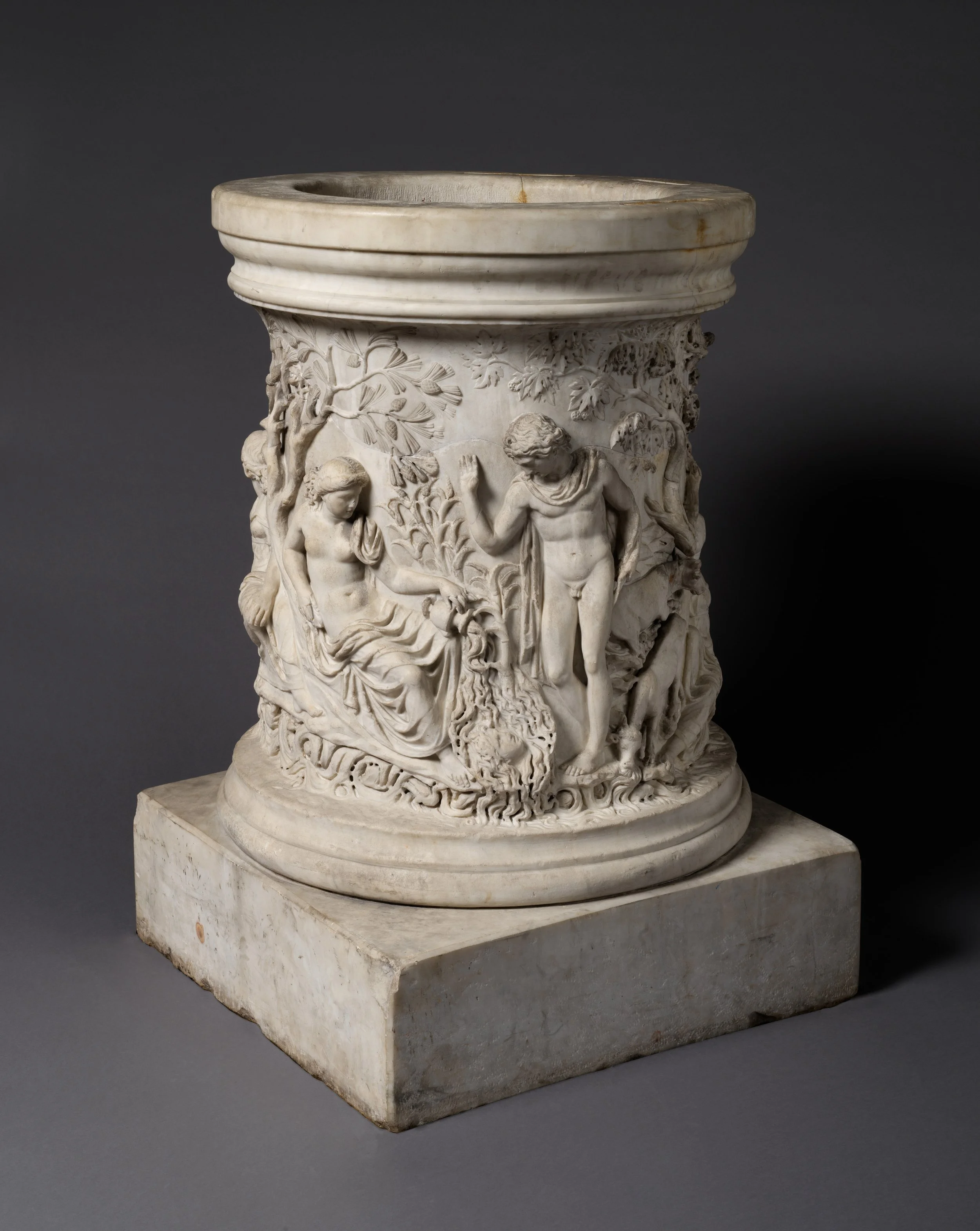
Detail with Echo and Narcissus. Puteal (wellhead) with Narcissus and Echo, and Hylas and the Nymphs, 2nd century. Courtesy of the Metropolitan Museum of Art.
The Gosford Wellhead (Gallery 162) presents a formal paradox where iconography and cylindrical geometry converge. This Roman relief utilizes two distinct myths that relate to water to articulate its own circularity: the story of Narcissus (the male youth) and Echo (the female figure) on one side, and the abduction of Hylas (the male hero) by a group of nymphs (the female water spirits) on the other. By placing these four character types—the introspective male, the female, the captured male, and the alluring females—around the drum, the ancient Roman sculptor has constructed a scenario for the ambiguity of desire. While Narcissus gazes downward at water flowing from a vessel held by a gracefully seated Echo, Hylas is captured in mid-motion, his right arm and left leg grasped by the insistent nymphs.
As this puteal is saturated with mythological imagery, it recalls Erwin Panofsky’s methodology of interpretation: “Iconographical analysis, dealing with images, stories and allegories instead of with motifs, presupposes, of course, much more than that familiarity with objects and events which we acquire by practical experience. It presupposes a familiarity with specific themes or concepts as transmitted through literary sources, whether acquired by purposeful reading or by oral tradition.”¹
On the level of form, this densely layered iconography is articulated through a shifting modulation of relief depth across the surface. The projecting bodies of Echo and Narcissus emerge from a background of trees and leaves rendered in low relief, where flatness reads as sky and atmosphere behind the figures. In Alois Riegl's framework, which describes the formal logic of earlier Attic relief sculpture, surfaces are seen to have as much tactile elements as optical ones: "Reliefs in the Attic golden age present themselves neither as the flat, planar reliefs of the Egyptians nor as the very high reliefs of Hellenistic or Roman times. Even when multiple figures were brought together as a group, each figure was still conceived independently."² This contrast between the rounded, projecting figures and the flattened ground behind them enacts precisely that alternation between tactile and optical perception — a formal logic echoed across the organization of the Roman relief.
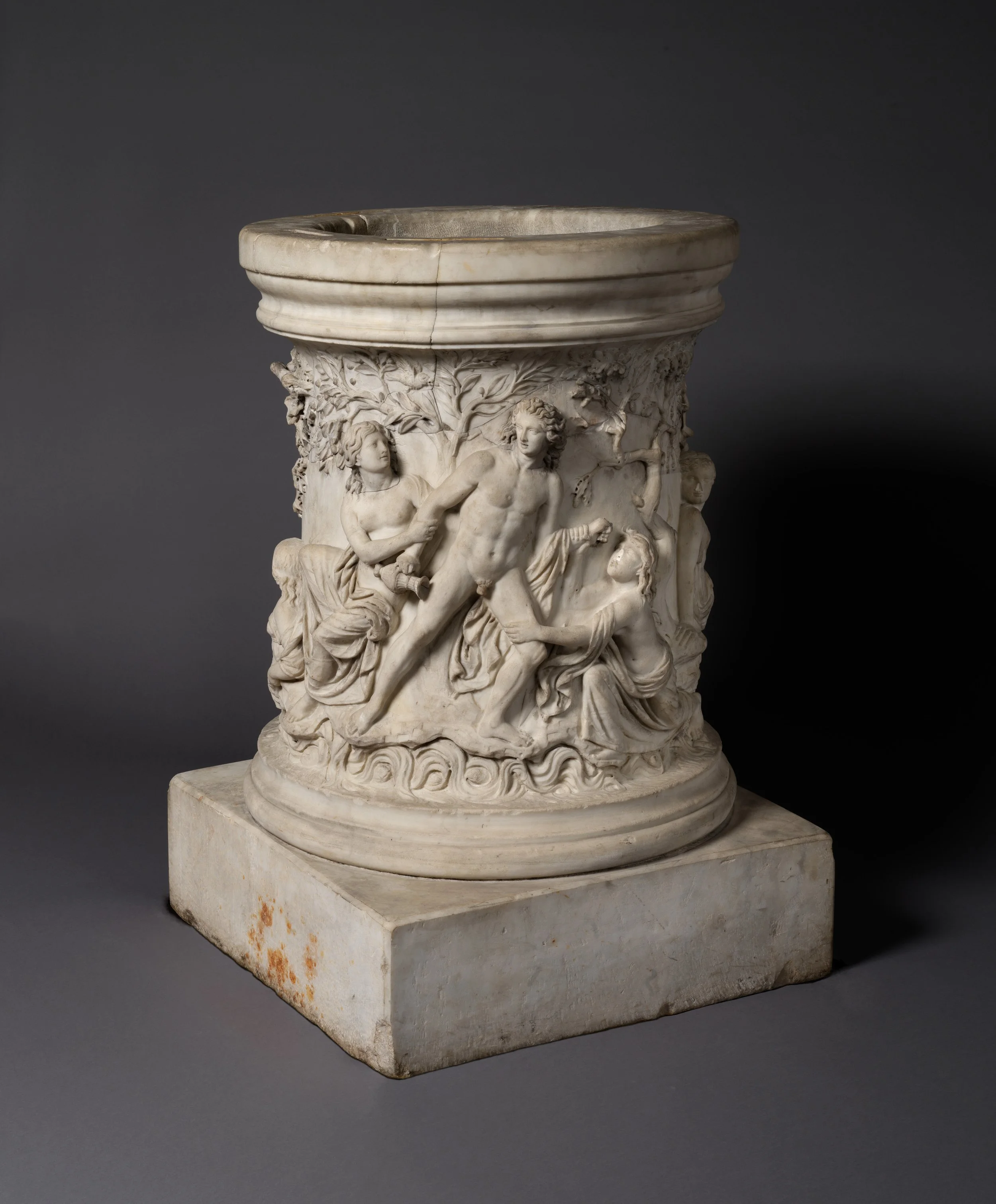
Detail with Hylas and the Nymphs. Puteal (wellhead) with Narcissus and Echo, and Hylas and the Nymphs, 2nd century. Courtesy of the Metropolitan Museum of Art.
To witness the puteal today is to witness an object where the skillfully carved figures undeniably intensify the narrative lure. The shifting play of light and shadow across the cylinder multiplies the desire found in the myths, charging the stone with an animate, psychological cycle.
This ancient Roman wellhead, presented as a relief sculpture in the round, finds a vibrant successor in Henri Matisse’s Joy of Life. While the wellhead fixates on the tragedy of a life interrupted, Matisse transforms the human form into a celebration of vitality. Here, the joy of embrace, piping, and dancing infuses the colors and rhythmic shapes of the canvas, creating a space where the individual is no longer separate, but part of the larger atmosphere. Whether in the shadows of 2nd-century marble or the vivid color of 20th-century paint, the human figure is always found in this natural drive to connect with the world around it.
1. Erwin Panofsky, Meaning in the Visual Arts (New Jersey: Doubleday Anchor Books, 1955), p. 35.
2. Alois Riegl, Historical Grammar of the Visual Arts, trans. Jacqueline E. Jung (New York: Zone Books, 1999), p. 208.
Space, Surface, and Hand
By Tan Nhat Nguyen
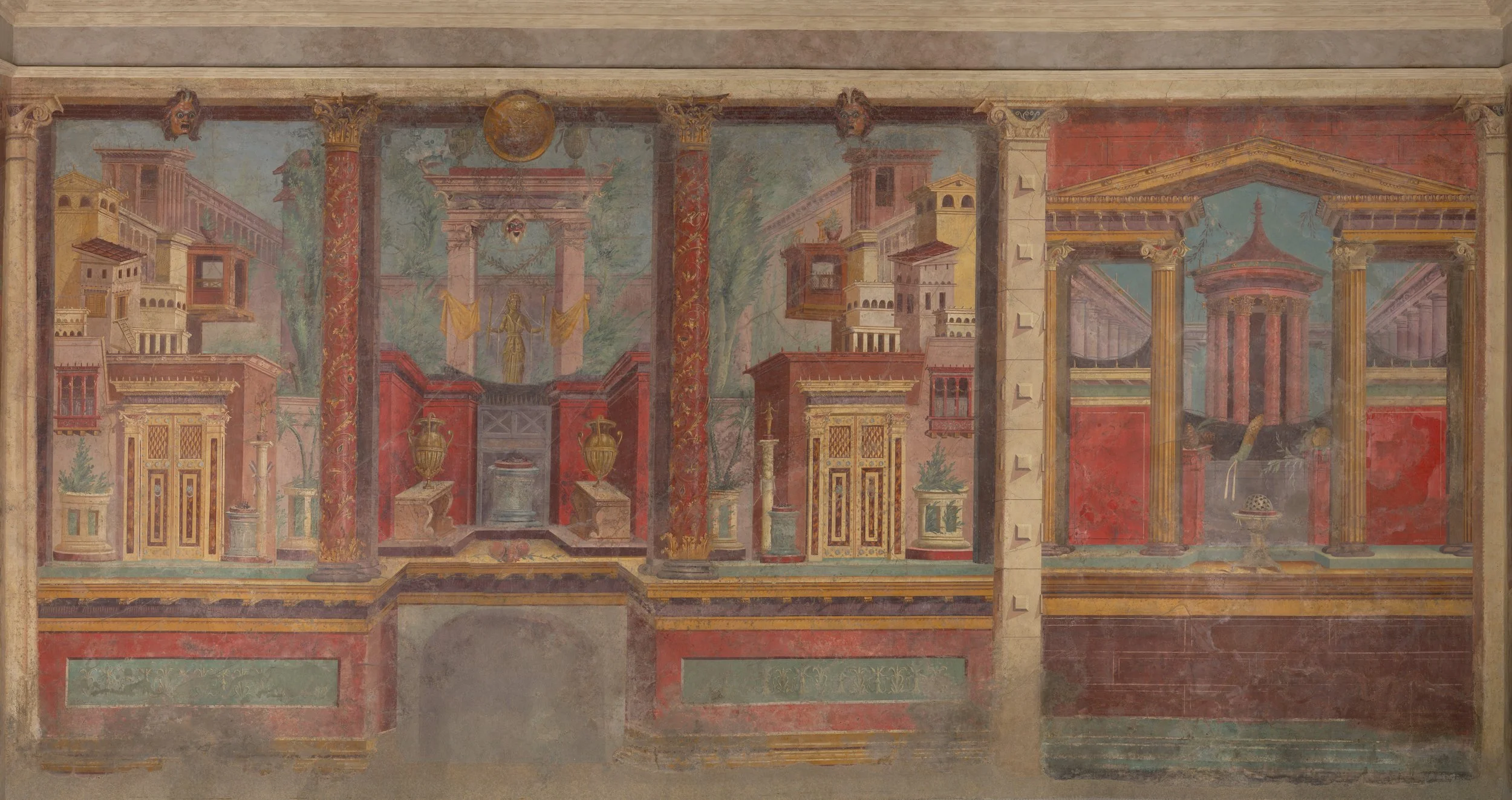
Detail from Cubiculum (bedroom) from the Villa of P. Fannius Synistor at Boscoreale, ca. 50–40 BCE. Courtesy of the Metropolitan Museum of Art.
Before entering the Roman bedroom installation, I spent time in the Gubbio Studiolo, Gallery 501, at the Metropolitan Museum of Art. The room is entirely covered in wood marquetry or intarsia, a technical achievement of the Italian Renaissance. Standing inside it, I was surrounded by carefully cut pieces of walnut and oak fitted together to create precise illusions of cupboards, shelves, and musical instruments. Everything is constructed through geometry and perspective. The eye is directed toward a single vanishing point, and the illusion depends on exact measurement and patient labor. The result is calm and stable. The wood grain and sharp edges reinforce a sense of order and permanence.
Moving to Gallery 161 and the frescoes from the Boscoreale Cubiculum, the experience changed completely. Instead of solid wood and measured construction, I encountered painted architecture that opens into air. The fresco creates the illusion of looking through a wall into a built environment. I begin my viewing at the upper right corner, where a pale blue sky suggests daylight. The light seems to fall downward onto the painted architrave—the horizontal beam that visually supports the structure. This element attempts to stabilize the composition and give it architectural credibility.
Below, a dense arrangement of balconies, rooftops, and columns extends into space. From a distance, the colonnade appears solid and convincing, almost like real architecture. But when I move closer, the illusion breaks down. The arches and columns are built from a velocity of marks rather than rigid, physical edges of precise geometry. The Corinthian capitals are suggested with speed and economy. Unlike the blade-sharp contours of the Renaissance woodwork, fresco applied to a flat surface invites a different relationship with edge and atmosphere—lighter, more transient, and more atmospheric at times. The wall no longer feels solid; it becomes a surface that opens outward. The physical boundary of the room thus dissolves into an imagined exterior world.
What Marilyn Stokstad calls 'intuitive perspective' is visible here in the suggestive rather than mathematical construction of space. Stokstad notes that the artist has used this technique to 'create a general impression of real space. The architectural details follow diagonal lines that the eye interprets as parallel lines receding into the distance, and figures and objects that we are meant to understand as far away from the surface plane of the wall are shown smaller than those meant to appear near to it.'¹ Through this treatment of the fresco, the Boscoreale Cubiculum privileges approximations over strict geometric construction. Sight and semblance, rather than mathematical perspective, determine the representation of space here. Both are conditions of subjectivity — and it is precisely this acceptance of the subjective viewpoint that places the Boscoreale fresco within a fundamentally different visual logic from the Egyptian relief that deliberately rejected perspective and from which the freestanding classical sculpture was already free.
Therefore the painted architecture of Boscoreale attempts to represent pictorially the optical reality of the exterior world — as faithful as possible to the retinal image. Yet the Boscoreale fresco and the deeply undercut Late Roman relief share an unexpected common destination. In a section titled 'Aerial Perspective' of the chapter 'Form and Surface,' Riegl identifies the precise point of their convergence — shadow. In painting, shadow is chromatic and thus purely optical. In deeply undercut relief, shadow may continue with spaces nearby, giving way to pure opticality. Both arrive at the retina as the same phenomenon, indifferent to their different origins. It is at this intersection that Riegl observes: “Once artists actually broke through that ground, they ended up again with three-dimensional sculpture. The independent sculpture in the round tended toward the objective surface no less than the deeply undercut reliefs did.”² Thus the wall ceases to be a physical boundary and becomes primarily an optical reality — one that dissolves into an imagined exterior world.
1. Marilyn Stokstad and Michael W. Cothren, Art History, rev. ed. (Upper Saddle River, NJ: Pearson/Prentice Hall, 1999), p. 251.
2. Alois Riegl, Historical Grammar of the Visual Arts, trans. Jacqueline E. Jung (New York: Zone Books, 2004), p. 227.
Surfaces: Toward the Optical
By Kaizhong Tan

Marble grave stele of a little girl, ca. 450–440 BCE. Courtesy of the Metropolitan Museum of Art.
Moving into the galleries of Greek sculpture reveals not simply a stylistic development but a transformation in how the human body is conceived in relation to space and to the viewer. Having left the Egyptian Wing—where works like the Tomb of Akhtihotep present a body bound to the plane in structural clarity—one immediately senses the difference. In that earlier, Egyptian "haptic" mode, the figure is constructed for permanence; space does not open around it but remains sealed within the relief’s surface. However, as one encounters the Archaic kouros, the representation of the body undergoes a shift. Though still frontal and symmetrical, the body begins to detach from its block. The arms separate from the torso, the legs open slightly, and negative space appears between the limbs. The marble finally acknowledges the surrounding air.
This spatial awakening becomes more fully articulated in the Marble grave stele of a little girl. Carved in low relief, the young figure stands against a flat background holding two doves, yet her stance is no longer rigid. One leg bears more weight; the opposite hip rises subtly; the shoulders respond with a gentle counter-turn. Contrapposto has entered the composition, but here it remains pictorial rather than physical. The shift of weight is an illusion carved into a slab that continues to support the figure fully. The relief negotiates between plane and projection, suggesting depth without detaching from its ground.
By contrast, nearby freestanding works such as the Diadoumenos embody physical contrapposto. In these sculptures, associated with the Canon of Polykleitos, the weight-bearing leg truly carries the marble mass, the pelvis tilts, and the torso compensates in a coordinated system of symmetria—a measured balance of opposing forces. Yet even this seemingly natural stance depends upon discrete supports such as tree stumps or struts. The freestanding body achieves organic equilibrium through calculated structural intervention. Relief and sculpture thus complicate one another: one produces the illusion of balance without engineering risk; the other achieves spatial daring but must quietly negotiate gravity.
What ultimately distinguishes the stele, however, is not merely the introduction of contrapposto but the activation of perception. The carving of the drapery gathers shadow; the slight projection of shoulders and arms catches light; the figure’s presence shifts subtly as the viewer moves. Earlier art privileges what Alois Riegl described as an “objective” and tactile mode of representation, in which form is constructed for clarity and stable legibility. Classical art increasingly embraces a more “subjective” and optical mode, in which form depends upon illumination, viewpoint, and the spectator’s experience.¹ The sequence from the kouros to the Grave Stele thus marks the gradual transformation of the body from a fixed schema into a perceptual event. Contrapposto becomes the visible sign of this shift—not simply a pose, but an acknowledgment that the body exists in space, in light, and before a viewer.
Regarding the treatment of drapery in Greek relief, Riegl notes: “The Greeks, on the other hand, used the accidental folds disdained by Egyptians to strike a dual balance. First, folds allowed these artists to break up the broad plane of the draperies, second, by arranging the folds harmoniously, they could imbue the transitory with the character of the essential.”² The dove held in her right hand and the one poised on her left enact the very opposition Riegl theorizes: the first, contained and tactile, figures the haptic; the second, on the verge of flight, anticipates the optical — the moment when the object releases itself into space and the eye must follow. In this sense, every fold conveys an aesthetic message as much as an ontological if not the metaphysical one.
1. Alois Riegl, Historical Grammar of the Visual Arts, trans. Jacqueline E. Jung (New York: Zone Books, 2004), p. 74.
2. Riegl, p. 205.
The Luminous Wall
By Steffany Yalong
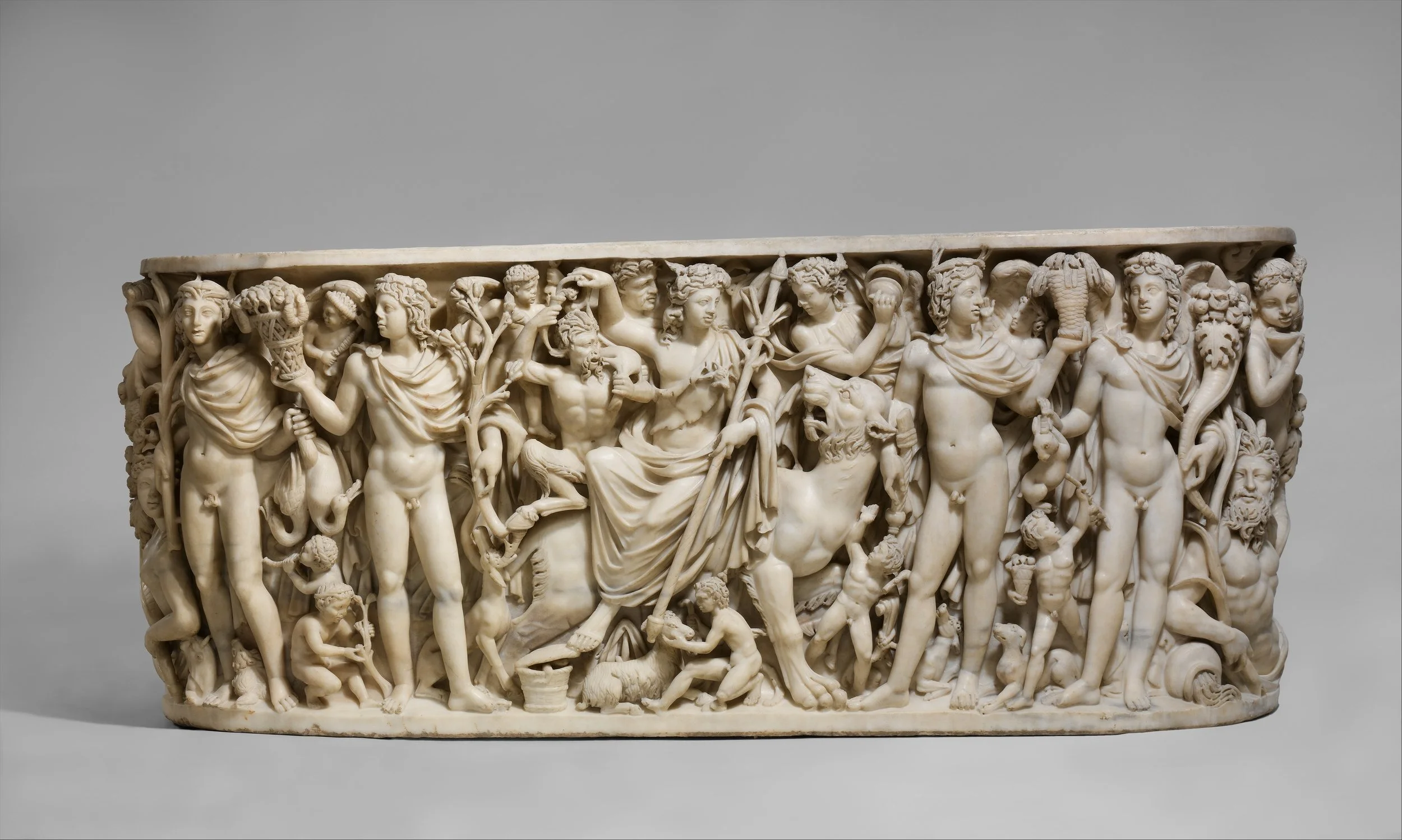
Marble sarcophagus with the Triumph of Dionysos and the Seasons, ca. 260-270 CE. Courtesy of the Metropolitan Museum of Art.
Moving through the galleries from the Egyptian wing to the heart of Greek sculpture reveals a transformation in how the human body is conceived in relation to space and the viewer. At the austere Tomb of Akhtihotep, the figure is bound to the plane with a structural clarity that allows for no weight-shift or spatial negotiation. The relief is shallow and shadowless, constructed for legibility rather than perception; it presents what is known to be permanent rather than what is seen in a particular moment. Space remains sealed, and the image is tactile in its clarity. The enigmatic Archaic kouros introduces a subtle but decisive change, as the body begins to detach from its surrounding block. Negative space appears between limbs, signaling an awareness of the body as something that occupies surrounding air. While the kouros still stands in equilibrium, the potential for movement has entered the stone, even if it has not yet been fully realized.
That realization becomes visible in the tender Grave Stele of a Little Girl, where contrapposto appears in a pictorial form. One leg bears more weight, the hip lifts subtly, and the shoulders respond with a gentle counter-turn. Here, the shift of weight is an illusion carved into a surface that continues to support the figure fully. In nearby freestanding works like the poised Diadoumenos, this contrapposto is fully liberated into three-dimensional space, the figure maintaining balance entirely within it. This recalls the Canon of Polykleitos, emphasizing symmetria — a dynamic equilibrium of opposing forces. Yet, this physical balance contains a paradox: the natural stance depends upon an artificial support, such as a tree stump, to stabilize the marble. The relief creates the illusion of weight-shift without engineering risk, while the freestanding sculpture achieves structural daring only through concealed assistance. In the stele's carved drapery, light already begins to gather in folds and shadows to fall across the surface, frequently erasing the relations of figure and ground.
Partly a picture and partly an object, relief sculpture’s third dimension activates a play of light and shadow while bringing in the parameters of perspective, if not its very dilemma: the foreshortening of forms within the field of perception. As Riegl writes, "Bright light causes outlines to lose their definition and dissolve, while deep shadows can not only obscure but even obliterate motifs — for what is invisible ceases to exist."¹ The sarcophagus with the Triumph of Dionysos and the Seasons (Gallery 162) represents a radical departure from the history of relief sculpture: here, the drill excavates the relief plane so deeply that the figures visually dissolve into a restless alternation of light and shadow — generating a second, highly optical surface, a luminous wall.
This progression from the tactile to the optical runs parallel to the Metropolitan Museum's own architectural plan. The tactile/objective versus optical/subjective model of Riegl is engaged primarily with stylistic shifts across cultures and times — a necessary method to establish art history as an orderly system. By privileging formal development as an autonomous, self-directed process, Riegl's model risks overlooking the social, economic, and historical forces that shape how art is made and received. Walking through the Met, I notice how the Museum's own architectural sequence mirrors Riegl's systematic ordering of visual culture. The fluted column shaft from the Temple of Artemis at Sardis stands at the midpoint of the Greek and Roman galleries — its vegetal ornament marking a threshold between the tactile and the optical worlds he described. Passing by the Ionic columns of the Mary and Michael Jaharis Gallery and the Doric ones in Kevin Roche's design for the Leon Levy and Shelby White Court, I am reminded of their precursors: the papyriform columns of the Temple of Dendur in the Sackler Wing. This architectural continuity seemed to mirror the narrative arc that Riegl's framework constructs. Whether Riegl's categories illuminate or impose, whether style mirrors society or determines its very socioeconomic and aesthetic conditions, the light continues to fall — indifferent to theory, faithful only to the surface it finds.
¹ Alois Riegl, Historical Grammar of the Visual Arts, trans. Jacqueline E. Jung (New York: Zone Books, 2004), p. 220.
Surfaces: The Highly Optical
By Yiping Zhao
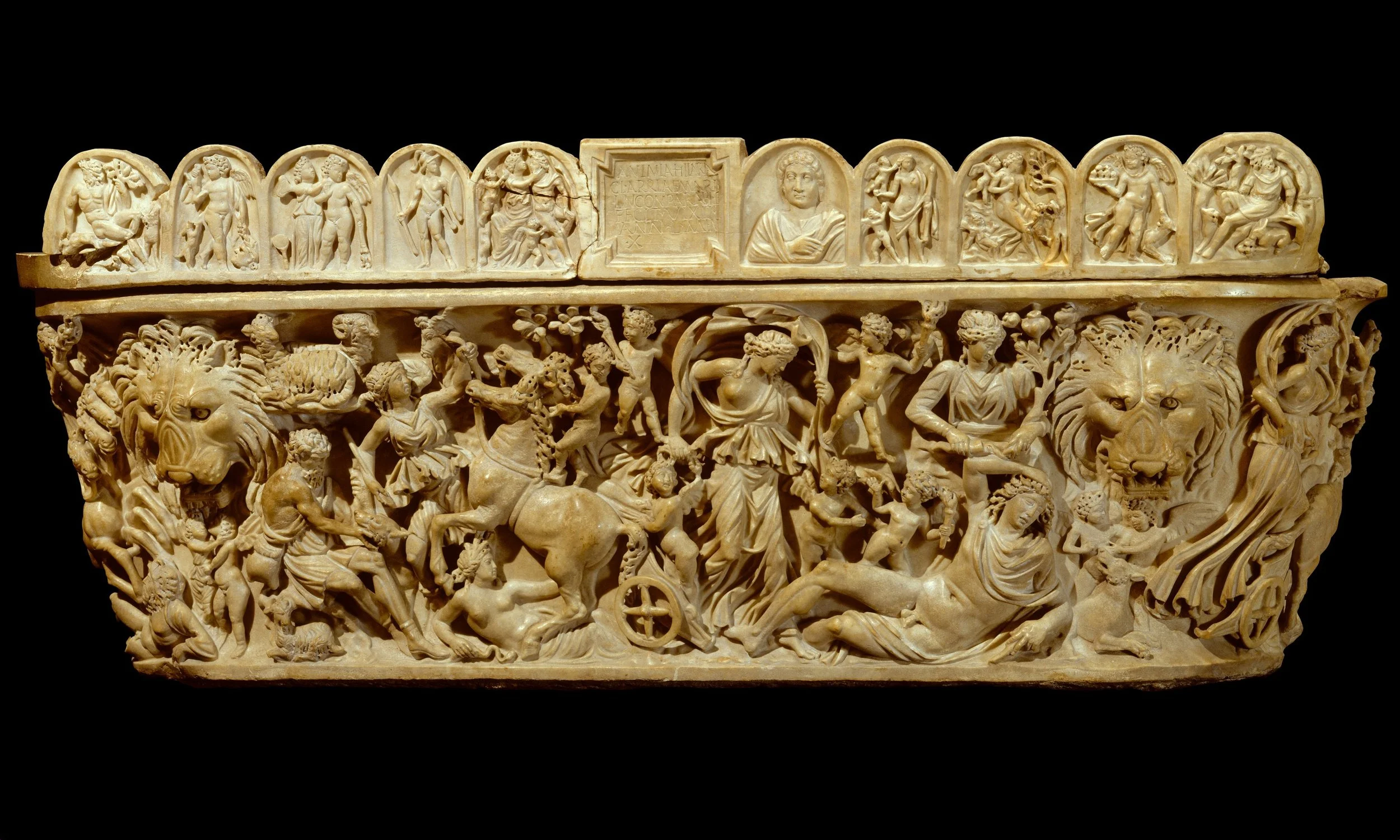
Marble sarcophagus with the myth of Selene and Endymion, early 3rd century CE. Courtesy of the Metropolitan Museum of Art.
To read this Roman sarcophagus is to move between two registers simultaneously—the mythological and the formal, the story told and the surface on which it is carved. At the center, the moon goddess steps down from her chariot to visit her beloved Endymion. Her figure forms a graceful vertical arc that cuts through the horizontal expanse of the composition. The deeply carved, tubular folds of her drapery do not merely hang; they swirl with a centrifugal force that suggests the wind of her flight. The marble here is carved as if pushed to its limit, where the lift of her body and the intricacy of the stone together convey motion suspended. She is shown in a distinct contrapposto: her torso is frontal while her head is turned in profile, a posture that allows her to mediate between the viewer and the myth.
Below and to the right, the mortal shepherd Endymion anchors the lower register, echoing the horizontal floor of the sarcophagus itself, defined by his suspension in eternal youth. At this monumental scale, his muscular mass functions as a sculptural analogue for the rugged terrain of Mount Latmos; the stone behind his head is not a void, but the mountain itself, carved with deep, dark recesses that suggest the mouth of a cave. His body repeats the goddess's physical logic: his head appears in profile while his torso remains frontal. This "horizontal contrapposto" relies on the torsion of the midsection to create a series of shallow, undulating planes. By smoothing the transitions between these volumes, the sculptor allows light to skim the surface, simulating the soft mass of a body in repose.
At the left side of the frontal composition, this logic shifts into a zone of pure optical agitation centered around the spoke-wheeled chariot. Here, the rising sun god Helios drives his chariot forward, his horses straining upward while attendant figures struggle to manage their momentum. This is a masterclass in deep undercutting: the horses' manes are a series of dark, drilled recesses, and their overlapping limbs create a frantic, flickering rhythm of light and shadow. The bearded groom is a knot of straining muscle, his body carved so deeply that he seems to be fighting his way out of the stone itself. This density does not disrupt the scene but provides a textural contrast to the smooth, light-catching planes of the sleeper, completing the horizontal sweep of the marble.
The density of this surface—where scarcely any portion of marble remains untouched—finds its precise theoretical context in Alois Riegl’s analysis of Roman art. Riegl observes that artists of this period employed deep undercutting to produce an interwoven surface in which forms emerge from the background and establish a secondary shared spatial field. As Riegl writes, “If people wanted to approximate reality more closely, they had to reject the ground surface completely and replace it with something that gave the impression of empty space. This was the very last phase of Roman Imperial art: motifs—for example, of foliage—were undercut in such a way that the shadows within the deep crevices, not those on the blank surfaces surrounding the motif, would be interpreted as empty space. Once artists actually broke through that ground, they ended up again with three-dimensional sculpture. The independent sculpture in the round tended toward the objective surface no less than the deeply undercut reliefs did.“¹ The deeply carved drapery of Selene, the drilled manes of the horses, and the layered contours of the figures together generate a surface that is wholly optical in its logic. Instead of presenting isolated bodies against a neutral ground, the sculptor weaves gods, mortals, and the cycles of nature into a single enveloping surface—one that constructs night itself as a spatial condition.
A contemporary viewer might recognize that this impulse—to define form through the medium of figurative sculpture—has not disappeared. The straining horses of Helios find an unexpected echo in Damien Hirst's mythological sculptures—winged lions, unicorns, figures of Medusa—hanging from columns and thrusting into the dining room at Bacchanalia, his London restaurant collaboration, where the cast or carved object still commands presence. The context has shifted from sepulcher to restaurant, but the sculptural medium's capacity to embody myth remains undiminished.
1. Alois Riegl, Historical Grammar of the Visual Arts, trans. Jacqueline E. Jung (New York: Zone Books, 2004), pp. 226-227.
Severed Songs: Subjective Surfaces
By Ziyan Zhong
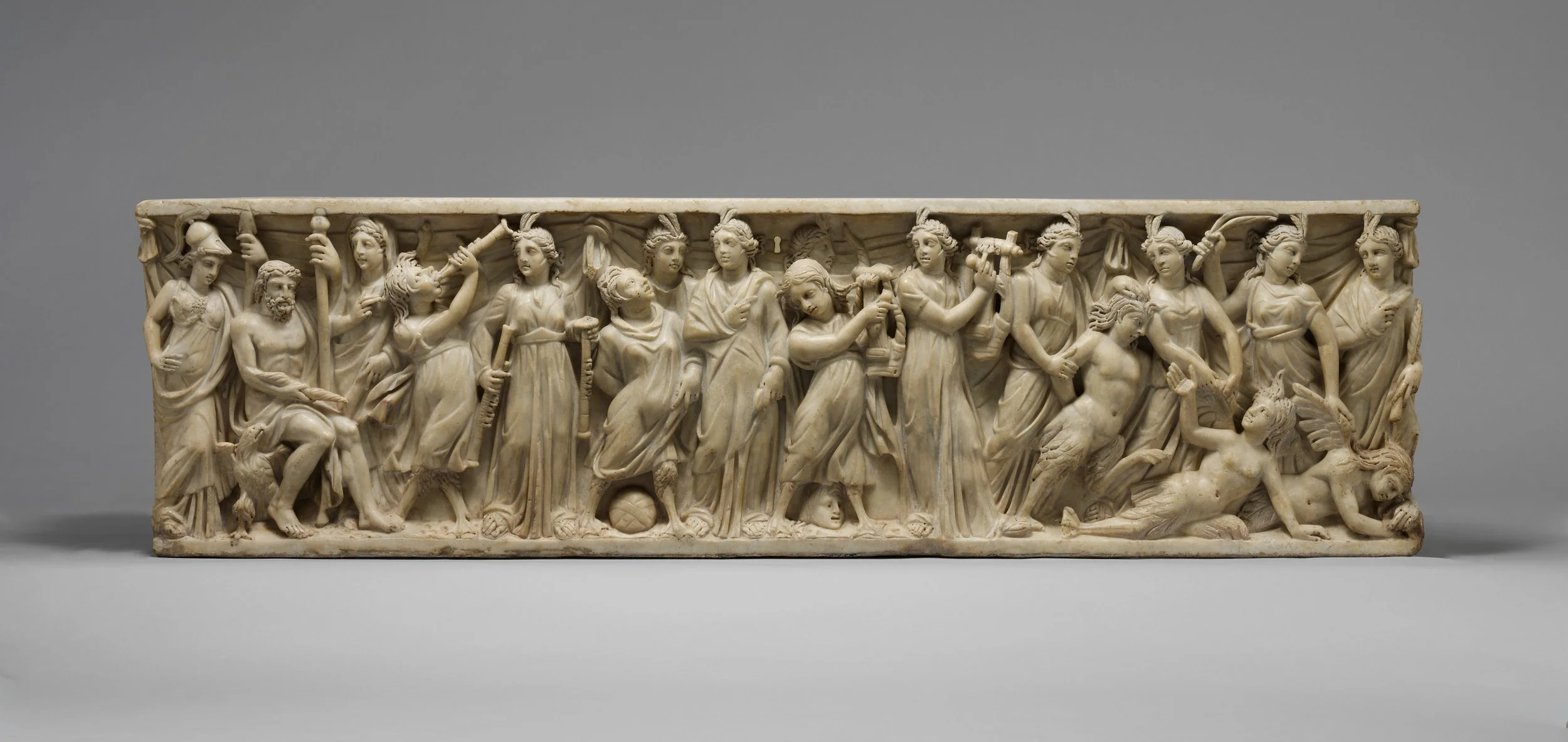
Marble sarcophagus with the contest between the Muses and the Sirens, 3rd quarter of 3rd century CE. Courtesy of the Metropolitan Museum of Art.
This third-century Roman sarcophagus depicts the musical contest between the Muses and the Sirens — a contest the Sirens are losing. A sense of the antithetical dominates the scene, where the sculptor uses the marble to stage a battle between intellectual order and zoomorphic chaos. The composition begins on the far left with the deities Athena and Zeus, who hold two long vertical staves and serve as an iconographic point of departure, establishing a vertical orientation from which the rest of the scene unfolds.
This verticality is echoed in the musical instruments of the Muses. A pair of lyre-like instruments, one held by a Muse and the other by a Siren, are positioned largely upright, aligning with the stable presence of the gods, while to the left a Siren blows a wind instrument held at a diagonal angle. The varying degrees of tilt between the two groups suggest a competing geometry still in tension; the upright instruments of the Muses strive for discipline, while the angled wind instruments of the Sirens introduce a sense of instability and agitation that characterizes the heat of the contest. The Sirens themselves are rendered as grotesque hybrids — part woman, part bird. While the Muses are defined by smooth, light-catching skin, the lower bodies of the Sirens are finely carved, their claws, legs, and feathers rendered with striking naturalistic detail.
As I walk back through the galleries, I find myself re-evaluating the museum's various relief sculptures through Riegl's lens — his analysis of how different styles of relief sculpture appear to the viewer at varying distances, shifting from a purely tactile, close engagement to a purely optical, atmospheric one. In the Egyptian wing, the Corner Niche of the Tomb of Akhtihotep represents the opposite extreme. As Panofsky writes, "the Egyptian method of applying a theory of proportions reflects their Kunstwollen, directed not toward the variable, but toward the constant, not toward the symbolization of the vital present, but toward the realization of a timeless eternity."¹ The figures remain bound to the flat plane, their forms rendered as permanent, objective accounts rather than fleeting perceptual impressions — tactile, self-contained, indifferent to the conditions of light. The Roman relief is its opposite: its surface depends on the viewer's point of view and in this sense becomes subjectivized, while remaining conditioned by the flickering play of light and shadow.
Passing through the Greek galleries, the Grave Stele of a Little Girl offers a transitional moment: the stone remains a solid backing, yet the figure begins to emerge from the surface, shadows gathering around her form. In a sense, the complex theory of Riegl can be summed up through this single object — its flat ground echoing the Egyptian past, its partially protruding figure foreseeing the Roman high relief.²
At the far right, three Sirens enact their defeat in sequence — one still held at sixty degrees within a Muse's grasp, another tilting at thirty, the last lying horizontal, her instrument silenced, her music severed. This “severed song” is rendered not merely as a narrative subject but as a formal achievement. Here the sculptor stages a battle of acoustic textures, setting the resonant vibrations of the Muses’ strings against the breathless agitation of the Sirens’ pipes. The relief ceases to be a static carving and becomes a rhythmic event of light and shadow. For a contemporary listener, the opposition is not hard to find. In “Butterflies and Hurricanes” by Muse, the British rock band, the opening minute and a half unfolds with melodic restraint — order holding — before surrendering to a torrent of overwhelming sound. Here structure gives way to the chaos. As if, in this song, the Sirens finally win — and the verdict of the sarcophagus is overturned.
1. Erwin Panofsky, Meaning in the Visual Arts (Garden City, New York: Doubleday Anchor Books, 1955), p. 61. The German word Kunstwollen — variously translated as "will to art," "artistic volition," or "artistic intention" — is a concept developed by Alois Riegl.
2. See Alois Riegl, Historical Grammar of the Visual Arts, trans. Jacqueline E. Jung (New York: Zone Books, 2004).
Postscript: A Journey Through Stone and Myth
While my preface established the pedagogical “how” of our study and its formalist methodology, this final note traces the iconological path taken by my students. As we moved through the Metropolitan Museum, ancient sculptures and paintings served as frameworks for a new understanding of both physical material and iconographic meaning. This iconography of the object is revealed in the following observations:
Will Baker explored the iconography of permanence in the Tomb of Akhtihotep, observing a shadowless surface where the human figure remains an absolute, measurable fact.
Kyle Kaizhong Tan examined the Grave Stele of a Little Girl, mapping the development of contrapposto as a transitional bridge between the stillness of earlier relief and the weight-shift of freestanding sculpture.
Tan Nhat Nguyen analyzed the Boscoreale Cubiculum, examining how an iconography of perspective and illusion expands the boundaries of the room toward an optical expansion of city, garden, and sky.
Christina Mei focused on the iconography of reflection, tracking the circular path of the stone to connect the mirrored fates of Narcissus, Echo, and Hylas.
Yiping Zhao analyzed the Sarcophagus with the Myth of Selene and Endymion, mapping how deep carving defines the iconographic encounter between the goddess and the sleeping youth.
Ziyan Zhong analyzed the iconography of the Muses and Sirens, observing how the rhythmic arrangement of the figures defines their musical competition.
Steffany Yalong analyzed the Sarcophagus of Dionysos, observing a shift where the body is no longer a mere tactile unit but an optical entity defined by the play of light and shadow.
While these analyses remain anchored in Riegl’s formalism, they acknowledge a contemporary shift in art historical critique. We move away from a strictly teleological view—the idea of an “evolution” toward a more technically resolved mode of vision—and instead recognize changes in a given culture. This engagement embraces a layered temporality, suggesting that our gaze today involves a collapse of eras; we are not merely looking back at the past, but participating in a constant negotiation between ancient material and modern perception.
To examine these objects in situ was to observe a layered temporality governed by the behavior of light on the surface. By following the sequence from the Tomb of Akhtihotep to the Sarcophagus of Dionysos, the group engaged with the specific mechanics of relief—moving from the sheer materiality of the carved mark to the illusory depth of the iconographic program. They traced a rhythmic necessity: the disciplined transition from the Nahsicht (the near-sight of the shallow surface) of haptic objectivism to the Fernsicht (the distant-sight of the deep surface) of optical subjectivism, where the stone and the eye continue negotiating with light.
This text emerged from a seminar conducted at the School of Visual Arts (SVA) in collaboration with the Metropolitan Museum of Art.